Two Fifty One – Curing Methods
Two Fifty One – Curing Methods
On Wednesday we did our first large(ish) concrete pour (225m3). This was for the basement raft and 2 pile caps. The aim was to fill the 2.1m deep raft (large pile cap) to underside of slab which will be formed across the entire site (450mm thick, to be cast in waterproof concrete). The setup was a mobile pump at the end of our pit lane which involved having concrete wagons back onto the pump. Luckily the front of the vehicle was far enough away from the road to avoid any road traffic accidents.
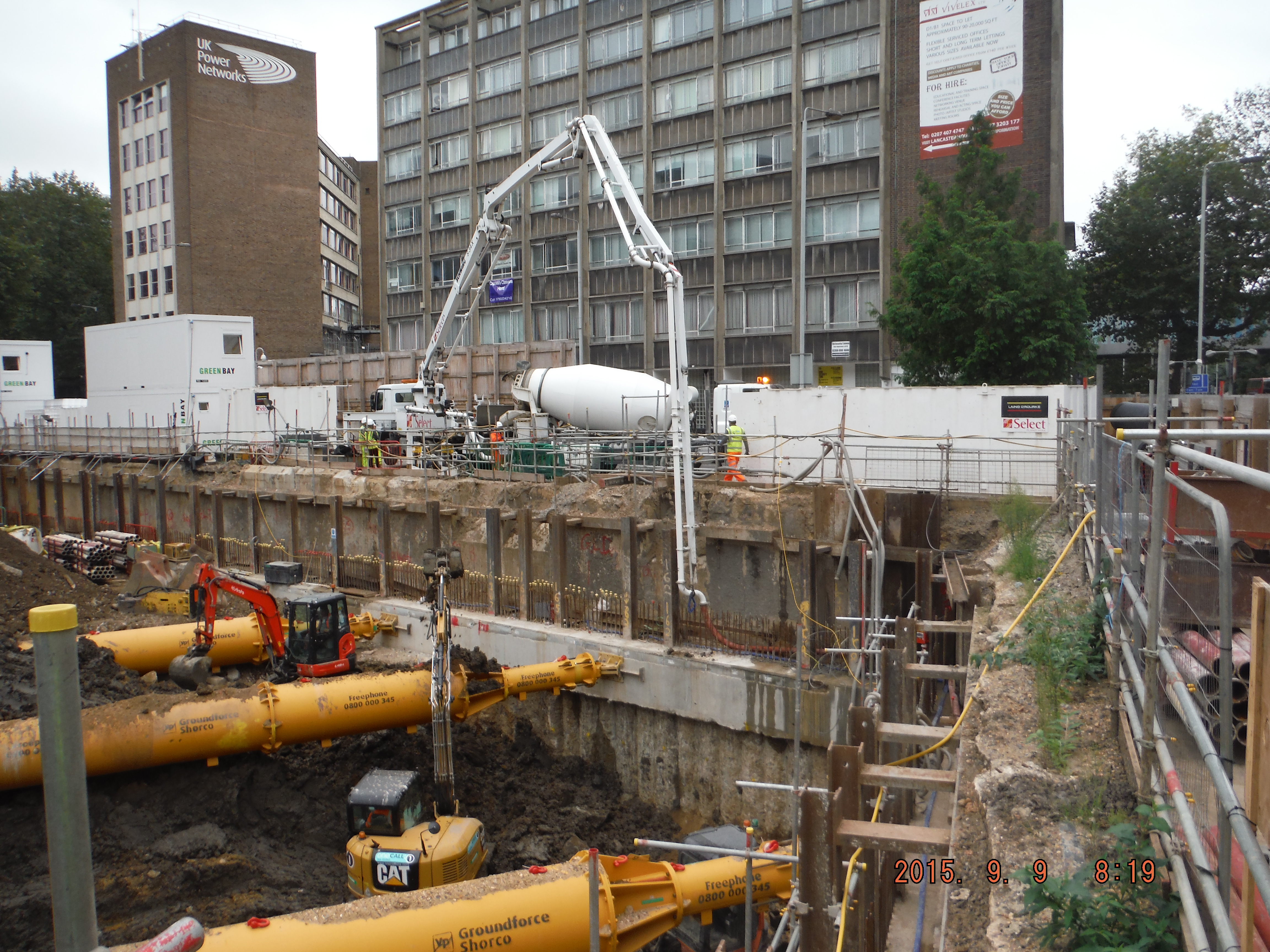
Pump positioned within the site, concrete wagons backing onto it, just into site. The pipe line then ran around along the capping beam and down to the pour location.
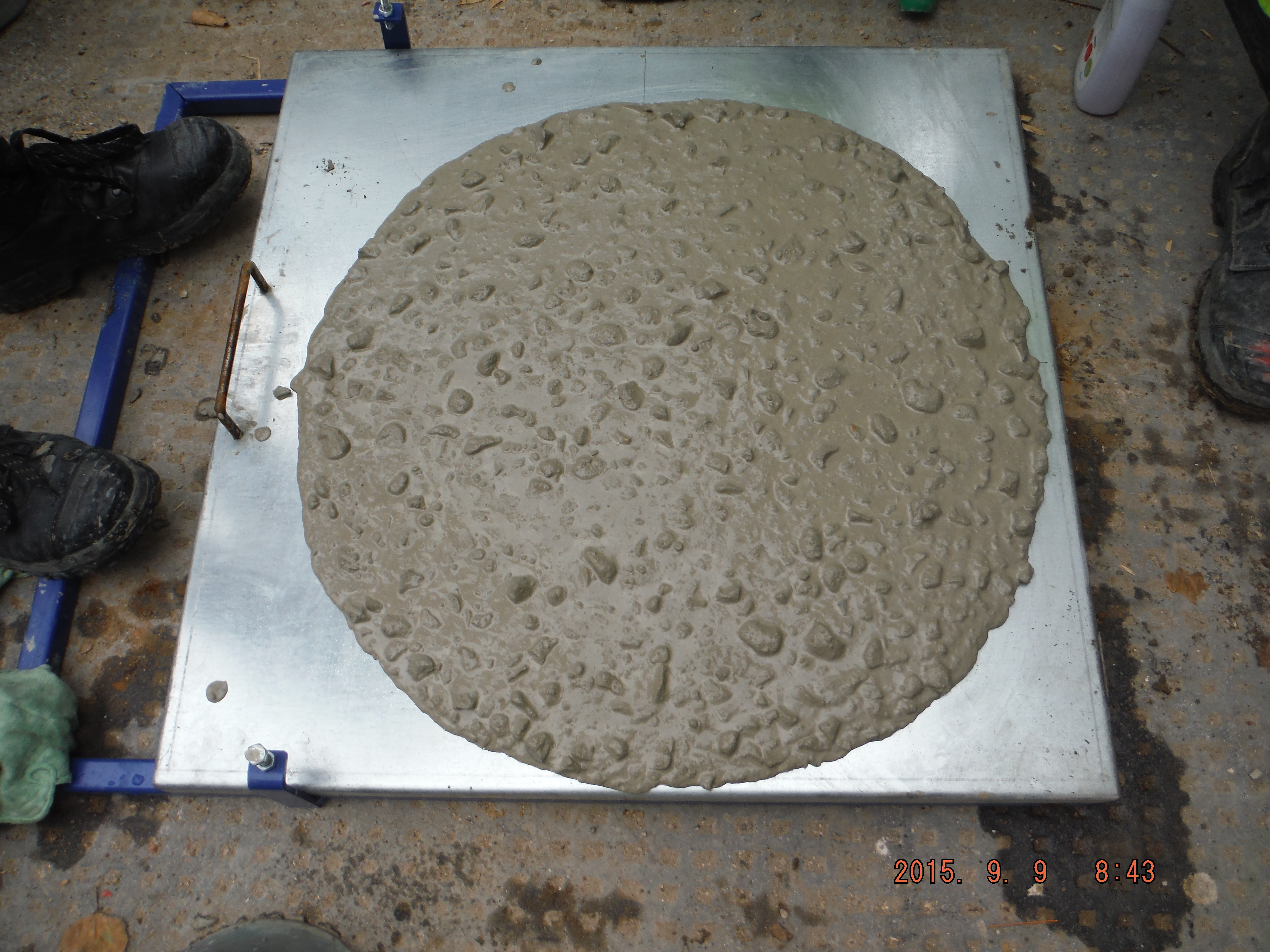
F5 consistence – therefore flow table tests. Interestingly the test was repeated after 4hours and it achieved just a 20mm lower radius.
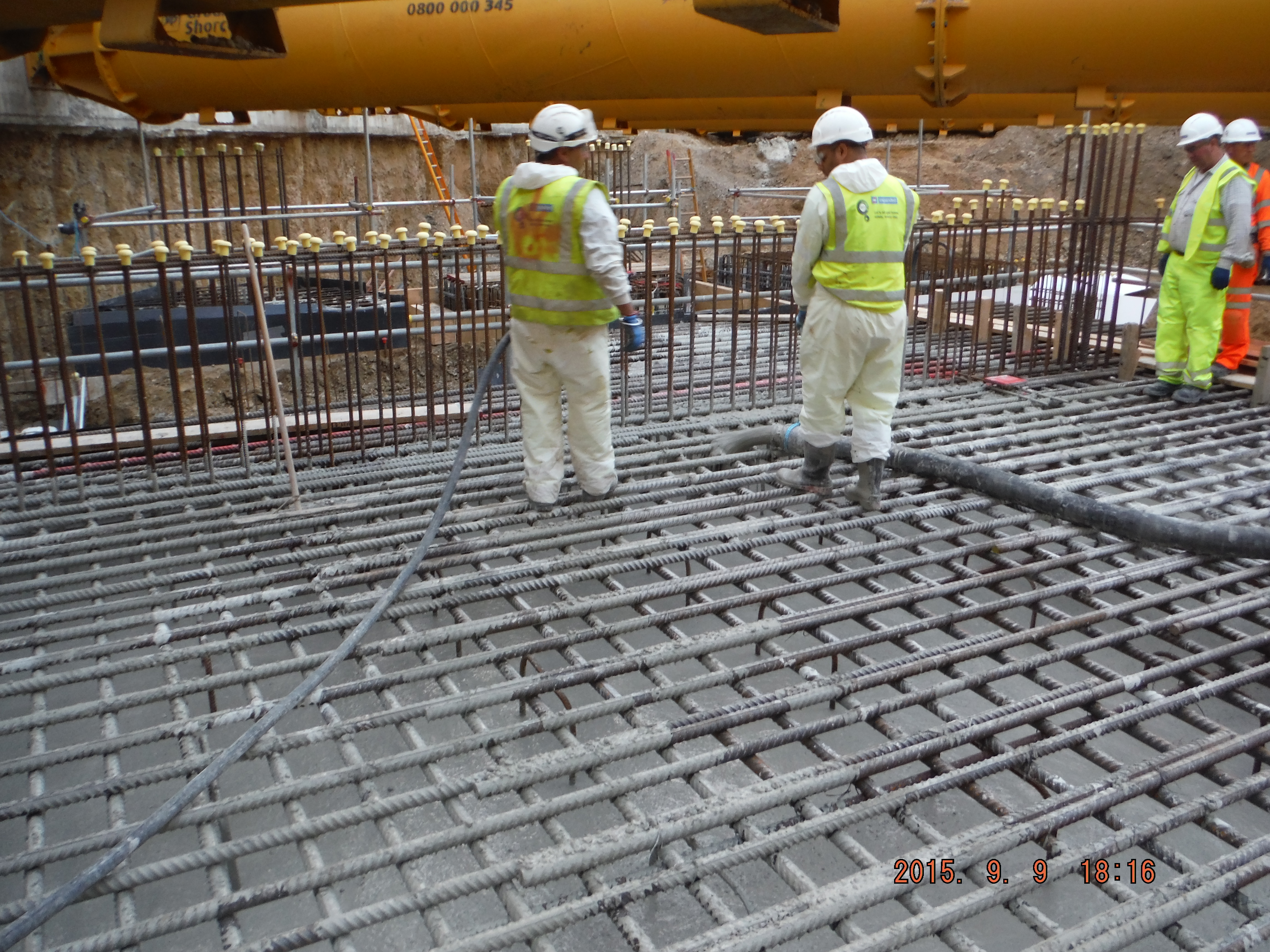
Pour was to underside of slab level, which is about 400mm below the height of the reinforcement shown. Before the concrete is fully cured it will need to be removed from the rebar.
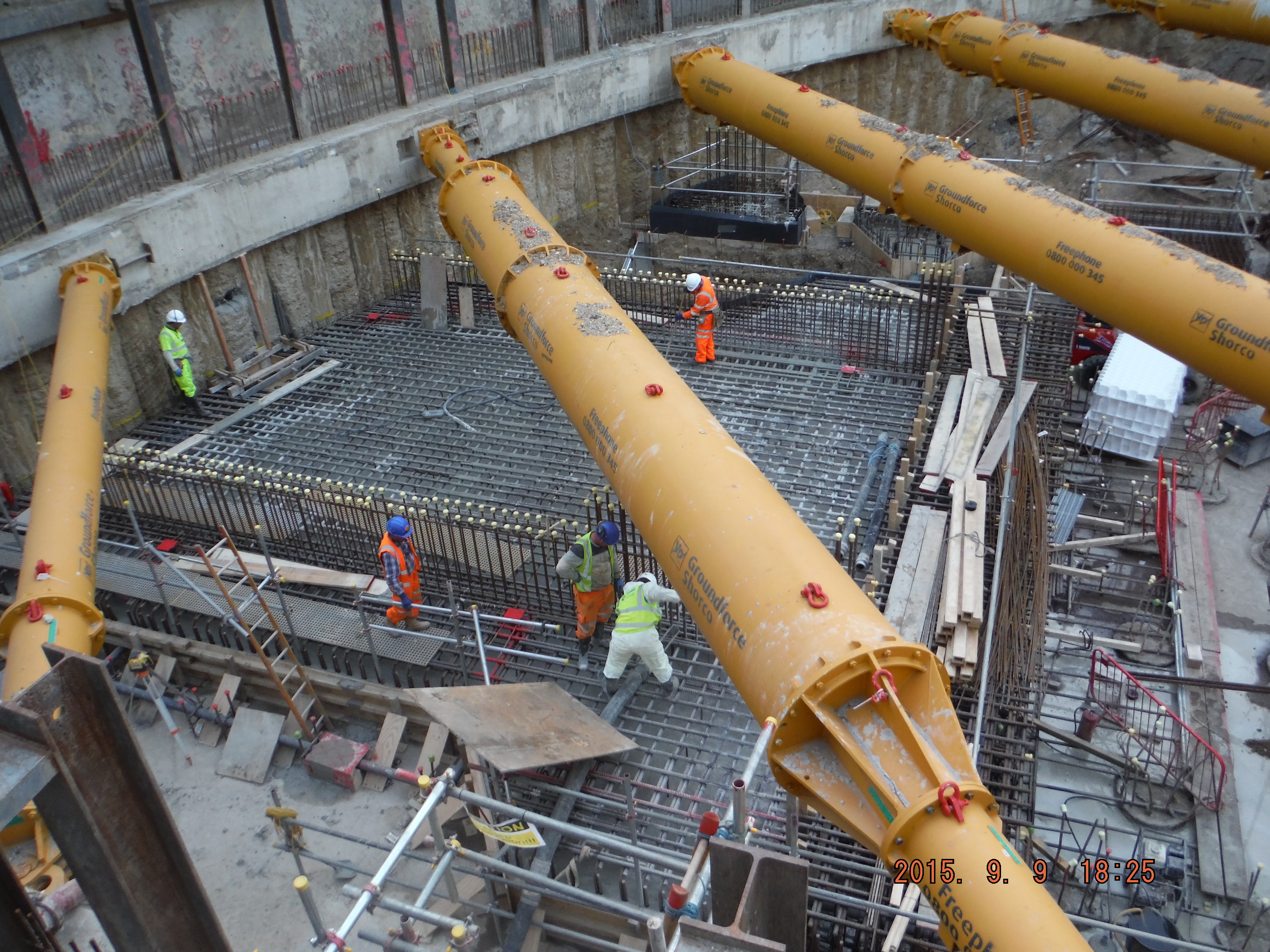
Overview of raft pour – see wall starters to negotiate when curing.
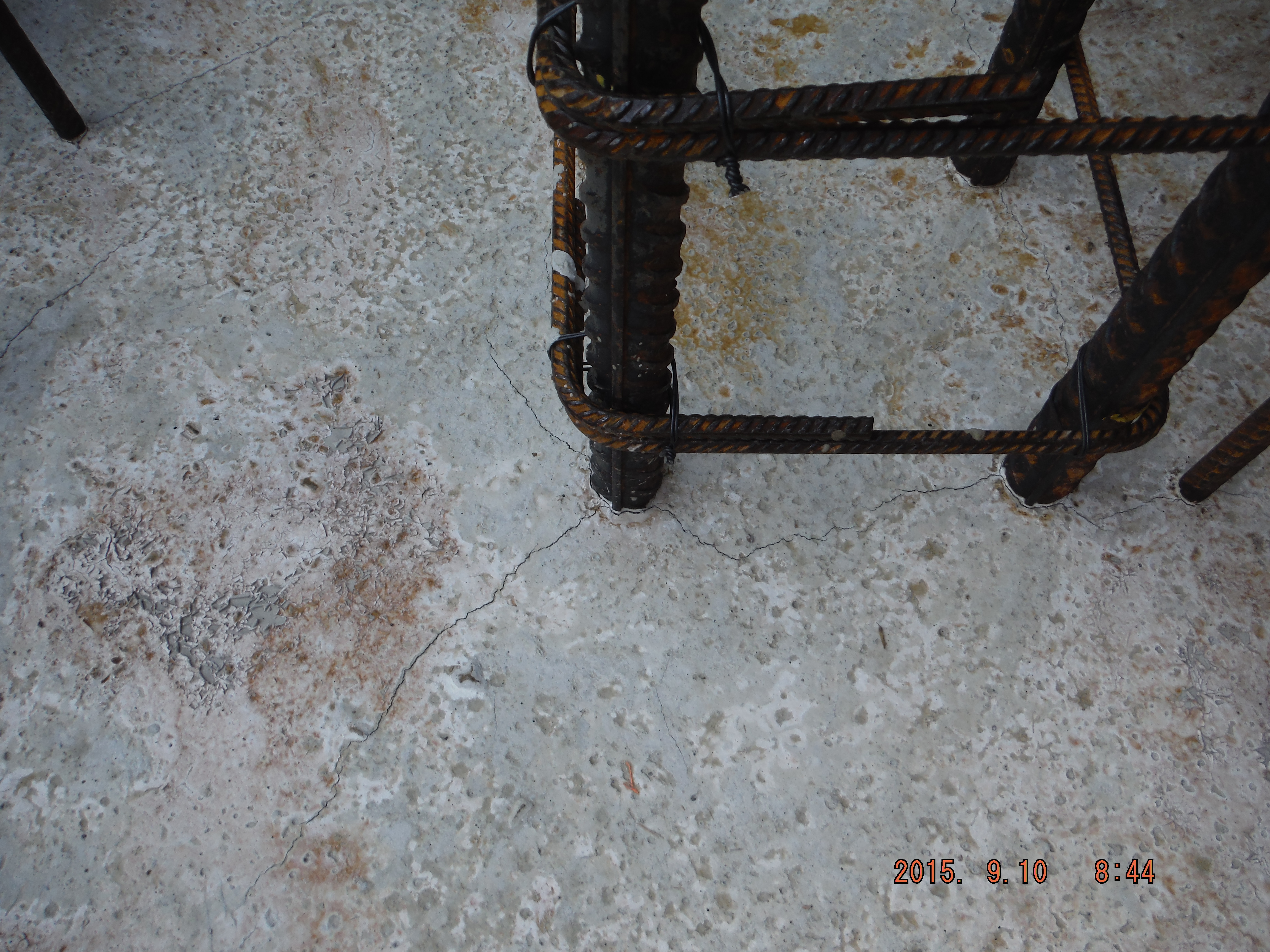
Next day thermal shrinkage cracks. The hope is that when the slab is cast on top it will have fewer cracks because it is only 450mm. Additionally, it will contain a waterproofing additive to prevent water ingress.
Quality Assurance
The quality assurance process involved taking flow tests of the wagons every 5 vehicles and cubes every 50m3. Each delivery was checked for the mix and the details recorded on the pour history sheet (mix, batch times, location of where the concrete ended up). The idea being that should a random concrete wagon arrive at our site we would spot it. Amusingly, one of our wagons ended up somewhere else who were not using quite such a stringent checking process!
There was a drained cavity sump within the pour which had to be in waterproof concrete and so this was poured using a hyrib stop end with the last pour of the day/night.
When we come to do the slab the final finish will be an epoxy floor coating, the concrete slab will be shot blasted to give it grip because it is a car park. Coming to our part in this plan, the slab will need to be cured. There are two common methods:
Polythene and spray on.
Polythene
Advantages: Quick to apply, logistically not too difficult to put in place (polythene rolls are not heavy), 100% moisture barrier (assuming all sides are fastened down),
Disadvantages: Protrusions such as wall starters, polythene marking the slab, mitigated by keeping the polythene sheets as flat as possible, and tearing is likely.
Curing agent
Advantages: Pretty cheap and not difficult to apply.
Disadvantages: It is time consuming to apply, a sprayer is needed, ensuring complete coverage is difficult because it is not easy to see where it is applied. It is not an impermeable membrane so there will be some evaporation.
Recommendations
Polythene, if applied correctly is likely to give a better method of curing because of the 100% moisture barrier. The difficulties in our case of fitting it around wall starter bars can probably be overcome by fastening it either side of the protrusion.
Anyone any experience/views on the matter? What do they do in the US/ Australia for curing slabs?
 Holdfast Training Services Trial Blog
I have always viewed polythene as the crude option for rough cast pours for pads and bases in the open where it is a case of wrap up a lump of formwork and it’s contents and come back in a couple of days i.e. nothing too precise/critical and no awkward shapes or protrusions. Spray on curing is the usual choice if there is limited logistic space, awkward access, or starter bars etc in the way. It gives a fair coverage (about 5m2 per litre) and can be ordered with coloured additives to allow ease of QM/QA both application and effect through colour change in the most sexy stuff. The only time I have heard of issues has been when there has been a need for a folow on casting to be bond to the surface and the curing crystal structure was deemed unaccetpabe. Even this resulted in surface scabbling rather than using polythene (probably a poor choice for H&S but it was Aus). Have a look at http://www.adomast.co.uk/product-range/concrete-curing-agents-retarders/adocure-ww as an example.
curing agent is sprayed on here, not sure if thats a US thing or a site thing. Your QA seems quite similar to ours, but ours is done by a sub contractor. Are you working with different mix designs in different locations? If so be careful to check that the right mix design number is used. We had a truck of non-air entrained mix go into a pour which was supposed to be air entrained. Do you have a guy who visually inspects the first bit of the pour to give an assessmenet as to whether the consistence is acceptable? (reason being that you are supposed to take your slump test sample from the middle third of the pour, IIRC) This means that potentially you will have poured upto a third of your truck before you realise incorrect consistence. Also do you test before and after pumping? The concrete seems to typically loose half an inch in the slump after being pumped. Not sure why, perhaps the water content is altered somehow.
In Perth we used Aliphatic Alcohol spray to slow the evaporation rate of the concrete. To use polythene would have been impractical due to the size of the pours and the wind; site would have ended up looking like a humanitarian relief camp.
The problem on the lump sum concrete contract was that the Subbie was trying to save money and used a clear AA applied less liberally than he should have so quality was an issue in places (at his cost to fix).
The fix for us to Richards point about follow-on pours, was to spray a retarding agent in the area that required a column/wall/hob pouring and the jet blasting it the following day. The inevitable issues here was the spread of the retardant in surface water and strangely the liberal application by the contractor (potentially just a mince worker), which led to yet more poor concrete finishes around columns/etc. Solutions: 1. Use a scabbler if it will fit between the protruding rebar; 2. Use retardant spray, but make a spall sump trench with a straight-edge internal to the perimeter of what ever is being cast on top to stop additional spread; 3. Closer supervision by management.
Small sump, not Spall sump
Richard, Brad, Nick – thanks for the responses. Richard we have been using the Adocure WW curing agent (spray applied) to date as the curing method of choice along the capping beam. This has been good because of the king posts and reinforcement making any other method unfeasible. I expect we will push the use of polythene, see how it goes and then resort to spray on curing agent if, as Nick says, practical issues like weather prevent the use of polythene. I shall report back.
We are doing exactly the same as Nick in terms of using curing and retarding agents where final surface and future pours are required. The follow-up jet blasting is then used as a safer method to the user than scabbling.
Brad – we test pre-pumping. The concrete we are using has at least a 4-hour life before initial set and is the highest flow one can get (F5) so consistence has not been a problem. We have a junior engineer who inspects each load (consistence, mix design, batch time, visual appearance) which is a useful stage before dispensing – especially when different mixes come to be used!
It is interesting to hear the contractual arrangements in the US and America with subcontractors being responsible for the works – in the Laing O’Rourke model, the contractor doing the basement and structural frame is a Laing O’Rourke company so the risk sits within the business. It does mean we have to play both sides – inspect it thoroughly post pour, but have prepared/checked sufficiently well before hand to make sure the team are able to achieve the standards in the first place.
Damo, We slump every wagon that comes on to site!!! Whilst this is very time consuming it is the only way for us to ensure that we don’t get a dodgy batch in the bridge (we’ve turned quite a bit away to date). If we did them you could bet your bottom dollar that it would end in a catastrophic failure when we start to post tension the bridge.
We also use the same method as you and Nick however we are currently reviewing options. Very soon we’ll be pouring over the top of the river and simply washing off curing agents is not an option. We are trying to develop a system to catch all of the chemicals however at present no cost effective solution would gain EA approval.
In your 3rd photo it looks like you are pumping the concrete on to the top mat and allowing it to fall. Did you do this for the full 2m depth? Why are you not placing the pump hose between the bars and pumping direct? Not only do you have less control by doing this but you’re also making a mess of your rebar which means you have to clean it. How did you clean your rebar and what effect did it have on the concrete below?
Olly, thanks for the questions. I suppose the answer for not lowering the height of the concrete pipe to pour was because the 40mm diameter rebar would have been a pain to move. Especially as with a slab pour the area of coverage was pretty large. It was just static line, so moving of the pipe was all done by hand. Moving it about to be near the base of the pour was an extra hassle not needed ( no segregation of concrete for example). Cleaning of rebar was not as difficult as I imagined – it was jet washed off the next day when the raft had cured sufficiently for the water not to penetrate.
Did you use a mobile pump for your abutment pour? If so I presume lowering the tremmie to the bottom of the pour was not an issue?
Yes we used a mobile pump, our deep pours were in the coffers in the middle of the river. Closing up holes was not hard at all. We opened up a load of holes to get the hose through and then closed them up once we had done it that area. Our top mat was 5 layers of 32 and 40mm. Our steel fixers were not keen to do it but were directed. As it turned out each hole was closed in a matter of minutes and it was no hassle at all…the classic hunt for the easy option!
You are really lucky that separation was not an issue, a 2m drop is well outside of what we could allow even with our high slump mixes (not a patch on your cow pats though).