When concrete goes bad…
The Wastewater Treatment Plant project I am working on has quite a lot of concrete tanks. Amongst these is the ‘Plant Water Vault (PWV)’ which for the first month I assumed was just another tank, but couldn’t place it in the treatment process. Turns out its not a tank, but a pump lift station. Confusion rectified it still looks like a tank and part of my role has been doing rebar inspections. In the grand scheme of things they are probably pretty simple as it is a box with a few, but not that many, penetrations.
Below shows the form work and rebar for the ceiling.
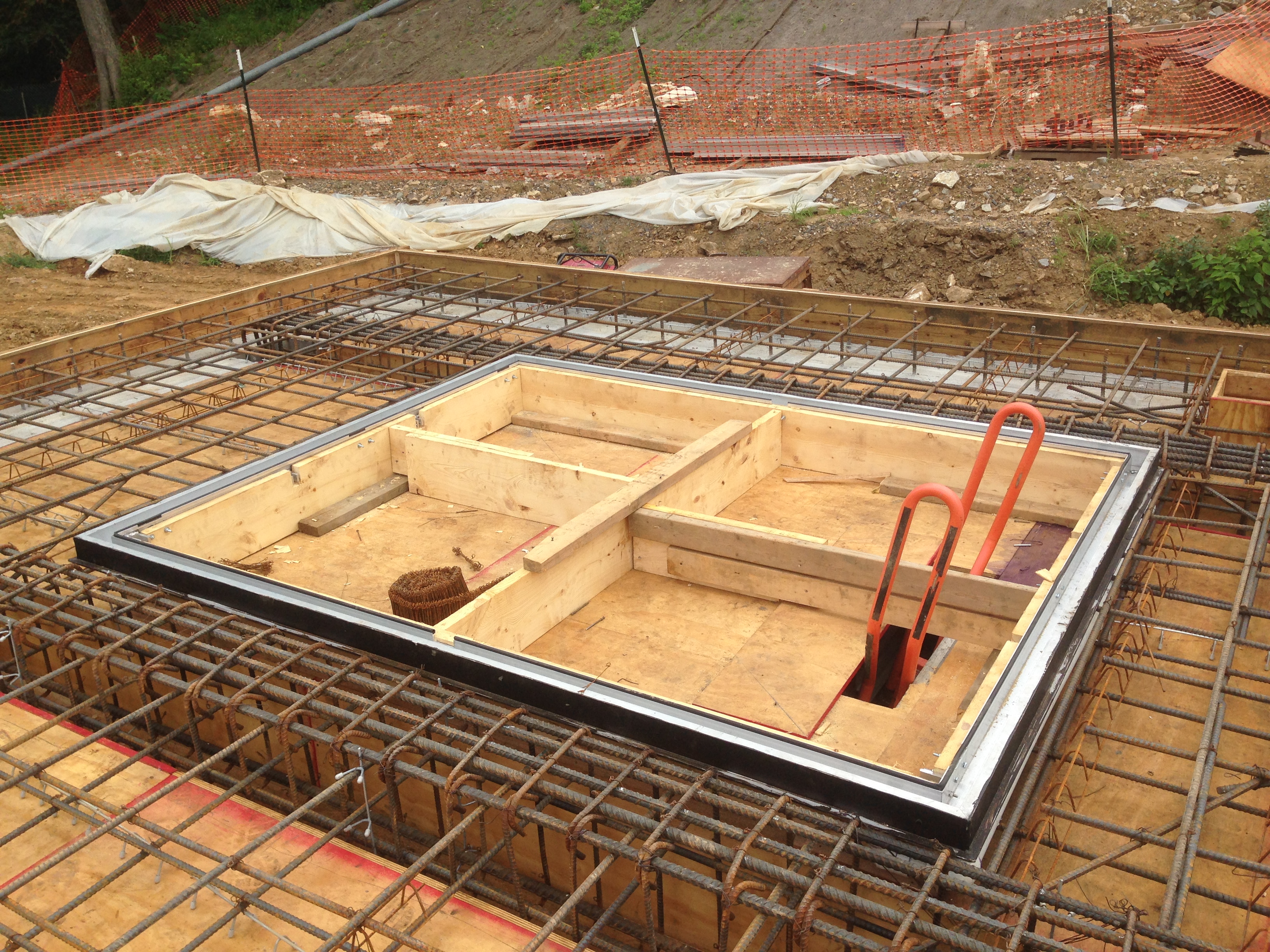
Rebar in the vault ceiling with the penetration for the service hatch.
And the ceiling is where the problem lies; it’s not meeting the design strength. The pours for the base and walls have been comfortably meeting the 4500psi strength in 28 days as one might expect. However, at 28 days the contractor had to do some rounding up of the percentage strength up in order to meet the 85% threshold for removing the formwork. Now at the 56 day point the last two breaks have come in at 4400 and 4320 psi.
So what… The short and simple answer is strip it out and try again it as it doesn’t meet the spec. At the 28 day point when we were looking down the barrel of this as a possibility that is exactly what my boss said cueing the squirming; not least from the concrete supplier who I believe will be footing any bill. However in reality all parties are aware that a compromise will probably be reached. The options on the table on Thursday were:
- Feasibility of replacing slab. This really is the last resort for all:
- Quality: It will definitely meet the quality.
- Cost: Nil for the Government; expensive for the contractor and concrete supplier.
- Time: 2 weeks for breaking, 2 for forming, fixing and pouring, 4 for curing. The PWV isn’t on the critical path but the steel fixers have weeks of work in front of them and winter is coming fast.
- Destructive testing of cores. Will assess the difference between the cylinders and the real condition; they are as likely to be worse as better.
- Quality: Difficult to find a gap in all the rebar to core.
- Cost: Cheap for contractor
- Time: Results back in a week before next decision is made.
- Structural Modifications. Adding more steel to bring to strength. This requires a design analysis of which element of the concrete requires to be 4500psi.
- Quality: Unknown as we don’t know where steel will have to be placed. The PWV is hardly a work of art already so a bit of steel won’t hurt.
- Cost: Less expensive than replacing the slab.
- Time: Overall it would be concurrent activity so wouldn’t add to the programme.
- Analyse the slab to check the required strength. Apparently concrete is specified in 500psi increments so there is a chance that it is strong enough already. USACE could ask our design consultants to do it but that wold cost us money so we won’t. Instead the contractor can do it independently and our consultant can check it.
- Quality: We wouldn’t get what we asked for, but we would get what we need if the calcs showed that the concrete was strong enough.
- Cost: $500 – $1000 for a Professional Engineer for a day.
- Time: A week or two and if all is good then no knock on to the programme time.
So we are going down the analysis option, which would be required for the structural modifications anyway. From there on we will see what happens.
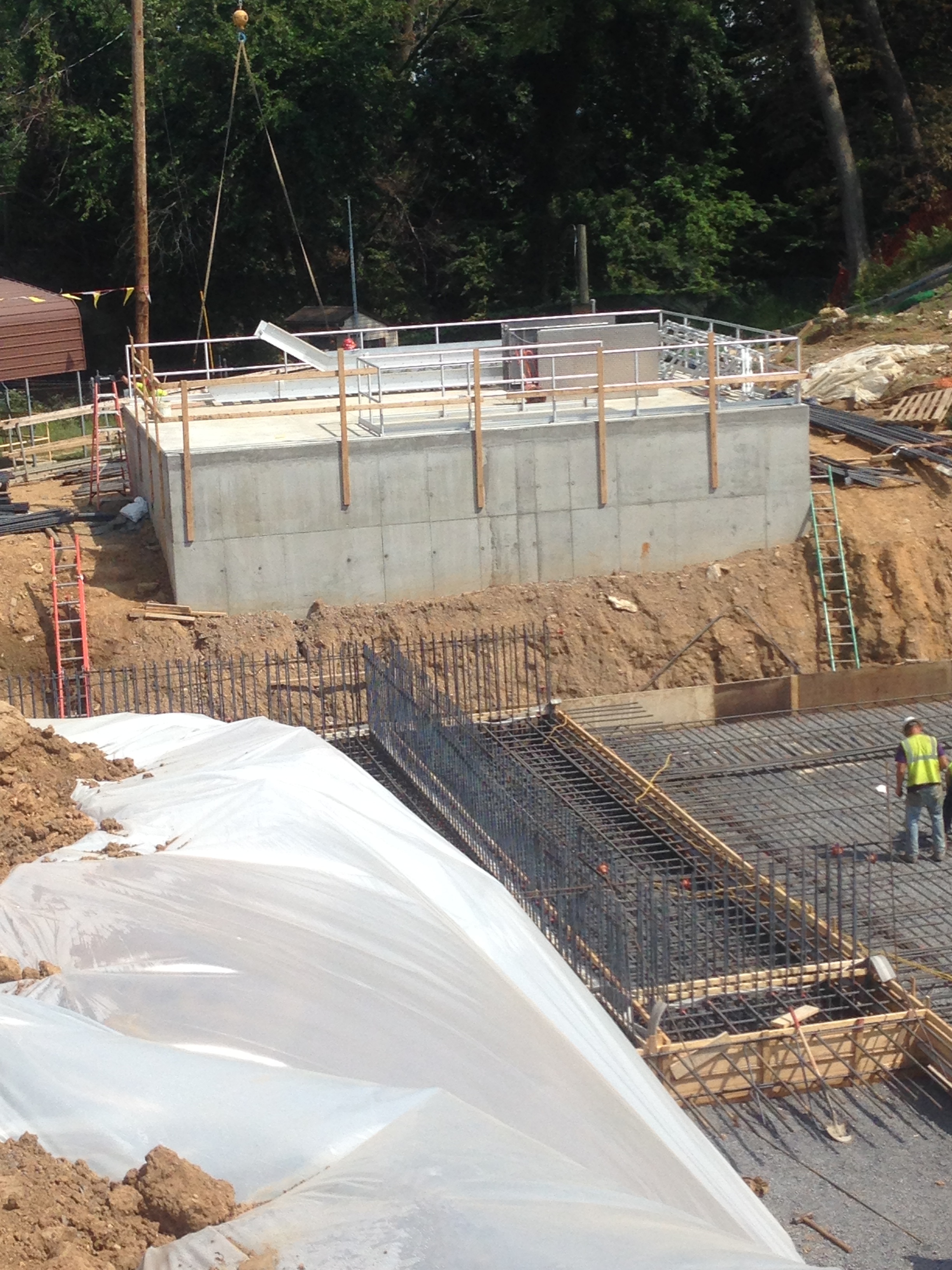
The PMV in the background. The actual tanks are currently being poured and will keep the steel fixers busy until the end of November.
And finally…
This is now the second car crash I have seen in 6 months of being out here. The woman in the blue car turned in to get gas, but tried to go through another car to get there. I had been planning on using that pump but it was blocked when I had turned up. Fortunately no one was hurt but all of the blue car’s airbags deployed and her groceries met her in the front of the car.

I now put a couple of fuel pumps between me and the road.
PS. I don’t know what mix the concrete is Damo so don’t ask.
 Holdfast Training Services Trial Blog
Henry – Sounds like you have got a good spot of work on with the reinforcement checking. Shame no information about the mix design. If there was a low cement content in relation to cement replacement, that might be a quick fix for future pours. This would allow a higher earlier strength but consideration of final strength would be needed.
Regarding what to do now. What were the actual strengths at 28 days? What is the design strength required of the slab? If there scope to re-assess the design to confirm 4500psi is required? I would ask for more cylinders to be tested to confirm the issue. What does the concrete supplier say, have they done their own tests on that batch? There is an argument that in-situ strength can be higher than a cylinder strength because of the greater heat in a mass pour compared to a small cylinder. If the cylinders were cured in a curing tank set at about 20 degrees then results, as you say are not likely to be hugely different.
I agree coring is not ideal; hitting reinforcement is highly likely unless you have very detailed pre-pour inspections or a magnet.
I presume the room below the slab has spatial requirements that mean additional structural elements would not be acceptable as a worst case alternative to starting again?
No the short ansd simple answer is not break it out and start again it is go back to basics and understnd your statistics. The mean strength of a batch of tests is not the same as the characteristic strength which is not the same as the design strength, which is why Civils do concrete and E&M don’t! You will have a specification that will require testing to a standard, the standard will set up families of tests, whioch will determine how many tests may be below the target value whilst maintaining a characteristic strength within target. It is the distribution of results about the norm that leads tomany twst reults comming in with stregnths significantly greater than design strength even when testing at 7 days.
If, after undserstanding specification and QA you find the concrete is understrength then you have the design options at you disposal. I would start with the last first as a sensible option . It is probable that there is residual capacity in the structure becasue it would be unusual to get steel with the precise area required. IF that option fails core the concrete: Concrete as a material is routinely factord at 1.5 to allow for impercfections and on site variation; if you test in situ you will remove the need for a significant proportion of this factor. Next option is trengthening or the structure. In the UK you might remember many bridges being reinforced to deal with changes to Eurpoean HGV axle configurations and weights. Much of this was done with resin bonded carbon fibre on the soffit becasue it negates the durability issues associated with exposed steel. It as, however, only the best option because access to the crown would have been probelmatic. In your case it is expodsed and not being trafficked so simply adding a topping to give greater section depth woud be an easy fix. i.e. more concrete, greater d therefore greater z and lower sigma c. Any phase 1 in the classroom now should be able to tell you how much you’d need given the actions and geometry. It a half hour calc so a mere £200 to your contractor unles I realise how over ta barrel he is…
I’m intrigues by the reinforcing shown in your photo – is this a imply suported beam in the fore ground? there seems to be a lot of top steel and in UK terms it is not bundled or adequatley restrained by links.
Forgot to say – if you don’t have decent as built info (and your photo would probably be good enough to locate a core) you should be using a feroscanner to locate bars. I’d expect a diamond core co. to do so as standard practice.
i also just checked what you’re at with 4500 psi – it’s a 30N/mm^” concret and 4320 is a trivial difference. I would expecte your designers to agree to run a check at some cost, go for a coffee, laugh at the ignorance of contractors and PMs and then sign it off.
Henry – I think what Richard was trying to say (whilst on his soap box) was well done for bloging about an issue outside of your taught syllabus. The civil Ph1s have just started concrete so this is a good insight.
The difference from a 4500 to 4320 is minimal (30.3 – 31N/mm2 to split hairs) and I expect, as Richard said, this will be quickly resolved with some input from the designer.
Sorry to ask a question (it’s an easy one) and add to the list Damo has asked but do you know if any test or trial was carried out to ensure the concrete was sufficient prior to construction?
It would be useful to know how this issue is resolved and what changes are made for the future.
Actually Olly, prioir to pointing Henry to the elementary concept of statisitcal conformance and then engaging with the content of his blog, I was trying to say that you must be competent in an area to work in it and if your aren’t then you shouldn’t. The greatest sin a professional can commit is to fail to recognise the limit of their knowledge and experience. One of the attributes of a chartered engineer, not a soap box subject at all. The comment from Henry that refers to “what my boss said…” would suggest to me that he has done exactly that and referred the matter to someone with suitable knowledge and experience.
Well one mention of the ‘c’ word and the comments flood in. Apologies all around as in trying to keep the blog short, and palatable for E&Ms and phase 1s I have missed some details. So to answer all the questions:
Damo,
The mix design is 4.5: 1: 20.5 Cement: Flyash: Aggregate.
I think I may have confused the issue with terminology but at 28 days the break was 3800psi (85% – which is sufficient to break out the formwork). As far as the ‘design strength’ the specification requires 4500psi concrete. This is for the whole of the PWV and also the tanks you can see in construction in the foreground. My assumption is that the designers have specified one strength for all to keep construction simple. I don’t have access at present to the calculations on the roof to know what the requirement is and therefore how large the safety factor is. Our way forward is to assess whether 4500psi is required in this case as you suggest.
I’m not sure if the supplier has tested that particular batch, but all of the contractor’s cylinders for this batch have now been broken. As for adding structural elements the room is a pump lift station (mechanical room) and is massive (horrifically over designed one might say) so the biggest issues would likely be the stairs. Some cabling and pipework would need moving too but nothing big.
Richard,
I understand statistics. I hadn’t looked at the mix design and associated testing but the mean for this design (at 28 days) is 5831psi and the minimum of any of the 42 tests in the regime is 4545psi; so these tests are certainly low. Also the floor and wall pours came up to strength well too.
In my opinion, whether breaking out the concrete is the first option or not depends on your perspective. Looking at it from the contractor’s point of view it is clearly the last option, however looking at it from the customer’s point of view as the start point of a negotiation it’s the first. As the client we have very few tools to keep the contractor honest but we are entitled to what we asked for and painstakingly spelt out in a 1000 page contract. The onus is on the contractor to prove to that its okay and accept that risk.
Reference the beam; I am going to say that yes I think it is simply supported and that I have not seen any bundling of rebar out here.
Ferroscanner – seen.
Olly,
Thank you for coming to my defence. I get that the difference is small but it exists and is specified which is why it becomes an issue. Reference your question, it is a pretty standard mix and there are tests to back it up. The issue with the strength is suspected to be due to a change in the admix supplier (to save costs). This should probably prompt a resubmission of all of these tests.
Richard 2,
A good point but it did come across a little strong. I understand the points about the limits of your competence but would say that as an engineer one should also be able to convert the same analytical skills across the disciplines, with some guidance, with some success. I am sure all of us E&Ms will have to make decisions about concrete in the future at 170 Gp without having a Chartered Civil Engineer right on our shoulders understanding the whole situation.
And finally I can’t believe none of you had any concern for my safety on the roads. It’s like a demolition derby out here!