Adding water to concrete on site!
I have mention this in an earlier blog however, Richard asked me to highlight this again as he’s currently delivering the concrete package.
The practice of adding water to a concrete mix in order to brings it’s slumps back inside tolerance is poor at best. It alters the water/cement ratios and affects the whole mix, however, we are allowed to add water on site!
The concrete specified for our bridge is a C40/50, 20mm limestone mix. The limestone aids with the strength but also assists with ensuring that no chlorides are in the concrete which would cause long term PT tendon corrosion issues.
The problem is that limestone draws moisture out of the mix at a hell of a rate and during the trials we had real issues in maintaining a workable mix. Plasticisers and retarders have been added but altering a mix is not as simple as adding more….
As a result, the supplier monitors the mix, travel time and ambient temp and provides a certificate that details how much water we can add to each load. Every load that arrives is different and ranged from 0 to 72 litres (the most I’ve seen to date). Very rarely do we have to add this, normally the slumps are within tolerance but when loads get held up or arrive marginally out of spec, it has allowed us to keep batches alive.
Today’s pour should have had a 180mm +/-20mm slump but one load was measured at 130mm. The ticket specified up to 33l could be added. I added 10l to a 6m wagon which brought the slump up to 190mm, a little water makes a big difference.
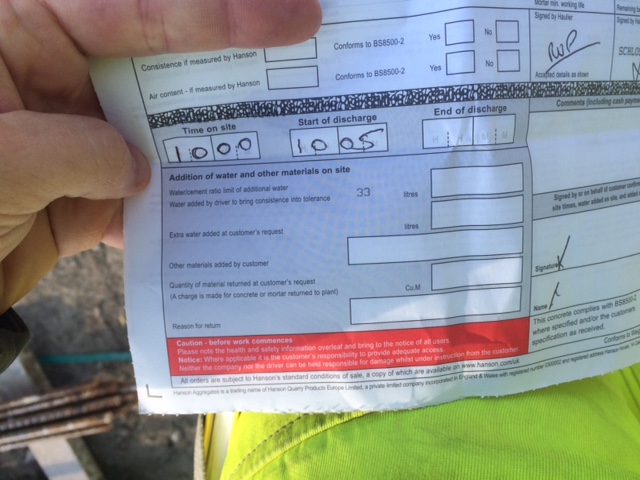
Concrete ticket – max additional water is marked on every ticket
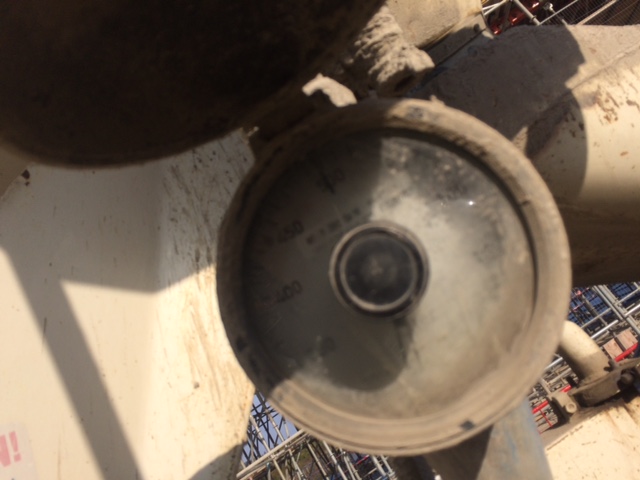
Water gauge – For QA we have to monitor how much water is added.
 Holdfast Training Services Trial Blog
Good and simple Olly. Just to clarify, are you saying that the limestone is the reason you are allowed to break the golden rule of ‘don’t add water’?
Yes. Our supplier has told us that limestone agg mixes are the only ones they permit this process.
Thanks Olly that’s a very clear and succint piece and I will be questioning the course on it tomorrow! I wasn’t aware that it was only limestone aggregate that could carry a permitted water addition. I’d be intereted to hear of the experience of others with regard to added water and experiences of concrete compliance issues on delivery to site.
The tickets here typically specify an amount of water that can be added at site (all concrete arriving has had this, limestone or not). This is done to address issues with consistence. The amount is in the magnitude of 10s of gallons (34 gallons being the most I have seen – so a lot.) I’ve never seen that much added though.
Another QC item is air content in concrete requiring air entrainment (likely for freeze/thaw robustness so look out on the ticket for foundations or SOG that the correct mix is arriving on site). This is measured using what looks like a little pressure cooker which, very loosely, is filled with concrete, allowed to settle, topped with water and then hit with a hammer. If the air content is low we have bags of air which are thrown into the mix.
Yes – I thought this was the Engineer equivalent of a ‘long weight.’ however http://www.velvetop.com/PDFs/pb124_air-plus_super-air-plus.pdf
They are essentially like the disolving bath balloons your wive’s / girlfriends / moms get for christmas. We are only allowed to add one which will bring a truck of concrete (10 Cubic Yards) air content up by 1-3%.
Also – there is a limit here on the amount of revolutions that the drum can make. any more than 300 spins and concrete is rejected.
In the summer months we also had temperature readings taken, anything getting close to 90 degrees could have a bag of ice added, with ice being a part of the mix at the batching plant.
Hope thats useful.
Olly
Two queries:
As little as 10L to make such a large difference to the slump?
How does your site record the addition of water from a QA perspective – or does the supplier still carry the risk for the concrete even though the user is adding the water?
Addition of water will be annotated in the QA/QC rep’s notepad, uploaded into the daily logs as well as noted on the ticket. The risk I think you might be referring to is that of the strength of the concrete, this will still be borne by the supplier, as long as it has been placed properply by the contractor, because the supplier has specified a suitable amount of water which can be added. If it could be proved that too much had been added that would be a different matter. If a truck arrived on site with no such provision on the ticket for adding water, and which was out of spec for consisitence I would be turning it back.
Dickie,
What Brad said!!!
If you look at the ticket in the photo you can see a box below the 33l note for one of the engineers to write how much is added. The drivers are not allowed to add water without direction. As long as less than the max is added then the risk sits with the supplier. We also not of the pour record sheet if water is added and that is all logged on file (scanned to pdf and added to the BIM database).
If i’m honest, strength is not a massive concern of ours. Cube results have been coming back in the high 60s for a C50 at 28days. Our concern is consistence for pouring as we have some awkward cross falls and chamfers to cast. Low slump=curing v.quickly. high slump=a nightmare to form the shapes and finish.
Olly, I can’t help but ask about the detail on how the water volume is calculated based on the mix, travel time and ambient temp. Do you have any information on this such as if ambient temp is x add y litres. Was there some sort of correlation graph produced from the trials?
Do you have a set open life? Some of our high early strength concrete, needed to get to 40N/mm2 in a few days and was incredibly stiff (very high cement content). If it was over 2 hours from batching to pour we were to reject it, I wondered if there was a similar condition on yours, or if adding water gets you out of that?
Damo,
No and No.
2hrs to place is a standard (BS 8500), adding water doesn’t get us out of that. We would really struggle to keep concrete alive anywhere close to that two hours, the limestones ability to dehydrate the mix is impressive!!!
The supplier calculates the allowed additional water. Imperical data is very important to them, they frequently send a rep to inspect loads arriving and I do know they have adjusted their procedure whilst we’ve been constructing. Each batch of limestone they receive has to be tested for its water absorption rate (the limestone is also stored outdoors). The temp and travel time is critical so they know how much curing will have taken place on route. Each ticket has a unique quantity, two wagons arriving 10mins apart could will different because it doesn’t necessarily mean they were batch 10mins apart. Also, we’re skipping most of our concrete and it can take up to 45mins to unload a wagon which means every load is batched separately. Sadly we haven’t got the luxury of a London style batching plant that can punch out large consistent volumes. The two plants around here break down most days, panic if we ask for more than 30m and occasionally send out loads with a 35mm slump which makes me assume that the batcher has a Homer Simpson work ethic!
I suspect it is necessary for some sites to alter the 2hr rule based on location/logistics etc, but I suspect that they would have to agreed with all parties as to where the risk fell. Richard, any thoughts?
Now, more importantly……..what are you doing on here, I guarantee Juliet is more fun and entertaining than concrete!!!!!!!!!!!!
The short answer to varying the two hour rule is simple: don’t ask me it’s a legal/contractual matter! But yes, its all down to whatever the parties to the contract can agree within the law.
In most cases the engineer has some influence. Recall, there are three parties involved in concrete specification and supply: The specifier, the user and the producer. The specifier is bound by design needs and constraints which might include code boundaries for adoption i.e. if it is a highway structure then it will comply with BS5400 unless you can agree a departure. The normal intersts of the specifier are strength and durability (possibly density) so if not bound by compliance with a non variable/non negotiable it becomes a case of agreeing acceptable specification for final properties. The user is interested in two things, how easy it is to place and finish (time and quality) and how much risk there is in non comliance (cost!) They will therefore take the specifiers output, add a couple of their own requirments and pass it over to the producer. Time may remain a variable with constraints more flexible than two hours. Where risks are left at this point often depends upon market conditions because the conept of who is best placed to manage them is trumped by who is prepared to do so at lowest cost/greatest risk to themselves. Success usually means it is managed by those able to do so. The producer therfore has as much or little leaway left as others have permitted but if they are carying risk they will usually impose constraints of their own back onto the user e.g. we will guarntee consistence and strength if placed within x hours of delvery. Who carries delivery delay risk is a contractual point of interest. I have known a user take this on becasue their supplier refused to supply at their risk and there were no other options, equally I have seen suppliers carry the risk because the proximity of their plant meant that there was low risk and they could use mass concrete site blinding as a means of disposal for rejected loads from other locations as long as they won the contract (savings made within the contract that could only be realised by the supplier).
Bottom line is it comes down to who wants what, where and when, how much they are prepared to pay and what risks they are ready to accept to achieve it.
Is that enough? Can I go home now!?