Archive
Anywhere but Chatham…
Phase 1s,
Following up from Fran’s blog about Perth I thought it worth mentioning that there is a wealth of information in the blog archive about transitioning to phases 2 and 3. Looking back you will see that the blog has been a cathartic release for students past and present to whine about their experiences both overseas and when venturing out of the Army cocoon in the UK.
USACE:
https://htstrial.wordpress.com/2015/04/16/usace-not-a-place-in-china/
https://htstrial.wordpress.com/2012/03/23/progress/
Matt Fry had some difficult administrative times and is very articulate in presenting them!
BP:
https://htstrial.wordpress.com/2015/04/20/lang-time-nae-see-far-hiv-ye-been-min/
https://htstrial.wordpress.com/2014/04/21/getting-started-in-aberdeen/
For the design office to come:
https://htstrial.wordpress.com/2014/02/20/what-colour-is-my-parachute-or-do-i-have-add/
For anyone ending up in the US Brad and I have tried to ‘tag’ our posts so that they are a little more sortable. It may be something we could do in the future to separate the E&M blogs from the unending pictures of concrete too.
The blind leading the blind.
I have now started my design attachment in the USACE’s Baltimore District Headquarters and am currently working on two projects. One of which is a ‘server room’ cooling survey at Fort McNair in Washington DC, which this blog will focus on outlining.

Fort McNair, in the heart of Washington DC. As you can imagine the traffic was delightful.
I have realised my utility, I am cheap, and so have used this to secure some responsibility early. The project budget is $50,000 and, in the mechanical section, the average engineer’s time is billed at $135 per hour. The basic sum on this gives an engineer 370 hours, but add in project manager time, vehicles and other overheads and it can soon be eroded. This is something I will research into for a further blog but the upshot is that this is now my project, and a handsome little mess it looks like to. The scope of the work currently is to write a report on the cooling within a number of server and communication rooms within the Military District of Washington (MDW) office buildings. There are 15 different rooms spread across 8 buildings, built circa 1900, all with vastly different loads and in different conditions.
After meeting with the USACE project manager, the client and the HVAC engineer for the buildings, Don Ruhl (my partner from the mechanical section) and I toured a number of the rooms. As we travelled around it became apparent that not only did the client not know what they wanted; they also didn’t know what they had in the rooms. The photos give an idea of a couple of the rooms and the varying conditions.
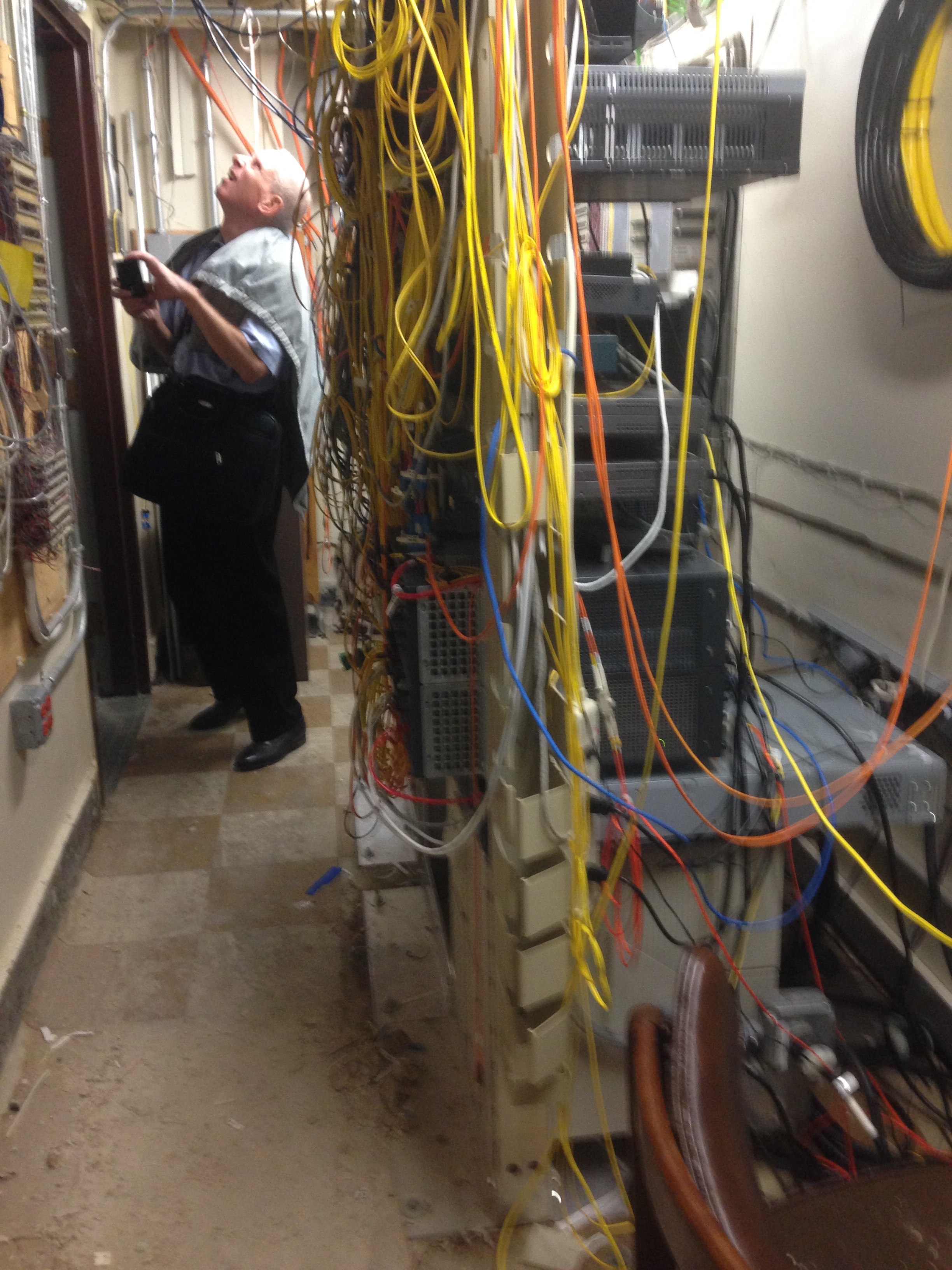
Don inspecting the many unsealed penetrations in a small converted basement broom closet. This room had about 12U of switches and had a retrofitted ductless cooling system. It also had a condensate drain to a sump, thus allowing the condensate to re-evaporate and continually cycle through the cooling system.
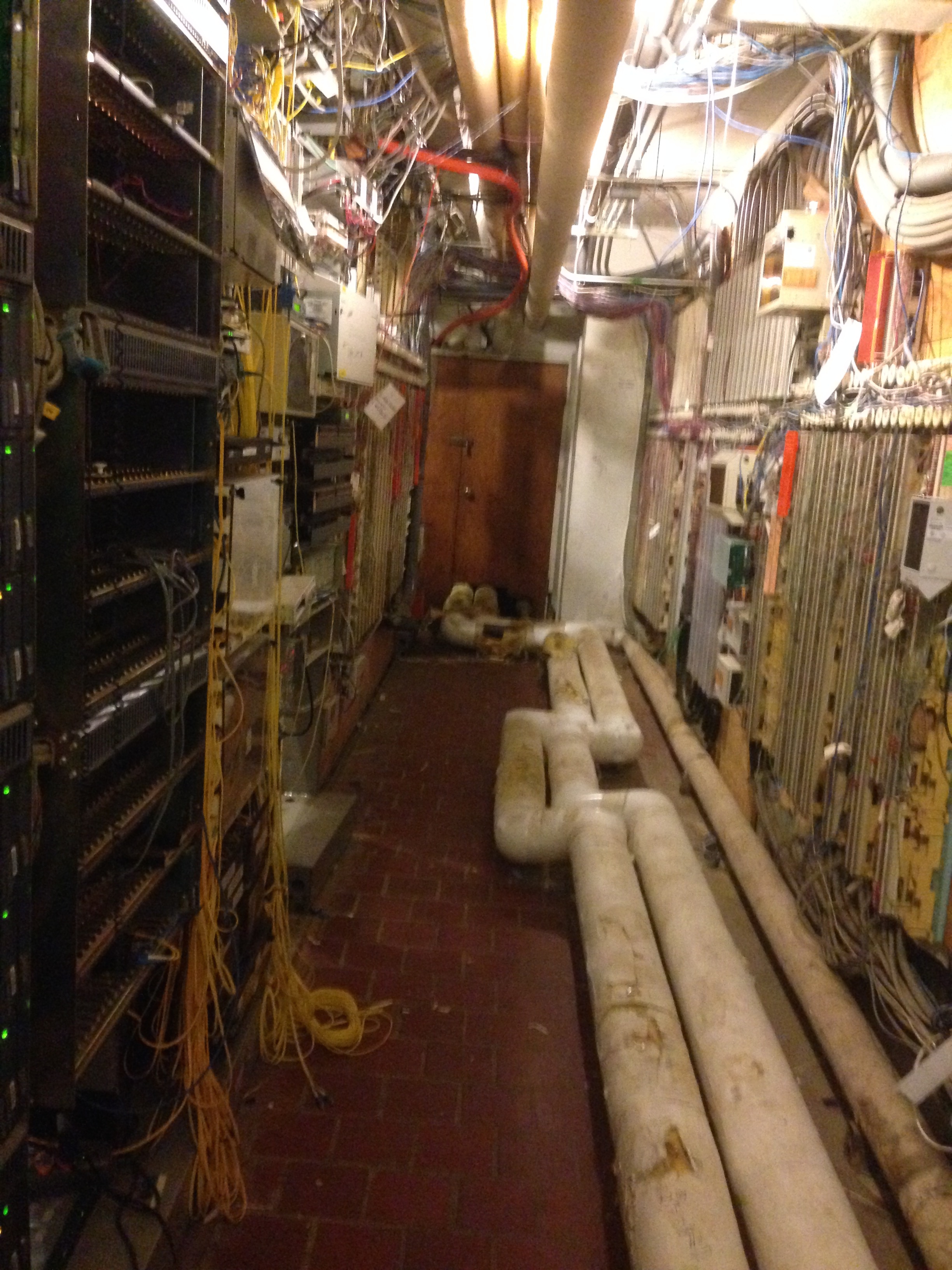
Another basement room with abandoned hardwiring to the Pentagon. About 45U of high grade servers in here. The pipe on the floor is for chilled water with heavily damaged insulation allowing condensate to form on it in the summer.
Server rooms are ideally internal within a building in order to avoid solar heat gains and also because servers don’t need a window to stare forlornly out of. They are usually sealed from infiltration; tidy, to control airflow and have some form of HVAC. The current standard for low and medium density data centres and server rooms is to use a hot aisle, cold aisle system as illustrated below. Cold air is fed from low down in the ‘cold aisle’, either through the floor or by retrofitted ducts; the server blade draws it in through the front and rejects warm air through the rear into the ‘hot aisle’. This rises and is collected by the return air system. As the photos above indicate this was not the case.
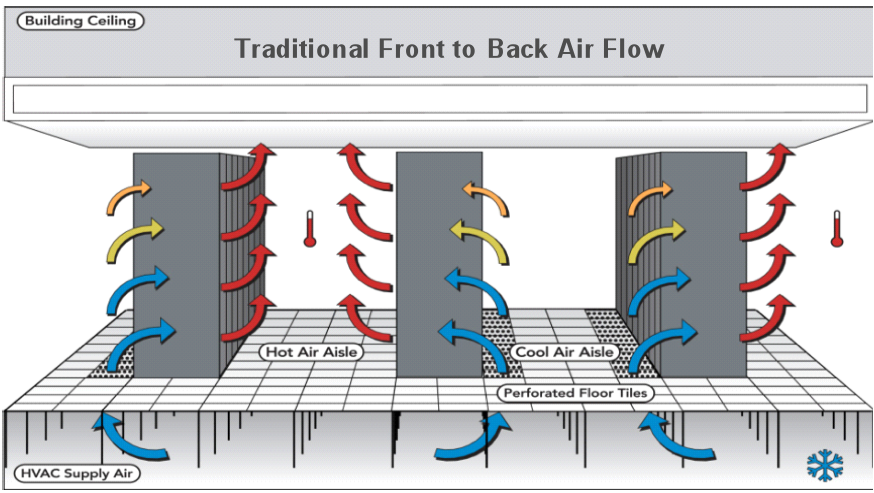
Hot aisle, cold aisle process diagram.
So what. Well given the conditions in many of the rooms, even doing a complete survey would be incredibly costly on time. After this initial assessment we need to engage in some expectation management in what we will be able to provide and re-write the scope of our work, which is currently pretty open ended. I see this largely as focusing effort on the more important rooms in terms of upgrades and identifying the risks of each room to the client so that they can make an informed decision.

In an age of BIM, I have been told that the best we can get is a floor plan for some of the buildings so it appears that even a set of out of date as built drawings are a wish too far. Due to this if construction work is ever completed on this then the contract will almost certainly have to be a design and build as the potential for change orders on a traditional contract would be immense!
Finally, a little leadership challenge.
I mentioned earlier that I had been given the lead on this project but I am working with another engineer. Don has worked for USACE design section for at least 30 years and is probably the most intelligent person I have met out here. He has no aspirations of leadership and is very happy to let me control things; however his ability to take a tangent and dive too far into the details too early are something to behold. Certainly a different management challenge from both soldiers and contractors!

