Programme vs Quality
This blog follows on from my previous blog about getting ready for pre-commissioning flushing. This time I will be focusing on point 4 of the check list – having a complete system.
As previously mentioned the original construction programme date for starting commissioning was 17 Aug 15. I had managed to get my elements of the pre-requisites in place and it was now down to SRW to provide a complete system. SRW did not achieve this date therefore for once CCL were in the position to be able to write a notice of delay; something SRW have been all too keen to do up until know. However it is only really worth writing a delay letter if there is actually going to be an impact on the programme (something SRW seem to have missed the point on), otherwise you are writing a letter which has little impact contractually, wastes time and erodes good will.
By sitting down with my SRW counterpart it became apparent that the date of 17 Aug in the programme was plucked out of thin air / had a huge amount of float associated with it. The completion of flushing (six week process – 1 week fill, 3 week flush, 2 weeks for results to be processed) was linked to the start of commissioning which wasn’t required until 16 Nov according to the programme, however, the fit out matrix is at least 2 weeks behind in core A and therefore this date could be slipped to 30 Nov which gave us a requirement to start filling the system by no later than 19 Oct, which is the date we agreed on to start. Buying SRW 2 months more time, which seemed more than enough time to complete the works that were left to do.
Unfortunately this time has been squandered by SRW. 19 Oct came and went and although the system was complete in that it had been installed the requisite checks that I eluded to in my previous blog hadn’t been completed: visual inspections were not completed to identify and rectify snags. As of 20 Nov the system still has not been filled. It is now looking like this won’t happen prior to Christmas – if the system is filled now we’d potentially still be flushing during Christmas stand down. What is frustrating is that this is all down to an issues of balancing time vs quality. SRW simply aren’t on the same page as Carillion with respect to the quality we will demand. They have been pushing on trying to hit programme targets and in doing so are slipping on quality. Carillion will not allow SRW to proceed with filling and flushing until we are happy with the quality of the system and therefore SRW’s approach is inefficient in that they are going to have to pay to go back and conduct reworks.
Nobody from SRW appears to be managing the quality of the installation; they are letting their trade contractors call the shots and are taking their word at face value. This became very apparent in the lead up to 19 Oct. I had been monitoring progress on site and knew SRW were going to be nowhere near ready. My counterpart in SRW said this wasn’t the case. It was only when I sat him down, explained the issues and walked him out on site that the penny dropped with him as to what was happening. Everything I have picked up is blindingly obvious to see, but the SRW manager had been trying to manage from behind a desk. Unfortunately this doesn’t seem to have changed much and some of the key issues I have highlighted are still present. Although this is frustrating it is great for me in that I believe it presents some good C2 and C3 competencies to discuss at CPR.
The issues I have picked up include:
1.Union joints on pipework only being done up hand tight. What is particularly concerning about this incident is that SRW had recorded this section of pipework as being complete and having been air tested. Which then brings into question their whole process of checking the system.
2.Pipework not being installed as per the drawings. SRW’s response to this was that the drawings are only indicative! This would be fine if we had loads of space but the ceiling voids are tight and a small fortune has been spent on BIM for them. CCL sought assurances that this wouldn’t cause clashes with other services (it was obvious it would), SRW have not provided it and it is now becoming apparent that issues are developing, which will result in pipework having to be removed. An example of this can be seen below:
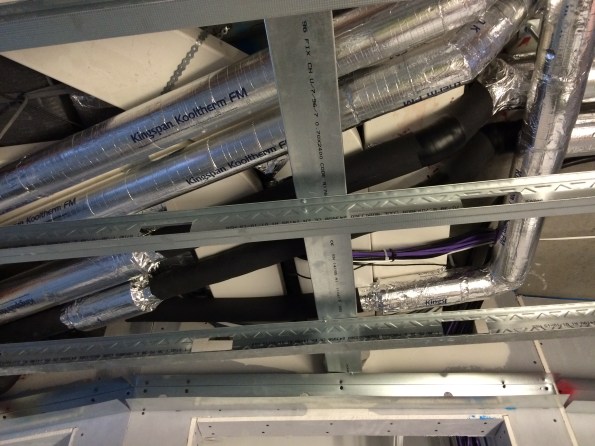
LTHW and CHW flow and return pipework above the ceiling grid of an apartment. The pipework had not been installed as per the drawings which means the lagging is now clashing with the flat duct work.
SRW’s solution to get around the clash between CHW pipework and the flat duct work is to use armaflex (black lagging above) instead of the normal Kingspan (silver), which isn’t acceptable. Why not? The employer’s requirements detail a specification for lagging on pipework which details the thermal conductivity of the material and thickness of insulation dependant on size of pipework. In this case the armaflex fails on both thermal conductivity and thickness. Although a 1 m length of sub standard lagging is unlikely to impact on the performance of the heat interface unit the main concern is that we are dealing with CHW pipework. Sub-standard insulation may lead to condensation forming on the lagging which will drip onto the ceiling and eventually result in a stain.
3. Clashes which prevent valves from operating which would prevent filling and flushing from taking place as per the RAMS.
My involvement in this element of the project has reinforced conclusions that I have previously drawn: the importance of getting out on site and looking at the progress of an installation on a regular basis, not just when it is offered up at an ITP hold point can not be under estimated. In addition far more information can be gleaned by talking to the bloke doing the installation than the manager of a main sub-contractor.
 Holdfast Training Services Trial Blog
RIchard (our network is playing up so forgive me if you end up seeing two posts)
Interesting stuff and definitely highlights the importance of not managing from a desk!
I note that you say “Sub-standard insulation may lead to condensation forming on the lagging” is this an assumption that you’re taking forward or a prediction based on a quick dewpoint calculation? This may be one of many spots where this has happened and I agree that you should get what you’re paying for (it sounds like kingspan specification writing) but is it worth the extra delays that it sounds like this will cause?
What’s the basis of the specification? Is thermal conductivity and thickness based on critical radius or on achieving a certain insulation surface temperature?
Mark
Mark,
I’ve dusted off my notes and got back into basic psychrometry – amazing what you forget after a few months! I’m getting a dew point of between 7 degrees and 15 degrees assuming a room temp of 21 degrees and RH of between 40 and 70. When I use equation 7.3 of section 7.3 of CIBSE guide A I get a value of between 12 degrees and 14 degrees depending on what maximum value of vapour pressure I use. What I now need to do is remember how to claculate what the surface temperature of the CHW flow pipe will be.
Mark,
To be honest I’ve not yet done any calculations – thank you for the prompt, I’ll see what I can dig out tomorrow night. At the moment it’s a more a case that there is a possible problem as SRW are not meeting the specification. It shouldn’t be for Carillion to do this calculation, although I can see there is benefit for me in doing it. We are now expecting SRW to rectify the issue altogheter to meet the specification or proved a response from their conultants that this will not cause an issue. Without the definitive answer as to whether or not we’ve got a major issue it is worth waiting in my opinion – water leaks cost Carillion millions of pounds a year; core A is the first of 11 cores and if we don’t get the process right here we won’t stand a chance by the end of the job.
From what I can see the specification is based on thermal conductivity and thickness based on critical radius.
Richard
Understood, from the outside it looks like an automatic “cut and paste” specification may be at the heart of the problem. I’m sure you’ll have seen that some suppliers (eg kingspan) are quite adept at providing a robust specification that can be used in design, funny how it will typically describe their product in a way that compliance otherwise would be difficult.
Good luck, let us know how you get on!
Thanks Rich for an excellent in sight on the work you are involved with on site.
Cheers John