Pack your costume
BPGC, woof.
The Civils who’ve just completed the living hell that is Cofferdam will be reciting ‘boundaries, properties, groundwater and contamination’ in cold sweats at ungodly hours. This blog will look at how groundwater has unsuspectedly given life to what was assessed to be the biggest risk on my project – the rate of tunnelling.
JHG bid on the AMSP (Amaroo Main Sewer Project) expecting groundwater inflow levels to be in the region of those described in the GDR, or not a million miles off anyway. The GDR is the designer’s interpretation of the factual data gathered from the site investigation, considered relevant to constructing the asset i.e. a 7.8km long sewer system above and below the water table at depths of up to 22m.
JHG risk register
JHG assessed the rate of tunnelling to be the biggest risk of the project with a risk value of $2,660,000 ($10,640,000.00 impact x 25% likelihood). The thought process was that the risk lay in tunnelling through fine grained material (clay) with floaters (basalt boulders) in the northern end of the project alignment. There was no mention of water (impacting tunnelling rate) which has a risk value of $150,000 ($300,000.00 impact x 50% likelihood), just 1/17th of the rate of tunnelling risk. It was soon clear during shaft excavation that groundwater inflows were far in excess of those anticipated based on the information in the GDR, and the shaft excavation (and hence TBM) programme had to be amended to keep water inflows at manageable levels.
JHG engaged a specialist subcontractor to conduct a groundwater investigation regime in an effort to determine just how much water they would encounter, and to transfer the cost risk of groundwater management to the Client by proving a compensation event. In order to do this, JHG needs to show a material difference between the designer’s groundwater inflow estimates and the engaged subcontractor’s estimates. The Client then needs to accept that the level of groundwater as an unforeseen ground circumstance (Latent condition in Aussie lingo). Both the designer and the engaged subcontractors’ reports stated their estimates could be under or overestimated by an order of magnitude. Convenient considering their estimates differ by about just that.
How did we find ourselves in this mess?
Tight market conditions may have persuaded JHG to bid on a project that other tier 1 contractors shied away from due to their interpretation of the risks associated with groundwater management. It may be that it was not possible to price all the risk into the bid if JHG was to be a serious contender, and that JHG was willing to accept the risk on a construct-only contract. It may also be that JHG assumed a Trade Waste Agreement (TWA) would allow 4ML to be disposed of into an existing sewer at the southern end of the alignment at no charge (the TWA limit is in fact 1.2ML). It could be that the risk register was just a revamped version of the one used by the same project team on a recent tunnelling job of similar scope in Queensland where water was not an issue. Or it may just be that JHG accepted the GDR as gospel truth and rolled the dice hoping they could save on doing an independent investigation. In any case, the risk now requires urgent management.
Back to the site investigation
It was known at the tender stage that the ground varies from fresh to extremely weathered basalt and residual soils. In contrast to homogenous soils where permeability can be estimated through laboratory testing, groundwater in rock masses flows through fractures and joint sets. Estimating permeability in a rock mass is impossible without in-situ testing. One could argue that a tier 1 company such as JHG should have had geotechnical engineers sufficiently competent to know that, and insisted on conducting an independent SI to make better informed decisions when compiling the R&O register. I suspect the cost of doing so would have prevented this if it had happened. Hindsight is 20/20 vision.
Walk-over survey
You will remember that a site investigation is comprised of a desktop study, ground investigation and site walk-over. JHG spent $293,536.04 on the specialist subcontractor. This may well have been reduced (or eliminated) if JHG had done a little research of their own for less than the price of a NAAFI watch. A google map study screams water to the north of the project alignment (Springs Road, Donny “Brook”, the presence of numerous farm dams) (Figure 1). A drive around the local area also gave a clue (Donnybrook Mineral Springs road sign) (Figure 2). The similarity of this situation to Rich Phillips’ project in Southampton is uncanny – time spent in Recce…
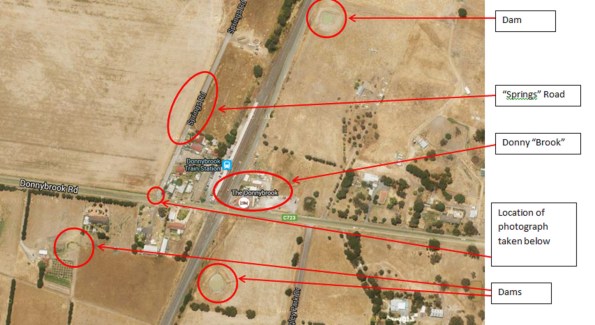
Figure 1. Google map study of the northern part of the alignment.
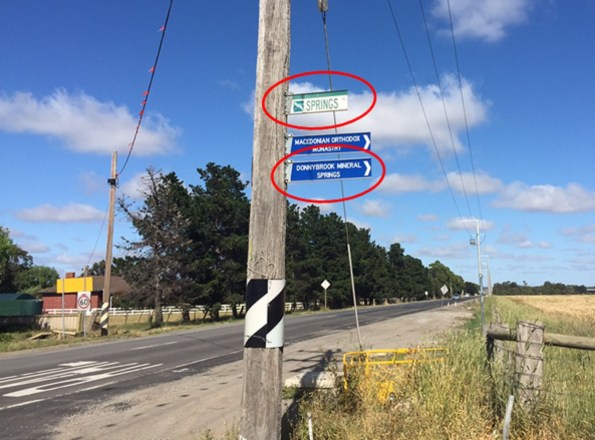
Figure 2. Road signs at the junction circled in Figure 1.
Conclusion
There could be a number of reasons why JHG accepted the risk of groundwater. A walk-over survey would have alerted them to the fact that the risk impact ($$$) was likely to be insufficient, and probability was more like 100%. The interesting part is that the TBMs cannot proceed without shafts, and shafts cannot proceed without a water management plan. To those who are soon to go onto Phase 2, line items in a risk assessment should not be assumed as existing in isolation. In this case, I like to think of it as the Jack Russell (groundwater) has woken up the Rottweiler (tunnelling rate) and they are about to bite someone on the………….ankle.
PS If anyone wants info on Melbourne, my e-mail address is daryn.mullen@gmail.com. Happy to answer any questions to do with nice areas to live in or bogan areas to avoid etc.
 Holdfast Training Services Trial Blog
Really interesting mate.
You mentioned they were bidding on jobs others were avoiding, but how did they come to make these dangerous assumptions? What’s the internal process of quality checking tenders?
Guz, I should probably give some more background info. The Head contract is a construct only contract with preliminary designs provided by the Client’s designer. The GDR (which forms part of the contract) stated a maximum of 4ML of water per day was to be expected and it was assumed it would be discharged to sewer. As the contractor, JHG owns the risk and appears to have made the decision to accept this risk assuming that 4ML per day. Surprisingly, the TWA was limited to 470KL (and subsequently increased to 1.2ML per day). Inadequate in any case and we believe that is some of the reason the Client wants to help us find a solution quickly (the Client is a local water authority). If this can’t be found, the Client will have to accept the compensation event and the price tag that comes with it. Failure to do so will result in a dispute.
My assumption is that other tier 1 contractors may have had recent experiences of groundwater in similar ground conditions, or that they placed a greater emphasis on establishing the groundwater regime before deciding not to bid. Tight market conditions could have made this project unsuitable for a risk-averse contractor. I don’t know the answer, this is pure speculation on my part.
Tenders are reviewed in monthly peer reviews which look at the risk and opportunity register and evaluate estimates at tender time against actual conditions on site. There is no denying that the groundwater risk wasn’t addressed as thoroughly as it could have been, but it all goes back to JHG accepting the risk as part of a contract. I have no doubt that anyone in this project team will spend more time reviewing groundwater risks when the next project comes around.
Final point; this job is being done on a greenfield site. Previous jobs have been on brownfield sites where existing sewer systems were in place. Disposal is allowed into the sewer at the southern end of the site (where there is no groundwater inflow). Having more sewers to discharge into if the infrastructure was already in place would have reduced this risk to say $300,000 x 50% = $150,000. Perhaps that is where the tender team missed a trick?
Love the piece – ‘groundwater has given life to…’ Looks more like death to me.
It’s always easy to criticse with 20/20 hidsight so I tend to steer clear…it’s more ‘there but for the grace of God….’
The point is that this is a clear narrative that you can take into CPR
John, agreed, hindsight is a wonderful thing. Especially when it’s not your head on the block.
Daz, interesting stuff. Effectively I am on a similar project now on phase 3 so might pick your brains. If the actual flow of groundwater is a factor of 10 higher than originally predicted what was the original solution to remove the water, could it be beefed up to still work?
Did the original geotechnical design report include location of fissures and joints? I presume boreholes could prove deceptive if they happen to sit within a rock mass and hence show low permeability.
Why does the higher flow of groundwater reduce TBM speeds – is it to do with heath and safety of dewatering or simply mean TBM cannot work as well (does additional water have a friction reduction benefit)?
Absolutely agree with the site investigation comments. We were not too far away from specifying a borehole to be in a church yard – a site walk over soon highlighted the issue.
Damo, original options (in the specification) include discharging into sewer, using as dust suppression on the temporary road, and filling farm dams adjacent to the construction boundary. We are currently doing all of the above and then using shafts not currently being used for construction as recharge wells to enable gravity fed aquifer recharge (the base of the shaft is not sealed). This is working but it has had an impact on the project programme and has therefore cost JHG money.
The problem with the borehole logs is that they provide a very selective sample size. Ground conditions at the same depth change from fresh basalt to clay in the space of a few meters. It is the fractures in the rock that have the high permeability.
The water inflow does not directly affect the TBM speeds. We are using slurry shield TBMs which inject pressurised bentonite slurry to equalise groundwater pressure in the cutter-head chamber. The tunnelling programme is affected by the fact that the shafts will be delivered later than expected and so the TBMs start later.
In terms of dewatering, the rate of tunnelling will be constrained by the amount of groundwater requiring disposal from tunnelling activities. In an effort to reduce this risk pending a long-term solution, shaft excavation and tunnelling sequencing has been revised.
Damo, original options (in the specification) include discharging into sewer, using as dust suppression on the temporary road, and filling farm dams adjacent to the construction boundary. We are currently doing all of the above and then using shafts not currently being used for construction as recharge wells to enable gravity fed aquifer recharge (the base of the shaft is not sealed). This is working but it has had an impact on the project programme and has therefore cost JHG money.
The problem with the borehole logs is that they provide a very selective sample size. Ground conditions at the same depth change from fresh basalt to clay in the space of a few meters. It is the fractures in the rock that have the high permeability.
The water inflow does not directly affect the TBM speeds. We are using slurry shield TBMs which inject pressurised bentonite slurry to equalise groundwater pressure in the cutter-head chamber. The tunnelling programme is affected by the fact that the shafts will be delivered later than expected and so the TBMs start later. In terms of dewatering, the rate of tunnelling will be constrained by the amount of groundwater requiring disposal from tunnelling activities. In an effort to reduce this risk pending a long-term solution, shaft excavation and tunnelling sequencing has been revised.
Thanks Daz, Fantastic Blog – very interesting. Am I reading it that you are getting 4Ml day of inflow at the cutting face?! Nice to see you online!!