Port Augusta to Melbourne
Prior to Christmas I moved from the Sundrop Farm site in Port Augusta to Melbourne where I am now doing my design placement with KBR. This blog summarises the progress on site prior to my move and initial projects on the design placement.
My packages of work on site had more or less come to a close by the time I left. The lining of the lagoons and the installation of the freshwater lagoon cover were complete with only commissioning remaining. The three pump stations were all practically complete, with only snag list items remaining. Ideally I would have liked to have seen this through, but inevitably this wasn’t to be. Despite my personal work packages drawing to a close, pace on site continued to accelerate as the end of the year approached. The reason behind this were linked to a drive to get the solar tower erected prior to Christmas, which enabled JH to claim more in the final progress claim of the year. As I left the project was at the 50% complete stage.
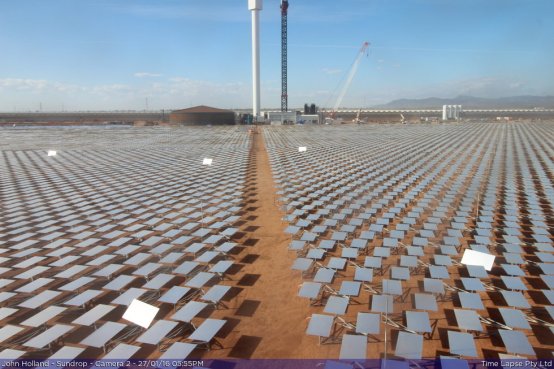
The Solar Field – beginning to look complete
With this increase in pace I ended up picking a few packages, these included: getting the tower crane foundations in place, ensuring the solar tower foundation was prepared for the first tower section, installing the pipe rack and getting the foundations in for all the mechanical plant. Everything fell into place eventually but needless to say there was a lot of coordination required, as all these activities were on the critical path and in the same 50m². The whole solar energy system is a bit of a nightmare to be honest. The primary subcontractor involved was Aalbrog Concentred Solar Power (AAL), who were on a supply only contract. The package had been tendered as a concept design and as construction progressed it was clear the level of detail in the design was poor. There were numerous design changes after the construction had begun and as I left there were still too many unknowns for JH to put out the mechanical package to tender and expect to get a reasonable price back. In the end they made the call to use a JH workforce and run the package themselves. As I was leaving the estimate was that the mechanical installation package would be at least $3million over budget. The reason for this were various, but main errors include missing the cost for the heat shield on top of the tower out of the initial budget and budgeting only $6000 for the tower fit out, when it is actually costing almost $1 million. The reasons for these omissions are again various but a lack of knowledge about the concept design and assumptions about the AAL scope of work appear to be the main causes.
Anyway the solar tower was erected prior to Christmas as planned and now they are waiting for the top module to be finished so that it can be lifted on top. Off the top of my head it is costing $100,000 a day for the crane to be stood there!
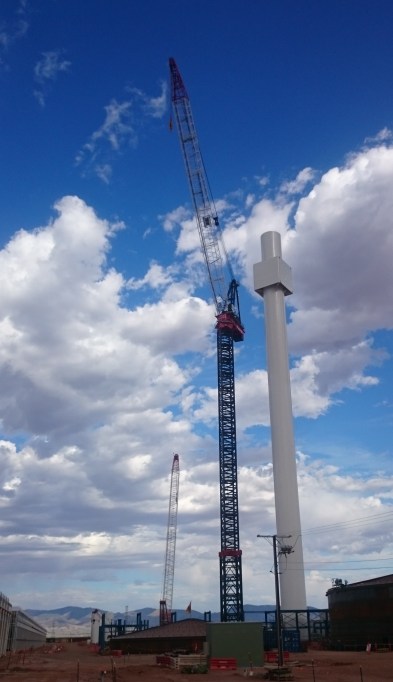
Solar Tower – Top module still to go.
Design Phase
I have been in the design office for two weeks now. Work wise it has been a little slow, as KBR where not expecting me and there are a number of packages of work that are out at tender with the results due this week. I am based in the water group in the KBR office in Melbourne. Most of the work the group does falls under what is known as the Joint Venture (JV) with John Holland and is for Melbourne Water. All of the projects are design and construct. So far I have found myself working on the following:
- An Odour Treatment Facility (OTF) at the entrance to one of the main waste water treatment sites in Melbourne. The design of the facility is just getting to the detailed phase and I have been involved with the HAZOP process. The concept is pretty simple, foul air is drawn out of the sewer and though a filter which contains a bio media which feeds on the volatile organic compounds (VOCs), ammonia, hydrogen sulphide (H2S) and sulphur compounds, thus removing the odour. The budget for the whole project is $7.3 million.
- The second is a project is a Sodium Hypochlorite (NaClO) dosing system at the Greenvale Reservoir. The site currently uses chlorine gas but residential encroachment in the area and with additional water demands this is now deemed to be insufficient. The total project budget is $3.5 million. So far I have been involved with reviewing the P&IDs, conducting some pump calculations and am now beginning to write specifications for the associated instrumentation and plant. I am also leading with the design of the HVAC design for the new building that will house the dosing system.
- The third project I have only just begun working on today. It involves writing the technical specification for a waste water treatment facility that is treating the leachate from a landfill site. Previously this was stored on site and driven away by tankers. The operators want to reduce cost by treating on site before feeding into the sewer system. The earth works and main pipeline are now complete and KBR are going to put the mechanical and electrical install out to tender. The idea is that the technical specification will form part of the tender pack.


 Holdfast Training Services Trial Blog
Matt, is your replacing of the chlorine system just because it is getting old or is it regulatory as well? The WWTP that I was working on in construction had a chlorine system, which we were ultimately eliminating.
A risk assessment on the facility and it fell out side the requirements for the Victoria WorkCover, which is a compulsory insurance scheme for workers, similar to national insurance. Their report found that the risk of fatality >1 in 10 million and also harmful concentrations of chlorine may affect up to 1000 residencies within 400m of the site. Other drivers where increased capacity of the site and increased risk with the transportation and security of the gas.
Matt, were there omissions in the design that resulted in the $6000 to $1M increase. Was it a design and build, so did the risk sit with the contractor? Do you have any photos of the crane base reinforcement/concrete pour or erection of the tower crane?
Damo, no this increase was more of a result of tendering on a concept design. The top module of the tower contains the receiver panel and a steam drum, as well as all the associated pipe work. The JH view was that this would turn up on site and be lifted on top, with the final connections being made once in position. However as the design matured AAL decided to supply the module in three sections, with some pipe inside and without the receiver panels on (they deemed in JH scope to fit it all together). The result is that the whole thing has to be assembled on site at ground level to ensure it all fits together, then disassembled to get lifted in place. I can’t remember the over all weight but it was well above the crane limits. The result is that as well as all the work that needs to be completed, the crane also has to be on site a lot longer, the original plan was to only have on site for two/three weeks, its been there for over a month already.
I will try dig out some photos but I think they may be on my ipad that I left on site.
I’ve updated the blog with some pictures for you Damo.
Matt, Many thanks. Sounds like there was a lack of understanding how the task was to be done with expensive consequences.
Thanks for the crane base photos. Looks like a shallow base with no piles! Must be some strong ground you are working in. By the look of the vertical sides of the excavation it looks like it must be getting on for stiffness of rock.
The cost of the crane sounds very possible especially if you add in all of the other works to get it built.
The bit about checking it fits together seems like a sensible move but I would have thought some responsibility sits with the supplier so they could/should be required to offset some of the additional crane time costs.
In all comes back to scope issues for a task that was probably high on a risk register somewhere.