Battersea Power Station – Phase3
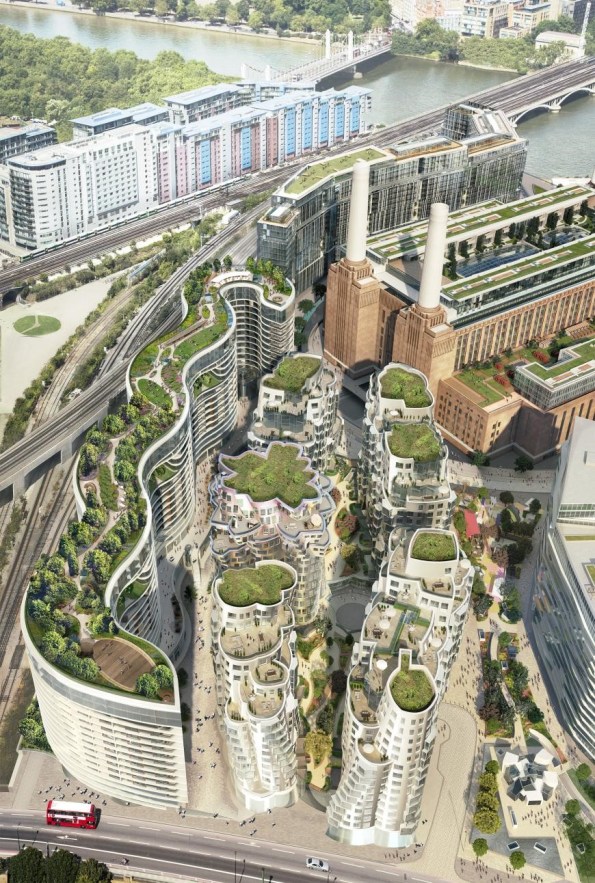
Like all my Phase 2 contemporaries I have now commenced my site attachment in my case, working for Bouygues UK, on Battersea Power Station Phase 3. I am a site manager with responsibility for a temporary bridge structure that provides critical access to the site.
Battersea Power Station (BPS) is part of a wider development of the south bank of the Thames in the Nine Elms area, from Lambeth to Chelsea Bridge, and includes the Northern Line Extension (NLE). BPS encompasses seven phases in total. Phase 1 and 2 are firmly in the construction stage. Phase 1, to the west of the old power station, is predominantly a residential project. Carillion is the principal contractor and the project is now in the fitting out phase with residential occupation in Q4 of 2016. Phase 2 (Skanska) is the refurbishment of the old power station. Bouygues UK were appointed the preferred bidder for Phase 3 late in 2015.
BPS Phase 3 consists of six buildings and includes over 1,305 residential units, a hotel, a health clinic and over 40,000 m2 of commercial space. The client commissioned Fosters and Partners and Gehry’s for the buildings’ architectural designs. All six buildings are over 20 storeys in height and have three basement levels.
The permanent works are relatively straight forward. Clearly, I am grossly oversimplifying the engineering in order to introduce three points that I believe will have future relevance.
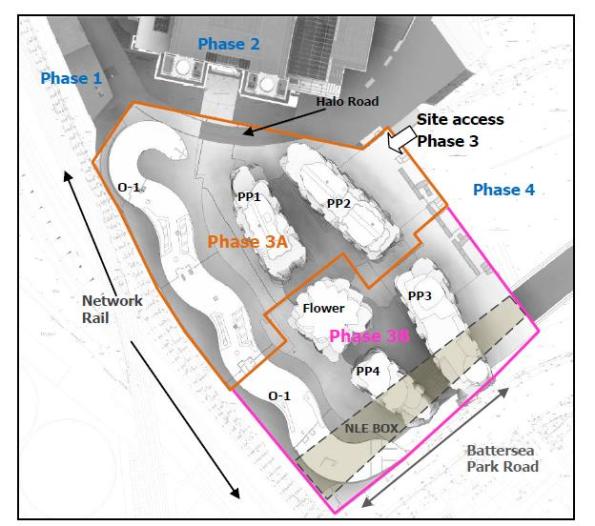
Interfaces
Phase 3 is surrounded and hemmed in by other stakeholders as shown below. The actual project is split into two phases due to the NLE station box in the southern half of the site. This creates some interesting engineering solutions to the problems across the interface. On the western building there will be a construction joint in the middle of the building (O-1) and across the southern boundary there will be the requirement for temporary ground anchors as the basement levels are excavated. There are further interface difficulties with Phase 1 and Phase 2 to the north as a result of their builds being at different stages and Network Rail to our east.
Temporary Works
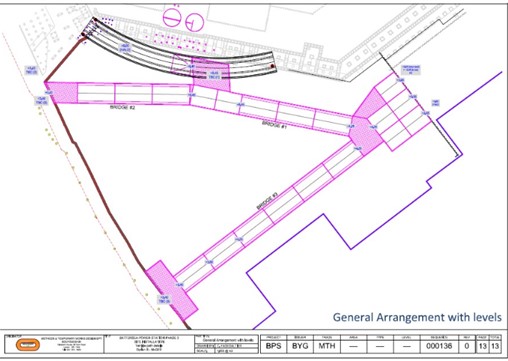
Access (for site deliveries and future residents) must be maintained to Phase 1 and Phase 2 for the entirety of the construction of phase 3 – In effect a highway (same road width as Ex Rhubarb Creek) through our site as we build … The temporary works solution is 3 large temporary bridges with accompanying platforms built approximately at existing ground level which will allow excavation and construction of the basement levels below.
Commercial
Finally and fortuitously for me as my commercial experience is limited the contractual aspects of this job are a bit of a muddle at the moment. Bouygues UK do not have a contract, Bouygues UK do not even have a letter of intent. Our sub-contractors (who were not chosen by us but procured directly by the client) do not have contracts, they do not even have letters of intent… And yet we are all beavering away. Set these contractual woes in the context of the London property bubble and a funding mechanism that relies upon pre-sales and I think I have the beginning of a TMR.
 Holdfast Training Services Trial Blog
Rich,
Sounds like there could be trouble ahead in terms of all those contractors/Subbies working away with no contracts.
What are your responsibilities with the bridge itself, has this been sub-contracted out too or are Bouygues taking it on as enabling works?
Good luck and hope you have your PPE on when the muck hits the fan!
Chris
Chris
You have hit the nail on the head re problems ahead. Presently, Bouiygues UK is the preferred bidder and is in the second stage of a bid process. We are conducting an open book procurement process in order to agree a fixed lump sum for the whole contract – Valued at £1Bn allegedly. All of which will take place prior to the main contract being awarded. We did have a Letter of Limited Authority (LOLA) a type of letter of intent but this ran out.
We are meant to be in a pre-construction services agreement (PCSA) period which allows us to manage the clients contractors until signature of the main contract when they are novated across to Bouygues UK and become our subbies..
The client directly procured the ground works and foundations in order to get the project moving with McGee (groundworks) and BBGE (piling) as the contractors… Our problem is that it is not entirely clear what the clients initial direction/scope of works was etc etc.
Anyway – I’m in danger of writing my next post so I’ll leave this as a cliff hanger!.
Hi Rich,
I can’t believe the client has allowed themselves to get in this position contractually. I believe there were major issues with phase 2 due to a similar situation. The client valued the work at £600m where as Skanska were putting it closer to £1Bn with an attitude of we’ve got more than enough work on books to walk away from this if we need to. Sounds like the same thing could happen again here. From what I understand phase 3 is so big and the client at Battersea has such a bad reputation that there was a very limited pool of main contractors to choose from: Bouygues and Balfour, so effectively a one horse race.
Do you know if the issues regarding the utilities interface between phase 3 and phase 1 on the Western boundary have been resolved? One I left site the HV cable was still clashing with phase 3’s piles.
Have fun.
Blimey, I must have been doing it wrong all the years. No contract… No letters of intent… Yikes! This may end in tears for the client & the PM. Bouygues have the upper hand here as they can either (1) submit a big quantum meriut claim to the client for works already completed and walk if it is not agreed or (2) stay on site with a revised project sum and then rewrite the contract for their own commercial benefit and advantage (for example, no or minimal liquidated damages). The client may soon be looking at the PM consultant’s PII cover to recover their potential losses with a claim for ‘loss of commercial opportunity’. Hopefully the PM has seen this one coming and has made sure that he has client confirmation reqarding the actions already taken to reach this state of affairs. This could run and run..! Regards Greg
Nice one Rich, I’d keep and eye on exactly who is instructing what and on what authority as you work on sorting out your bridges. As CHris observes it’s a case of needing PPE when the brown smelly hits the quickly revolving, not if! I love construction law – more cost than the actual works with nothing tangible to show but you can’t ignore it or afford to get it wrong!
Rich G
Utilities Clash – Barhale is on site along our western boundary moving the whole lot. They have a separate contract direct with the client although this is one of the constraints affecting our available site space.
Greg
Absolutely fascinating stuff from my perspective. There are different PMs for the different phases which adds to the friction. From my perspective the client has not given enough clear direction on his critical path. Skanska and Bouygues have critical path activity at the same interface… Deep joy
Rich
Sounds like an excellent start to the attachment…dash, down, crawl, observe, sights, fire – is the phrase to remember
Kind Regards
Neil