Temporay Tunnel Ventilation Problem
As well as getting my head around the intense amounts of jargon I have been occupying myself with a problem facing the tunnel ventilation team.
Here is the BLUF: Each tunnel (East and Westbound) contains a couple of dirty diesel-powered locomotives and a workforce occupied with drilling holes in the wall. The upshot is that the air quality in the tunnels has the potential to become very poor as the M&E fit-out work progresses, and the permanent ventilation system is a year away from commissioning.
My placement company (ATCjv) are charged with the temporary ventilation to prevent this becoming a big problem. Unfortunately they are also preoccupied with the permanent M&E fit; as a result the temporary works are getting relatively little attention. The permanent ventilation fan system is eventually designed to provide 100m3/s into the tunnels at each station when running at steady state; in the case of a fire or terrorist gas attack it can blow or suck 600 m3/s at full whack. This is enough to create a 9.6 m/s (21 mph) draught down each of the two tunnels.
However, whilst each station is under construction the main ventilation fans are months away from being installed; the ATCjv ventilation team need to provide a flow from Bond Street station to give sufficient air quality for the workforce in the tunnels. The flow diagram of the temporary ventilation installation is shown in figure 1.

Figure 1. Bond Street section temporary ventilation flow diagram
The interim solution at Bond Street station until a large-scale temporary system is commissioned is to fit a 250 kW forced ventilation fan into a tunnel feeding the main running track, an image is shown in figure 2. The flow rate of ventilation air through this fan is measured using an anemometer held in the flow– not a particularly scientific or reliable method. Ideally the temporary solution will give a flow rate that is comparable to the finished station; the current measured flow velocity in the fan jet is around 24 m/s, giving a volumetric rate through the fan (velocity x area) of 8.64 m3/sec. This is way too low to meet the temporary requirement of 35 m3/sec. The solution is to rely on the noxious gas detection equipment with the workforce in the tunnels as a safety net and take the problem ‘on risk’ (i.e. no-one important has noticed yet).
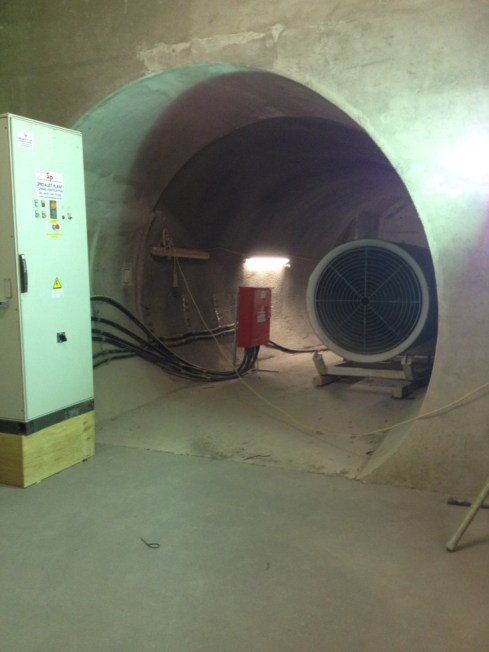
Figure 2. The temporary ventilation fan in its feeder tunnel.
The final ventilation system will be commissioned with a much more rigorous ‘grid’ system of anemometers to measure the flow velocity throughout the tunnel cross-section (see figure 3 below) which will give a much more accurate flow value. However this hasn’t been applied to the temporary system – it is too expensive.

Figure 3. Approved tunnel ventilation measurement methodology. Survey points on tunnel cross-section show anemometer locations.
To keep myself useful I have tried to figure out a more accurate figure for the ventilation flow than given by the current improvised method. The ducted fan acts to fire a jet of high velocity air down the centre of the tunnel drawing further air with it from the surroundings (air entrainment). This has the effect of increasing the airflow down the passage. To add some detail I have tried to improve upon the simple flow model by considering an annular boundary layer around the ‘jet’ of high-speed air, as shown in a dodgy sketch below (figure 4).
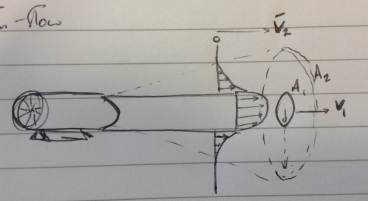
Figure 4. Flow pattern from the ventilation fan, back of fag packet version.
V1 in the image above is the peak flow at 24 m/s, with the air velocity at the edge of the fan ‘jet’ being 8m/s. Using this new approximation a revised estimate of the actual flow taking into account entrained air through the 3-meter wide tunnel is 19.32 m3/s. Still off where it should be, but a little bit closer to the desired 35 m3/s. The construction manager posed with this solution was simultaneously pleased that it was larger than his number and completely unconcerned as to the reasoning behind it.
I hope at least Mark Hill was happy that I actually tried to apply some of the knowledge he threw at us in the second half of last year. Please consult Palmer TMR 1 for a more detailed description of where this figure comes from…. if you can stay awake.
 Holdfast Training Services Trial Blog
Mark, I am also looking into temporary ventilation in a 4.5m tunnel and sat down with the ventilation sub-contractor, Schauenburg (who are also working at Paddington), last week. Where did the airflow requirement in the event of a fire come from? BS6164 doesn’t seem to specify minimum airflow rates in the event of a fire.
Also what is the airflow requirement based on?
In comparison, the tunnel I am working is only 132m long with one piece of diesel plant inside (working kW of 4.8kW) and a maximum of 10 workers working 10 hour shifts. According to a sub-contractors calcs, this alone requires 4.8m3/s forced ventilation.
The ventilation rate for fire conditions will tumble back to the only thing that really matters – ASET>RSET ie in the event of a fire people have to be able to get to a place of safety, whether that be relative or ultimate.
Smoke management is the way to achieve this through forced or induced draught (for an alternative version see Palmer (2016) where he terms this “blow” and “suck” but avoids sanction by discussing fluid flow in the same document).
Very happy and looking forward to TMR1! Remember discussing about the presence of dragons ? Well you are just about at the event horizon of dragon central when you start talking about boundary layers !!
Mark,
Accepting that civil engineers tend to stay in the open channel fluid flow arena and leave much of the detailed pipe stuff to E&M, I would have thought that it would be better to measure an average flow velocity after a suitable mixing distance rather than the peak forced flow velocity of the fan. I would simply look to St. Venant and go two tunnel diameters down stream (near enough and good enough) but guess you’d look to Prandtl for mixing lengths. I haven’t given much thought to whether you then measure peak velocity at the centre and assume a distribution or take a couple of third point measures but it should provide better measure of average velocity and therefore flow in the tunnel.
I would also have thought that the proposed validation proposal for commissioning would give some very interesting readings for comparison to theoretical modified Navier-Stokes output – a rich seam for thesis?
Agreed Rich, the general commissioning plan does just this (measuring the flow after a decent mixing length). The issue is trying to come up with a more reliable estimate of the interim fan solution without blocking the running tunnel (it is currently a permit nightmare for ATCjv to access a running train tunnel).
The feeder tunnel shown in the photo above is only ~10m long before meeting the main running tunnel; the junction point is also a long way away from smooth flow which is further impeding the effectiveness of the ventilation. All making it difficult to get to a downstream point where the flow has reached steady-state. As a result I have taken the point measures quoted in the text about about 3m downstream of the fan prior to the turbulent junction.
Do not fear – the results from my dodgy calcs are not being used for any H&S assurance or in place of any genuine commissioning.
Mark,
Thanks for that. I think the ‘dodgy’ calculations are exactly what engineers need to do more often. It is a habit hard to acquire, useful on so many fronts and yet so easily lost. I also think they are no more dodgy than some of the dressed up rubbish I see passed off as computer based design!
Mark
Can’t you get some interesting electrical work?
I think the fan itself runs on ‘electricity’. It sounded complicated so I stayed well away.
Mark,
Following on from Gary’s comment what is your fire strategy / legal obligation in the tunnels? Is there much of a fire risk down there or is it mainly non-combustible items? If you get a fire in Bond street are you not going to draw the smoke down to Tottenham court road? Or are you connected to a temporary fire alarm system linked to the temporary fans?
Whilst on my phase 2 attachment I witnessed Carillion turn a blind eye to fire safety. Being above ground in the main and open to the air we didn’t have a huge issue with smoke control and I didn’t get involved in this area. However, once above ten floors we were supposed to provide breaching points across the site for appliances to hook up to and dry risers for the fire brigade to be able to fight any potential fire at high level. When we got above ten floors the site was only being supplied by a 35mm pipe; not enough to fight a fire with. Rather than stop the works Carillion decided to delay inviting the fire brigade on site (if they had turned up they’d have shut the place down) and carry on at risk based on the fact that fit-out hadn’t started and there weren’t many combustibles on site. They eventually got their act together and installed a fairly substantial temporary fire fighting system, but from my point of view it seemed like programme took priority.
Rich,
Apologies for the slow response. It sounds like exactly the same situation – the ventilation requirement has lagged behind the pace of the programme in the tunnels. In the defence of the PC, however, there is little in the way of combustible material beyond the vehicles themselves. Admittedly you can have quite a big fire if a road/rail vehicle goes up.
As to the fire-specific question the specified flow rate includes some provision for smoke ventilation: there is no separate figure in the case of the fire. The final station design will include centralised management systems (fibre optic network) to allow the airflow to be changed to minimise the spread of smoke and exhaust it at the closest possible station.
However, the temp design has an emergency stop button next to the feeder pillar at the ground -5 level. Secondary means of stopping the fan are by cutting the power at the surface for the whole site. Not ideal.
Mark
Mark,
With regards to H&S, is this working environment classed as a Confined Space at the moment. I am unaware of how tunnels are treated before the full compliment of systems are installed/commissioned.
I assume the gas detectors you mentioned are accompanied by Respiratory Protective Equipment Escape Sets?
I am interested because we have an array of different tunnels with no Rescue Plans – these are classed as Confined Spaces and therefore require something along these lines.
Chris
Same as above Chris, I am still getting to grips with how to actually work the blog site. How did you get a photo up? Do you look that happy on site?
As to your comment – I had asked the confined space question myself. The answer is: no, the tunnels are not confirmed spaces, mainly because they have two exits. They are just 22km apart.
The only confined spaces on the sites are part of the under-platform extraction ducts, as some of these are dead-ends. Interestingly respiratory equipment is only carried regularly by those undertaking excavation or concreting work in the tunnels, I think the situation was different when the tunnels boring was actually taking place. The gas detectors are linked with the fire alarm system so any detection causes an evacuation of the whole site.
Mark
Figured out the photo bit now.
Hi Mark,
As your attachment company are charged with installing and managing the temporary ventilation system and the permeates E&M systems, do you think it would have been better to have contracted these out as two separate works packages?
This would surly aid mitigation against any possible lack of attention to either of the two elements.
Is this something that may be worthy of a lessons learnt mention to the managing contractor?
Fran
Yes; this is not lost on them. The actual situation is far worse; the single C610 contract is all elements of the tunnel fit-out, including electrical installation (small power not train HV), fire mains, temp and permanent vent, track laying, overhead lines….. the list goes on.
A lot of risk to place in the lap of a single joint venture. Something that Crossrail (i.e. the taxpayer) are starting to discover.
Mark