Home
> Uncategorized > How stuff works: post tensioning.
How stuff works: post tensioning.
As I was walking around site in the beautiful sunshine of Sydney’s first day of “winter” I found myself staring at the PT cables in a new slab and wondering how it actually works. Whilst I fully understand the theory of post tensioning, I was unsure why the cables were is conduit – so my question is: if the the cables are not in contact with the concrete, how do they transfer the tension into the slab?
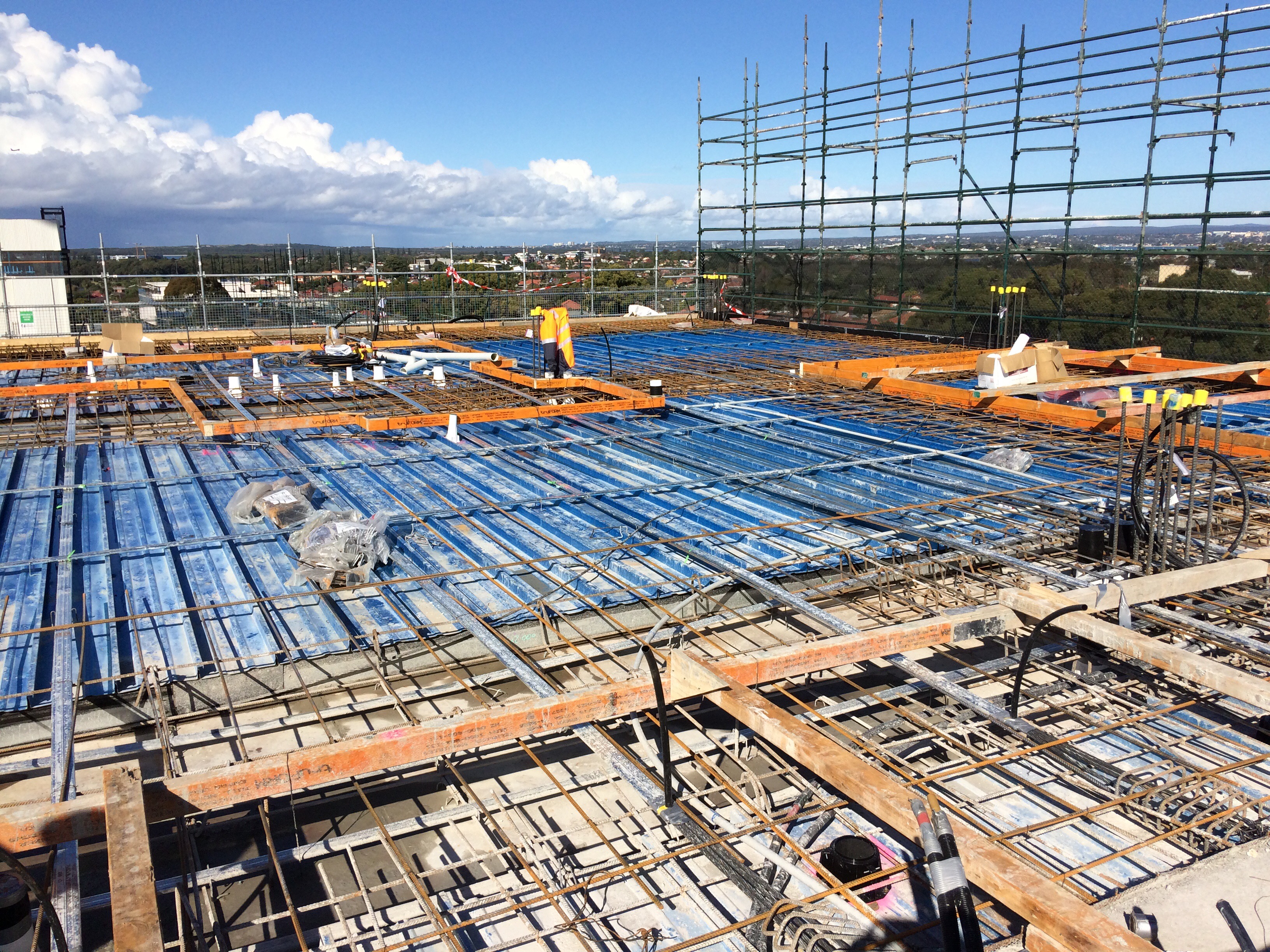
PT cables in conduits
Answers on a post card please.
Categories: Uncategorized
 Holdfast Training Services Trial Blog
The force is transferred from anchor blocks at either end. Compare it to picking up a long set of books by applying pressure to the end ones. There are fewer losses by post tensioning the cables rather than pre tensioning the cables so it is more efficient. To post tension cables they must be free to run in the conduits rather than cast into the concrete as the cables elongate when a tensile stressing force is applied.
Just explained it to my non-engineer colleague opposite who posed the question of how do you squeeze the books when you are elongating the steel, which I thought was a good question. The only thing I can liken it to is an elastic band – you pull the steel into tension, lock it off at the anchor blocks and it applies the ‘squeeze’ to the concrete by trying to snap back into its original non-stressed state. Best i can do.
I think Jo’s explanation is pretty good there.
It’s also worth noting that the cables will be in contact with concrete to ensure their longevity against corrosion and the like as grout will be pumped into the ducts through those short black tubes you can see sticking up on your photo which will be proud of the surface of the slab once poured.
This technique was a more recent addition to the process than it’s original conception. This was not done on very early PT structures and is a major contributing factor to the recent local failure and subsequent closure of the Hammersmith bypass.
That’s about it. Neatly done, thanks Jo.
One thing to pick up is that the cables are put into tension after the concrete has cured and they transfer force into the concrete actually putting it into compression not tension. The idea being that as the slab deflects the tension that would develop in the bottom (or top if continuous over a support) actually results in a reduced compression. This is very useful because it means the loaded slab has less stress in the ‘tension’ face than the unloaded slab and, because there is no tension, there is no cracking.
Just to illuminate the photo a little: The steel spirals you can see in the bottom right corner are anchor block reinforcement – there are high stress concentrations in the anchor blocks until St. Venant’s principle allows it to be evenly distributed throughout the slab. The short black plastic pipes sticking up in the air are grouting tubes so that the cable can be grouted after tensioning. The apparently graceful drape of the conduit is actually a deliberate and fixed profile designed so that the offset of the tendon from the centroidal axis of the slab generates a lever arm that matches the anticipated magnitude of forces in the slab under load.
Not sure how the above would play out in the office Jo but I hope an E&M can manage it…
Tension elastic band steel to squish concrete books, then grout. Simples. Within construction at what point do you actually tension the cables? When the concrete hits the 28 day strength?
On my site we were doing it after 4 days
Mine was 28 day strength but it was a much larger PT system. 155mm ducts with 26 tendons in each jacked to 590tn at each end. Saying that, we normally achieved 28 day strength in around 14 days.
The tendons are tensioned once the concrete achieved a predetermined strength. Once the tendons are stressed and locked in place (using the conical wedges Richard had floating around his desk) then the grout will be pumped in. If your ducts are longer than 15m then it is necessary to have bleed valves along the length of the duct. this ensure that air can escape from the duct and prevents air pockets remain. these are also vital if your ducts are pitched or vary in their vertical profile.
The Hammersmith bypass and is good example of early ungrouted PT tendon failure. The voids left the tendons exposed to chloride attack.