Pile 61 Cage Failure
A recent issue with our piling sub contractor (Skanska) has been taking up the majority of my time this week. On Friday last week whilst lifting in the top part (3 of 3) of a pile cage (Pile 61) a weld on the lifting band failed, causing three other welds to fail and the lifting band to deform. The Skanska project manager informed us that he had to stop the pile from being concreted. The lifting band is on part of the sacrificial cage that will later be removed but it there to lift and hold the cage at the right height. All good there. A good decision made on a safety and quality issue.
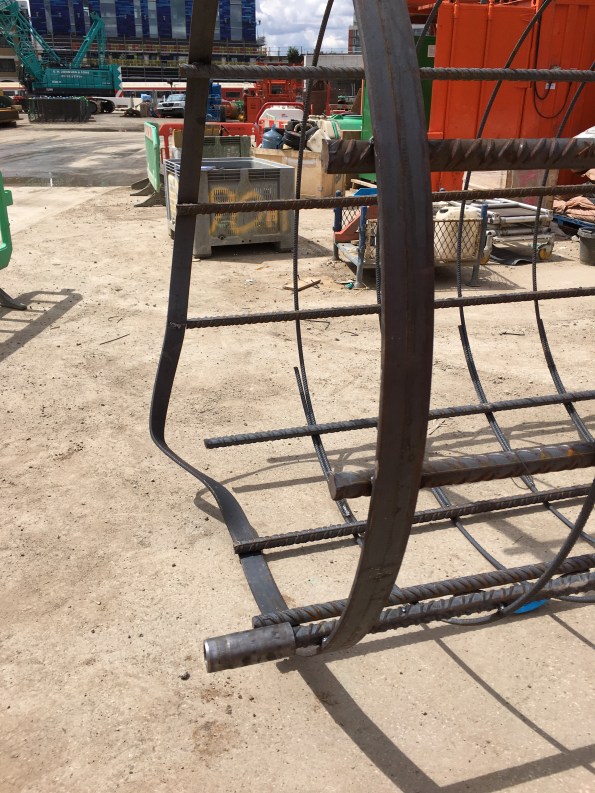
Pile 61 Sacrificial Cage Deformation
Pile 61: Diameter – 2.1m, Depth- 61m, with a plunge column.
Well, that is what we were initially told on Friday. As the investigatory wheels started turning it soon developed that not only had the lifting band deformed but that in ‘trying to make best of a bad situation’ they had taken the decision to cut off the top 2m of the sacrificial cage and tried to lift the cage from the bracing band 2m lower. This however also failed and deformed.
The decision to cut the top section and try again was not in the method statement and therefore not planned works (not authorised). The lifting and bracing bands are the same but the lifting bands have two welds where as the bracing bands only have one.
On investigation of the failed weld it is evident that there is only one weld (one side) instead of two sides, but more importantly that there seems to be no connection to the actual longitudinal bar. Very poor quality! Apparently the welder misread the drawing.

Weld seems not to have have had contact with band and not full width.
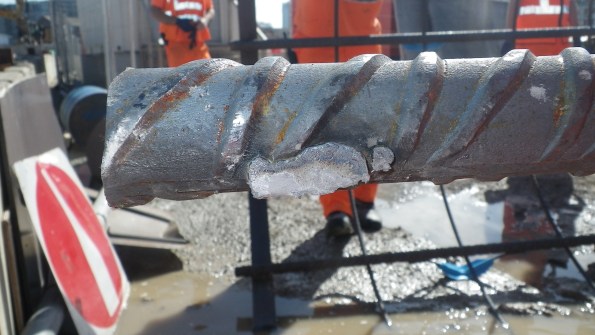
One of the failed welds, It should be 60mm (bar is 40mm diameter)
The proverbial grave got deeper as we found out that as of last week, although the cages are being produced still by the same fabricator (Express) the fabrication yard has moved from Neath (S Wales) to Newcastle. Neath went through a pretty serious quality assurance audit by both FLO and London Underground at the start of the contract. At no point was this communicated to us (the main contractor). Skanska have an engineer permanently based in Neath to quality check manufacture however do not have the same in Newcastle. Which has raised the question, how can Skanska provide quality assurance to us?
The result of all this is that we have issued an instruction to stop works until this has been resolved. This is at their (Skanska’s) cost which is evidently starting to hurt them (prelims alone are just over £10,000 a day). This morning I issued a communication (on behalf of the Project Manager) to the effect that following the site investigation diaphragm walling operations can continue however piling will be stopped until they (Skanska or Express) can provide the welding procedure, a witness statement from the welder, a CAT II check certificate for the temp wks re-bar cage remediation, revised H+S documentation and a joint inspection of the cages we have on site.
Regardless they will need to issue a Non Conformance Report as we have a 24 hour limitation for an open pile (i.e only supported with polymer fluid). But the pressure is currently on Skanska to prove the above. Funnily enough they aren’t too many smiles on their side of the office today.

 Holdfast Training Services Trial Blog
Jonny,
I assume there were no injuries – did this count as a near miss and get reported? We had an issue with slings, and lifting bands – the two different materials not best used together.
Clearly this is CPR gold and I would recommend your communication and associated emails/documents get saved for a PRR appendix.
Out of interest why do you have a sacrificial part of the cage? Why not plunge it as I assume this might mean you are having to get operatives to cut the steel down at a later date?
Why can a bore only be open (and filled with polymer) for 24hrs assuming the polymer pressure is maintained?
Damo,
What was the issue with the slings, sharp edges of the bands I assume? Did you come up with an alternate method, chains or suchlike?
Hi Sam,
The pile cages were fabricated with spacers (to maintain cover on the outside of the cage) which were located near the lifting band. So unless the sling was carefully positioned there was risk of ripping it on the protruding spacer (difficult to visualise, but basically a metal spike was poking out and easy to get a sling caught on it). With the weight of the cage pulling the sling over this spike, it meant some of the sling got damaged. The solution was to weld the spacers away from the lifting bands – the slings were still used. However, for loose rebar shackled chains were used which were safe but took forever to sling each bundle.
Pinching my questions Damo 🙂 I was going to query what the reasoning for the 24 hrs for borehole and what you intend to do if the 24hrs is passed? Obviously the less time it is open for the better but so long as the polymer is maintained at the same head I don’t see the issue – the main consideration though would be settlement at the bottom The longer its open, the more time sediment has to settle and the more you will need to air lift out prior to concreting. We had boreholes open 3-4 days sometimes – not ideal but when the unions and the weather come into play sometimes there is no option.
Jonny I’m also interested re the sacrificial cage question – we have sacrificial cages but these hold the sonic test tubes in place. Looking at your photos I do not see any QA test apparatus?
No one was injured as all cages are ‘test lifted’ first. In reality a very loose term for an initial lift before being lifted and attached to the remainder of the pile cage. So no near miss and not a RIDDOR event.
The sacrificial part of the cage is to hold the reinforcement at the right level. The pile depth is 60m but the pile cut off level is about 22m below ground level. Therefore the sacrificial cage extends above the starter bars so that the lifting chains so not get encased in concrete and can be released. The sacrificial part is only a few meters long. I have drawn a sketch and added it to the end of the blog.
The issue of the open bore is not a critical one but is still in breach of our specification. The specification refers to ICE Specification for piling and embedded retaining walls (SPERW) -https://www.thomastelford.com/books/SampleChapters/ICE%20Specification%20for%20piling%20and%20embedded%20retaining%20walls%202nd%20ed.pdf which says that
“The pile shall be bored and the concrete shall be placed without such delay as would lead to impairment of the performance of the pile, or affect its compliance with the design assumptions.”
In our case we have been given a 24 hour limit. I believe that this is because prolonged periods increase the erosion and risk of collapse in the sand layers (Upnor Formation and Thanet Sands) which can affect the skin friction. Jo, linked to what you mentioned, which I didn’t cover. Additionally we need to remove the bottom 1m of the pile to ‘clean out’ any settlement and concrete it within 12 hours. Though this just means 1m more of concrete.
What happens if the period is passed? In reality very little. It is recorded and forwarded onto the designers to check. We have exceeded the limit before (pile was excavated but truck with reinforcement delivery broke down). Nothing happened. So I believe the whole 24 hour rule is there to reduce the time it is open. How long is too long seems to be very subjective.
Jonny, the importance of air lifting the sediment was pretty critical on A108 as the design of the piles at ULS relied heavily on the base resistance. I think our specification was 1% fines in the polymer at the base to ensure the base resistance wasn’t compromised. Have you got something similar in your specs?
ALSO, IF YOU AIRLIFT WITHIN 12 HRS BUT HAVE UP TO 24 HRS TO POUR, IS THE SEDIMENT CONTENT RETESTED PRIOR TO POURING? WITH SAND LAYERS YOU WOULD ANTICIPATE A PROPORTION OF SEDIMENT IN THE POLYMER.
Jo, it sounds the same. What I haven’t done is go through the whole spec. Some of the big 2.4m dia piles take 3 shifts (days) to excavate so 24 hrs is unrealistic.
24 hours is the limitation between excavating through the sand layers (Thanet and Upnor) for reasons covered above. The sand layers are deeper so this is achievable.
Additionally there is the 12hr limit on the toe, so the last 1m is the last thing to be removed.
Samples are taken from the base of the pile before the start of concreting, 1% suspended fines is the limit. (very easy to get this in polymer in comparison to bentonite).
I believe our piles are mostly friction rather than bearing from conversation with the design team but I dont know what balance there is.
Procedure we therefore have established onsite is;
– Insert casing,
– Excavate to bottom of London Clay,
– Check everything is in place – Hold point (i.e is reinforcement is on site etc).
– Continue excavating to 1m above toe level
– Desand over night
– Remove last 1m of pile
– Take polymer sample from base (1% limit)
– Install reinforcement
– Install tremmie
– Concrete Pile
– Insert plunge column
Jonny
An excellent blog…little things tend to gather momentum vey quickly!