Ground investigation by method?
On the Paradise Circus site there are a number of different types of foundations:
- Rotary bored piles (900mm and 1200mm)
- Single pile caps
- Grouped pile caps
- Cantilevered pile caps with tension piles
- Ground beams
- Pad foundations
- Ground bearing slabs
- Suspended slabs
The last two are pushing it, but I thought I would throw them in as they are definitely in the future of this project.
I have been asked to investigate a request by the designer that the location of the Pad foundations be subject to a Plate Bearing test (Carillion are obsessed with these and so seems the industry as a whole – has anyone else experienced this?). The plate bearing test has been specified as a must have to us and due to my protests at this, I was given the task of liaising with the designer.
The need for this test is to qualify the assumptions made during design – happy with that. The test must be completed at the formation level of the pad foundation – not happy with that.
Although the pad foundations are nominally 1.2m deep, the formation level is the Sandstone strata that at it’s highest point is about 3.5m BGL. In order to conduct a plate bearing test there needs to be a technician with the equipment and a machine large enough to create the pressure needed on the plate.
Edit: The distance between the bottom of the pad foundation and the rock strata is made up with mass concrete fill (bonkers?)
I conducted a similar test on a 450mm dia plate at 550kPa and needed a 22T machine to Jack-off – this test has been specified to 1500kPa. Here is a photo of the former.
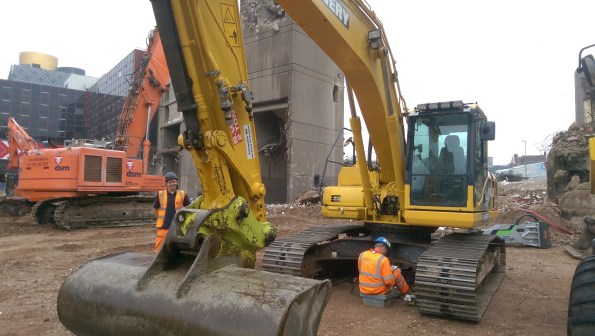
Take in to account the excavation to 3.5m depth and a safe batter of 1:1.5 (Carillion standard for large excavations) and the requirement to do about 10 of these over the site – we’re looking at basically doing a reduced level dig to the sandstone across the site.
Now I have asked the question “What do you want to know, Mr Designer?” As I said previously, the aim is to qualify the assumptions made during design – these are regarding settlement. The designer has come back at me with “Stiffness”.
I now need a method of finding the stiffness of the sandstone between 3.5 – 10m depth across the site – without excavating enough material to fill Wembley stadium. I have made some suggestions but will keep these to myself for now – what would you have said or come up with?
 Holdfast Training Services Trial Blog
Nice problem!
I’ve not but…… very occasionally ( usually for large piling jobs ) down hole plate bearing tests have been undertaken
You will recall the idea that you can determine the stiffness of the ground is piss-yer-pants risable…. UNLESS you were to do a set of plate bearing tests carefully designed to affect the right depth of material at or above the stress levels that the foundations will ultimately apply….and across the entire site
So what would you normally do?
a) Determine the approximate stiffness of the rock based upon uniaxial strength ( there’s a graph in BS EN ISO 14689-1
b) Use the RQD or some other rock classification to see if discontinuities in the rock mass would give any reason for this stiffness to be brought into doubt
c) Try to assess the greatest risk when on rock head- and that is that of the head being variably weathered ( again inspection of the BH records)
d) Try to assess whether the service actions are likely to tax a rock surface ( you have to be going into the realms of 600+ kPa to even start to worry
d) If you have evidence that there is no great variability BUT the service stresses are tasty you could organize a down hole bc using a little ingenuity ( a plate welded to a columns jacking off with kentledge or a reaction beam if you’ve some piles you can use.
e) If you have evidence of variable rock head- then you’ve an altogether different problem – what formation level?
e) Remember the problem is usually not absolute deformation but relative
Chris, John,
Interesting issues. Although very crude, could something like a dynamic cone penetration test be used (I.e. do some basic hitting with a stick). Fairly manoeuvrable kit which could cover the site but maybe correlations are too poor to be reliable? Or is it the lack of a properly controlled force (and small area) to measure displacement?
Damo,
I suggested SPT and tri-axial. Ramboll suggested a Flat (high pressure) dilatometer test which involves inflating a balloon in a hole and measuring the deformation (stress/strain relationship).
I think correlations of SPT in sandstone/sand is pretty good, although I’m sure John will rip me apart on this one. I think the process will be to get Ramboll to design conservatively (which I think they already have) and use information from existing BH and hitting the ground with a stick.
John,
I believe the idea was what you originally say, the PBT will affect the depth at which the foundations will act across the site (on a 20m grid). The issue being this depth is crazy deep and to get the size of plant in the hole to conduct the test is mental.
The BH on site are pretty minimal – this is due to the tunnel impact on not being able to conduct any investigation works currently. This is an effect of the poor planning that has taken place and the emphasis being put on designing and constructing rather than investigation.
The rock head is described as highly or extremely weathered Bromsgrove Sandstone, it turns to sand as soon as the boring rig touches it. Although a seam has been exposed on the site that seems to be a little more competent.
The formation does vary across site, particularly near the underground structures where it has previously been excavated at unknown batters.
Chris,
You don’t need to get the plant down the hole. You put a cased borehole down to the rock, remove the rig, insert a column section of suitable length with a plate welded onto the end of it and then bring plant/kentledge/a jacking beam back over the top and test (taking account of the length and young’s mod of the column! but the question is, why do you need to? Are your service loads similar or very different? How close to capacity are the footings likely to be? Has someone just asked for something because they can? Who would pay for this? Is there an opportunity to carry out excavation for tests as a cost outside the contract but which will then reduce the work needed to deliver the foundations?