Technological innovation in construction
I’ve been involved on the periphery of a few discussions with innovation in construction recently so I thought i’d type out my musings in case I want to use it in the future. Plus i’ve just ordered on Deliveroo so i’ve got some spare time tonight. Unlike the beautiful “E&M cut and pastes” from a TMR it’s not neatly formatted, more like the words have just fallen out of my head (akin to JMs feedback).
Firstly I attended a talk at the ICE on technology as a management tool, delivered by Highways England (should be available as a recorded lecture soon at http://www.ice.org.uk/recordedlectures , along with other videos for filling a boring winter commute). They’ve seen tangible improvements in management or delivery from technology in the following areas:
- Remotely Operated Temporary Traffic Management System (ROTTMS)
- Stationary vehicle detection software to prevent, detect and monitor incidents.
- Integration of design, operational, construction and environmental risks onto BIM 3D modelling.
- BIM 3D and “4D (cab view)” safety briefing and supply chain planning.
- Real-time view of national traffic conditions via the National Traffic Info System (NTIS).
- A digital component library – “design once, use repeatedly” (although you need to be careful that the use of standardised designs doesn’t stifle innovation).
- Drone surveys – reduction in risk to manpower on highways
- Data acquisition and analytics during construction to develop a “Haynes manual for construction”.
- Live task monitoring and reporting of progress, resource levels, reserves etc.
However, despite the successes above they admitted that introducing innovative technology is not straightforward. I’ve read that BIM will mean we don’t need to rely on physical surveys anymore. Great news, but as they said in the presentation, surely we shouldn’t have had to do that since CAD was first used if it was properly employed. Therein lies the problem, before introducing a new technology you first need to make sure the people and processes are ready for it. Definitely a lesson in there for the military (MAKEFAST?, MOSS?, JPA?, ORIENT?)
Look at the people (why are they not already doing it and are they ready for it?) look at the business model and processes (what is the need and what are the limitations?)
Barriers to adoption of technology can include confusion (certainly in my case), training burden, hardware and software costs, data storage costs, security of data, reliance on specialist personnel for operational continuity and what if it all goes wrong?
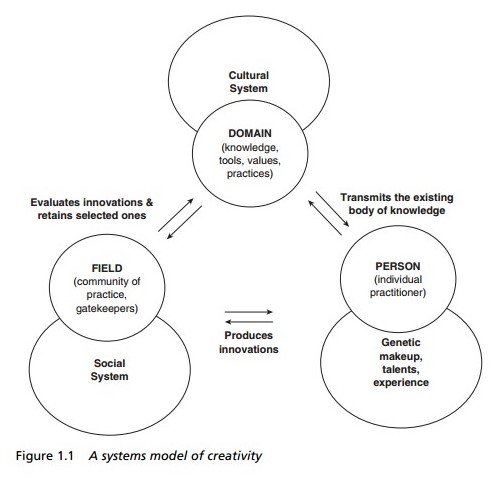
I attended a workshop on innovation as a test for some training the Think Up are delivering (https://thinkup.org/) and this presented a similar idea to that which I think was first coined in a systems perspective of creativity by some author with a crazy name full of consonants (http://www.sagepub.com/sites/default/files/upm-binaries/11443_01_Henry_Ch01.pdf).
He presents it diagrammatically as:
I prefer my own notes from the workshop:
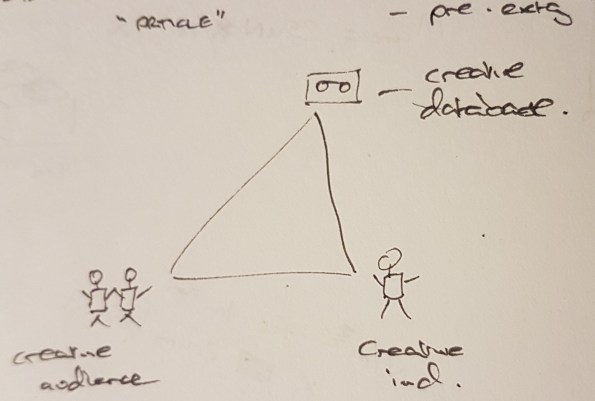
The workshop concluded with a discussion on how Expedition can encourage innovation internally. There were many suggestions including having a “dunce in residence” to ask seemingly stupid questions that then spark innovation (a role I am happy to fulfill), more talks from suppliers, innovation reviews at key design stages. They were enthralled by my suggestion of “tea & toast” as a useful discussion forum when I said the military do it. They thought it showed the military as a creative and forward leaning organisation allowing daily sessions for open discussion of ideas without an agenda. I did point out that it was just an opportunity to eat toast and occasionally drink port but I think it may make an appearance in the office soon.
As a look forward – the next installment will feature how we can use innovative materials. There may or may not be a quiz afterwards with Champagne (Asti) up for grabs.
 Holdfast Training Services Trial Blog
Tony, very useful discussion around topics pertinent to Attribute 1 – I see what you are doing. However, keep it coming as we can all learn too 🙂
Tony,
Thanks for the thought dump. I suspect that your colleagues with small children will tell you that Expedition need a three year old in residence not a dunce, I am assured that three year olds are a group for whom everything is ‘why?’.
The questioning of why things are not done already, whilst sound, runs up against the ‘do it the way you know it works’ argument for minimising failure risk in construction. The clients appetite for risk will usually run counter to innovation where quality is unknown, and time and cost are almost certainly playing against innovation in the short term. Part of the challenge is that repeat clients, who might benefit from the learning of previous applications of innovative technologies are rare and the long term through life advantages of systems such a BIM are slow to manifest, hard to measure and difficult to sell at the outset against cash flow.
One of the greatest challenges I perceive is the difficulty of articulating a strong and clear business case for something that is a prototype. There may well be unknown benefits (Upside risk) that cannot be seen or sold that might offset the known downside risks that must be accounted for and considered. Set the unclear advantages alongside the ‘confusion’ barrier you identify, which generally revolves around how ‘new’ fits into existing systems and procedures, what it does, when, and how the product is employed, and you have a challenge of governance (or doctrine if you wish to use the military palace). BIM definitely suffers from this.
Ironically it was established in the early nineties that 40% of design costs went on trying to source information and communicate it. It is suggested that BIM has resulted in 18-20% cost savings on projects as a result. I cannot verify these figures or confirm who it is that sees the net saving. CPNI see a new profession arising from BIM in information management (and have written draft job specifications), not least because of their security concerns. The challenge that they are addressing is not the technology but the procedures and controls, governance!
The annual reviewers conference at the ICE this year asked as one of the discussion questions “How do we assess creative and innovative development of engineering technology and continuous improvement systems at review?”, which is not as challenging as it seems. One of the obvious responses is to adopt the civil service interview methodology – ask. “What have you done to facilitate….” What your answer should be or could be was more interesting. One thought is that stating “I applied BIM methodologies” would be unacceptable because all that says is “I followed company policy” and it would need much more to demonstrate a personal influence in developing the technology or applying it in a unique or innovative way. Conversely the use of “whats app” to discuss challenges on site with a panel of peers in real time allowing collective experience to be brought to bear where some of the group may have access to data or material not available to the individual on the spot (akin to the third umpire?) would be a good response. Although the technology is not particularly new, nor is the information shared, the act of using it to facilitate the pooling of knowledge to contribute to the construction process in real time is innovative (although fast becoming a norm?). It is something that PET students do on phase 2 much more effectively than PQEs or practicing engineers in many insular organisations can manage to claim.
Richard,
A ‘child in residence was mentioned’ but I feel with the abundance of laws governing fair treatment of children it’s actually quite difficult to employ them. Idiots are far less protected.
I agree with your comments about a clients appetite for risk setting the limits for innovation (more on this in the next blog). Just as crucial is the QS’s appetite for risk. Decisions made early on how to break up specific work packages can stifle innovation that requires designers to work across briefs, I believe this may be one of the issues behind Doug’s PT versus conventional reinforcement costs spiralling.
Contracts need to incentivise and reward innovation. I think that often they are too safe. Clients and (QS’s – sorry for the QS bashing Greg) also expect a visible capital saving. This won’t always be demonstrable. As you say, BIM suffers from this. For instance who actually thinks that adopting BIM L2 on a project will deliver efficiencies and therefore savings for a structural consultancy straight away? More likely is a significant period of additional time spent getting used to the new system. I would be interested to see where the net saving you quote is realised. The best way to innovation is to snag yourself a nice rich client that’s actually interested in doing something different, and get in there before the QS can do too much damage.
In terms of evidence for CPR, in addition to Whatsapp, I suspect we all have a number of things we can talk about. Along the lines of your prompt I tested an electronic site diary app for progress and risk/opps reporting, tested and implemented an app for reporting safety concerns, and drew up a proposal for a CAT training area (non-feline variety). Just as much evidence could probably be generated from our rejection of powerpad/tablets for interactive drawings as the users just weren’t ready to use it, the IT infrastructure wasn’t adequate to support it, and the benefit would have been minimal at the current construction stage. There is a plan to review this at a later date. As you say these things are rapidly becoming the norm and I expect there is nothing different here to anything other people did on site.
I’d be interested to hear what others saw on site.