They said I was mad to build a castle in a swamp!
Monty python-Holy Grail
In my last blog I mentioned building a basement in a swamp. The tender is on a brown field along a tributary of the Brisbane river known as Breakfast Creek. The site that has recently been cleared (ish). On my recce I began to feel a sinking sensation in the pit of my stomach. The ground here is truly awful but, the client is adamant that he wants his basement.


Design. The structure is a 6 storey Mercedes show room/car museum with a single storey basement. The client’s design calls for a temporary retaining wall and then a concrete bath tub to keep it watertight constructed on the inside temp retaining wall. The structure itself will be supported by pile footings. It was originally tendered as a Traditional construct only package but, due to the risks is now being let as a Design and Build.

Boundary. Argillite bedrock between -7 and -31 m. Level of Bedrock varies across the site from -7 m in West to -31 m in the East.
Properties. Very Soft Alluvial Clay φ’ = 25 ° and c’ = 0 until Hard Argillite Rock.
Groundwater. Tidal range of RL +0 to 2 m (+3.5 m flood level)
Contamination. You guessed it ASS is back. With some potential hydrocarbon contamination.
Issues. The client wants this basement even if it costs him $5 Million.
- It is a swamp! It is possible to cantilever 5 m in this rubbish but the toe stability is the problem. The solution at the moment for sheet and contiguos piles is to have every 3rd pile down to the base rock which can be up to 31 m.
- The pile loads for earthquake loading are massive. Brisbane isn’t in a seismic zone but like all building it needs to be design to withstand a basic seismic. The problem is that because the neighbouring soil isn’t worth a damn the tension loads carried by the pile foundations are over and above what you would expect of a 6 storey building.
- Hydrostatic slab. Given the high ground water level, the basement needs to be designed for a hydrostatic slab. The original design calls for beams to carry this load but, this will be a nighmare for something that cannot achieve a batter of 1:2.
- Heritage structure. An existing heritage bridge abutment (not in use) is on the perimeter of the site and it cannot be damaged, despite the fact that it has failed.
- Existing retaining walls. The client also wants to keep any existing retaining wall structures that have been left in place. Unfortunately, the existing retaining walls from the previous structure show signs of distress. It appears that their is disproportionate settlement in at least one part of the retaining wall. To make matters worse there are no as-builts of the retaining wall structures.
Upside – The hotel where I took this photo does massive steaks and great red wine – so that’s how I spent the afternoon. If all recces were this good
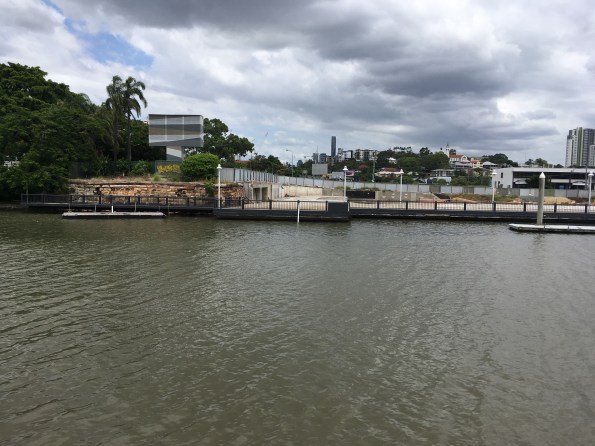
View South from opposite bank (bar). Failed heritage abutment on left. (Note high tide)
 Holdfast Training Services Trial Blog
Doug
Is the basement really the big problem here? Whilst waterproofing will be tricky surely the 6 storey building on pretty poor alluvial clay will require some substantial foundations regardless and may be a bigger problem?
I imagine the whole building will sit on some pretty substantial piles is it not possible that some of these piles be required to resist uplift of the basement slab (ie anchors)?
The reason I ask is that (if I read your drawing correctly) the Ground Water Level is +1.5m and top of slab is -4.5m? Hydrostatic head of 6m? I am looking at a Dry Dock in Glasgow with a hydrostatic head of 15m and we are likely using ground anchors to resist the uplift.
Ok there is a significant tension load on the piles but the basement is very much the problem. The foundations will be down to the argillite so no problems supporting what essentially is a light structure.
Apologies for the crap diagram bottom of the excavation is -2.5m approx. Top of slab is -1.5m. So 35 KPa ish load so there is a significant hydrostatic load. I have been looking a pile loads today. The anchor solution is interesting but may create water proofing issues. Also isn’t it difficult to have long term anchors. One potential subbie is looking to key the piles into the rock to assist.
The hydro load is important because we want to get rid of the ground beams which potentially could have us digging around in slop for weeks.
I am just spit balling ideas so not sure what would work/not work.
Anchors can be made to work in the permanent state.
The reason I mention “anchoring” is that I am presently designing a dry dock floor slab using rock anchors in the permanent state to resist uplift and our hydrostatic head is considerably larger.
I think(?) from your description you are telling me that some of the piles will be in tension anyway.
My understanding is that this is broadly the same as the “anchoring” piles I am describing too? By the terminology “anchoring2 I do not necessarily mean a ground anchor as such I mean a pile/anchor providing resistance to uplift.
Even crap alluvial clay will have some skin friction which could be mobilised?
It’s an interesting idea and could possibly address earthquake loads if I use passive anchors in the cores.
I would imagine the ASS won’t help the longevity of the anchors but I imagine if there is no oxygen it will remain as PASS (possible ASS) – I’m not making it up. There is between $0.5 – 1 million in reducing the earthquake loads. So it could work.