New arrival at Gatwick and a nugget for the Civils
Having received a detailed handover from Stu Douglas, I am now in the chair as an M&E Package Manager and currently involved in a number of interesting projects. The Department for Transport has imposed a directive on all major UK airports which requires Gatwick to install new baggage scanners to ensure they conform to the Explosive Detection System 3 Standard by 1 Sept 2018. The machines are larger in all regards, including size, weight and heat rejection, therefore there are multiple projects running simultaneously in order to install these machines; I will introduce you to these projects over a number of blogs in due course.
The Gatwick Airport estate is vast and is distributed across two terminals, North and South. The South Terminal opened in 1958 and has a footprint of 160,000 m2 and the North terminal opened in 1988 with a footprint of 98,000 m2, with a supporting workforce of 24,000 employees spanning 252 companies. GAL employs 2,800 staff directly which is sufficient to manage a throughput of 43.1m passengers in 2016. GAL is projecting that passenger numbers will increase to 52m by 2032 and the infrastructure must also expand to accommodate such a vast increase.
The airport boasts a colourful past, serving as an aerodrome in the 1930s and later requisitioned for military use for the RAF in 1940. The estate was renovated in 1956 to become a commercial airport paving the way for Gatwick to become the UK’s second largest airport. Figure 1 shows Gatwick in general with the South Terminal at the bottom of the image.
 Figure 1 – Ariel view of Gatwick Airport.
Gatwick is a heavily engineered and congested environment which makes the simplest construction project or electrical/mechanical installation very complex indeed. That said, I have come across a small construction project which may be of interest to the Civils. The principle contractor is MARCO (to be clear, this is not a person but the company name) whose brief was to Design and Build office space and a welfare facility for the Gatwick Handling Agents (GHA) to operate from in the South Terminal.
The project progressed well until the contractor had to excavate a 50m x 1m channel through a concrete base of 600mm to allow for soil pipes to transit waste from the toilets to a new foul drain. Figure 2 is a capture of the design drawing which shows the location of the toilets, pipe runs (brown) to the foul drain and I Beam columns (in the red circles).
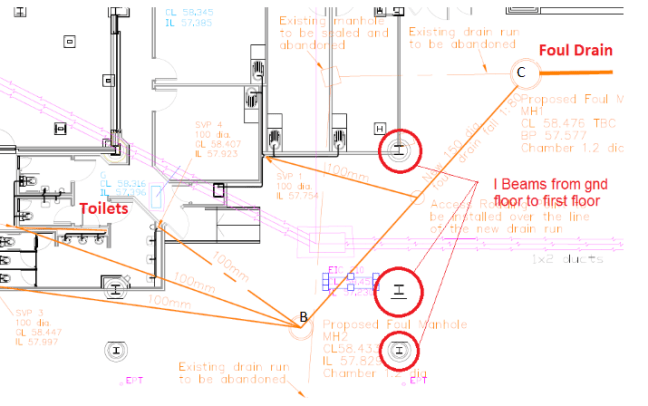
Figure 2 – A capture of the GHA design drawing showing the area of interest.
The foul pipe from B to C has a cross fall of 1:80 and both the grey and black water is gravity fed to the foul drain at C.
Unfortunately the channel is in a confined space with a low ceiling and restricted access, therefore the contractor is unable to use diesel powered excavators and dumpers to remove the rubble. Consequently they employed the use of a portable control BROKK hydraulic breaker and then handball the rubble from site. The BROKK and channel is shown in Figure 3.
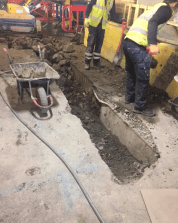
Figure 3 – BROKK and Channel
The BROKK is also shown in Figure 4 below, it requires an 15kW/32A 3 phase supply from a generator which can be remoted away from the confined space. There are larger machines on the market that can be hired, this is at the bottom end of the scale. The machine will produce a noise level well in excess of the HSE standard of 85 dB(A) therefore ear protection is required. The machine also produces a downward pressure on the tip at 25MPa.


Figure 4 – BROKK 100
THE PROBLEM
The vibration energy applied through the tip to the ground is transmitted through the concrete to the vertical I Beam columns circlied in red at Figure 2. The vertical columns connect to horizontal beams supporting the Departures Lounge and a number of retail outlets. The vibrations were having an impact on the outlets above and the Project Manager was summoned to Harrods to explain why their jewellery was dancing around the shop; as a result the excavation was halted with immediate effect. The noise level was measure by the on-site EHS representative at 76dB, to put this in perspective, employers must provide PPE to those exposed to noise above 85dB. Another 9dB increase then the customers in Harrods would be issued with PPE!
THE SOLUTION
At first, the PM suggested that disruptive maintenance is conducted in silent hours which is between 2300hrs and 0400hrs, however if this course of action was adopted, the contractor would fall behind considerably. The contract is an NEC3 Option E (Cost Reimbursable) which translates into delay costs which are imposed onto the client (Gatwick).
The second option was to cut the concrete channel beyond 600mm depth using an orbital cutter down to the compacted earth beneath, doing so detached the channel from the rest of the concrete pad. This simple act prevented the majority of the vibration energy being transmitted through the pad to the vertical columns. The BROKK was re-introduced and the noise assessment was conducted again during silent hours and a notable reduction was observed from 76dB down to between 52-54dB.
Both contractor, client and Harrods are happy once more!
 Holdfast Training Services Trial Blog
Was hydro demolition considered?
Lee,
Gatwick looks like a cracking project, I’m still pro Heathrow expansion though!
Jokes aside, I agree the noise generated by those BROKKs is an absolute pain. We used one on 100BG to break out circa 60m3 of very heavily reinforced temporary foundations in a public road next to a load of commercial offices in central London, not least the Old Leathersellers, a notoriously influential/powerful old school business that allegedly owns half of the private real-estate in the City. The task took four weeks to complete and needless to say they hated the noise! I was in their foyer grovelling / apologising for the disturbance at least twice a week to try prevent them getting us closed down by the City of London for Environmental issues. This can delay a project by months so def worth avoiding.
That said, sometimes these things cant be avoided. It was the quickest method of removal and had to happen. We mitigated risk by limiting the subbie to 30mins continuous breaking, then 15 mins rest. Repeat throughout the day with a pause at lunch. This was regularly communicated to our neighbours.
We also placed a temp scaffold frame around the BROKKE in order to suspend noise suppression blankets to the side and above the BROKKE in order to control this risk. I recommend it as it reduces noise significantly and also demonstrates to your neighbours you are employing all measures available to reduce the impact (Shows you care!).
In this case the subbie really should have thought of and included the control and mitigation of this risk in their RAMS. I’m assuming they conveniently forgot to add thorough noise control systems? Very naughty though I’d suggest not uncommon as continuously moving the matting takes time and slows progress thus costing more money.
Good luck, and I’d definitely ask about that noise suppression matting if it isn’t in place already!
TD
Multiplex have used diamond drilling on 1 Blackfriars to break through reinforced concrete all the time, doesn’t cause the as much noise, dust and vibrations.
Thanks for an interesting blog
Thanks Lee,
I will use this example on future RECSSA/ RECSSM courses as it covers a number of noise/ vibration issues and possible solutions as well as considerations when putting together RAMS.
Any more examples that could be used?