Construction – has it really changed?
Most of my time with RPS Consultancy has been spent analysing existing historic dock structures. I have been working on a design and build project to construct new infrastructure for the Royal Navy’s new frigates in Glasgow. In order to make alterations to the dock structure it is necessary to understand how the existing structure works. As a result, I have spent a great deal of time trawling through old literature sourcing information.
Recently, I found the following photos of the construction of a dry dock in Scotstoun in 1903. It occurred to me that, whilst there is no hi-viz and no fall protection, very little has changed in the world of construction.
Coincidently, my principal take-away from this analysis is that modern design codes are overly conservative. According to Eurocodes these docks should not be standing.
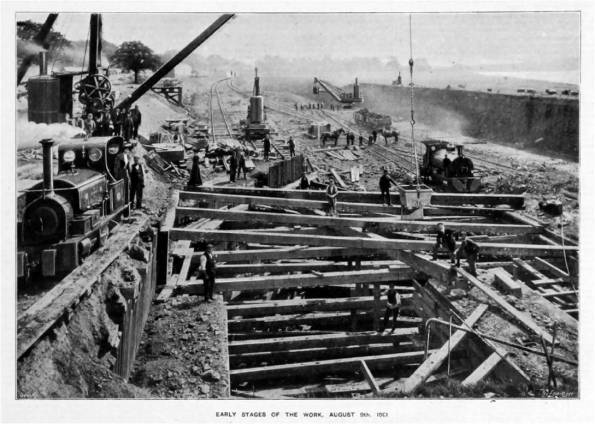
Dry Dock 1 – 1903
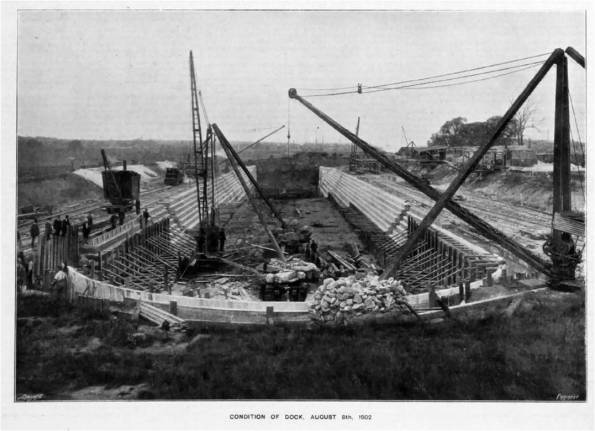 Dry Dock 1 – 1903
 Holdfast Training Services Trial Blog
Conservative codes make the world safe for shoddy engineers like you and I. Be more grateful!
This will be quoted in the latest CROSS report when one of your structures falls down!
So not much has changed then……?
Well that’ll be you standing on a timber prop in the first photo – no hi-viz?…..no helmet, no arrester, nothing other than what looks like a ham sandwich.
The prop arrangement appears to give a new meaning to the ‘highland clearances’ – a forest , stripped of bark and place horizontally, such that the bucket for the excavated spoil ( which the poor bastards at the base of the hole are no doubt filling by the spoonful) can barely be thread through the props.
The locomotive unit on the left is surcharging the half-unpropped wall. I suppose it is a saving grace that the bloke standing there is underneath a prop and just inside the propped area…..
All in all I reckon you could have started a ‘ spot the disaster’ competition and we’d still be going by Christmas
John
My post was deliberately titled to stir some interest. My point is there was no disaster…
However, I am not defending the lack of H&S what I am saying is that photo shows a bottom up excavation using props in a not dissimilar manner to any of the London basements many of us have been working on. Over a hundred years ago.
I think you might accept that engineering evolves through evolution not revolution. The concept of disruptive technology or technique is a distance from the risk averse world of vast sums of investor capital (risk wise?). The Romans did concrete and roads, the Normans did arches and castles, the RE do HESCO…
Similar time, similar method, different outcome…
http://www.southwalesargus.co.uk/news/4469387.Newport_Docks_Disaster_hero_s_example_still_shines_100_years_on/