Down hole testing – Tentative geo based post…!
I’ve been told to oversee the use of a Menard test to validate the formation of some substitution concrete that was poured in almost submerged conditions. I.e water was being chased out of the 30m x 15m x 2m excavation by the concrete. Testing came about as the regulatory body was not best pleased about the whole thing.
Menard tests give a horizontal total stress to allow the eventual shear strength to be calculated. The picture is of the Menard assembly that is placed down the hole and expanded with gas and water in two separate membranes to give a pressure. This is repeated at different depths, normally from deepest to shallowest.
Issues are as follows:
1. They are struggling to keep the hole open to get the required membrane Volume for the test to be valid. About 60cm3.
2. They are trialling the use of a polymer in varying quantities (pure bore I think) But the polymer is too viscous and the pump pressure is getting too high. Possibly due to the trial area being on rock that is better than the siltstone which the real test was specified for.
3. The whole thing is becoming time critical as it is the second go we have had at it.
Could an SPT test give a similar result? Or is it too crude?
The use of Menard was a method specification given by the principal contractor geotechnical engineer. So the risk is ours.
Any thoughts would be appreciated.
 Holdfast Training Services Trial Blog
Dan, is this for a slab? If so what strength do you require to load? I seem to remember a hammer or rebound test or a cone fired in and penetration being measured as way of none destructive testing. But it’s only 120 odd cube, if it’s low strength it will cost less than 8k, might be cheaper and quicker to break it out and re pour than slip programme and pay to test it. Did you take cubes?
Brad, thanks for that.
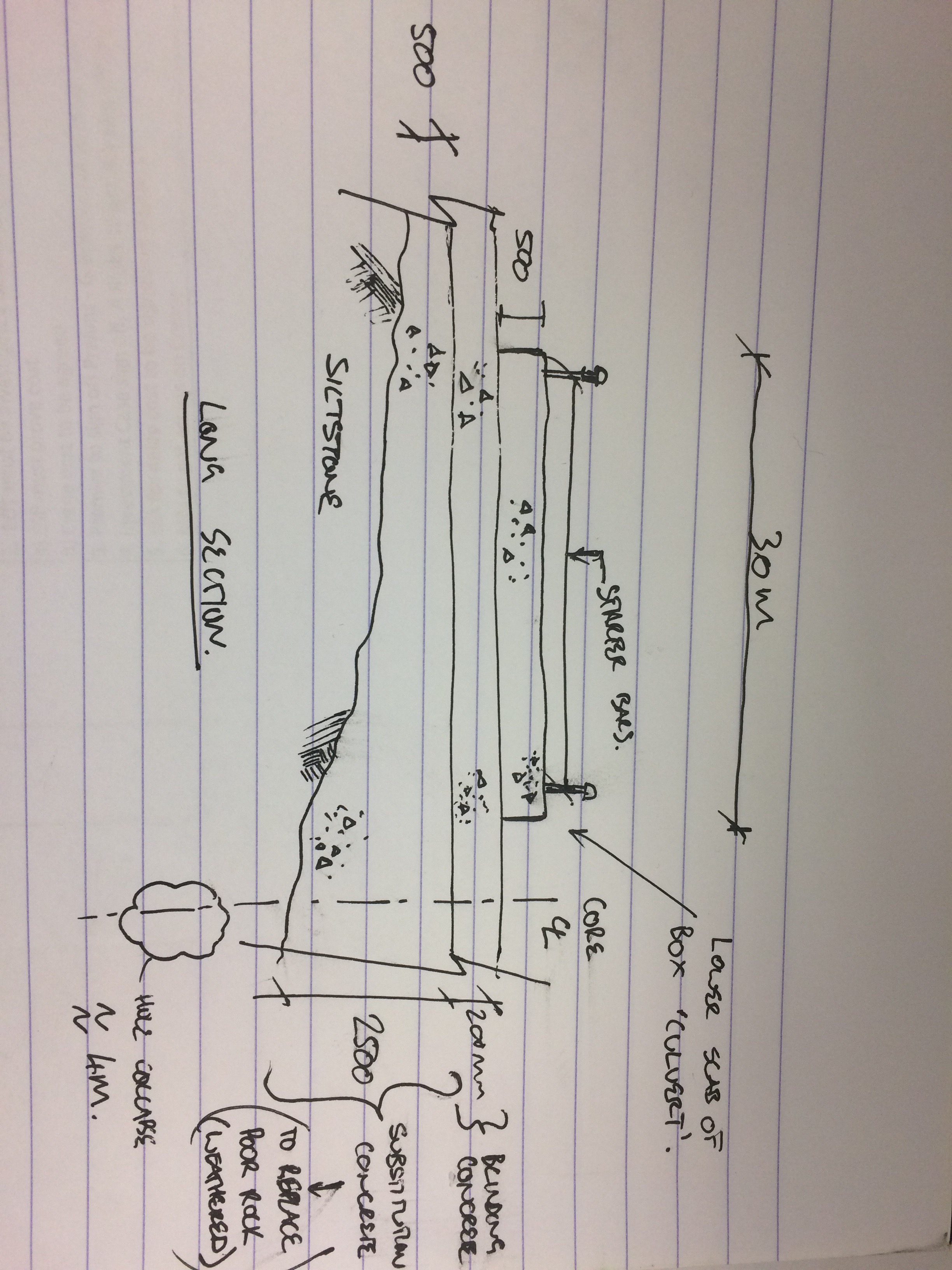
I’ve added a sketch of what’s in place. Breaking it out is COA 3 after COA 2 which is to grout underneath the substitution concrete to fill any voids in the formation. COA 1 being to do nothing.
Cubes were taken but from the mixer chute not the excavation where the water mixed with the concrete.
I am looking at suggesting having another test in place while the hole is open in case the Menard isn’t an option.
So the concern is not the strength of the concrete but the potential for voids between the Siltstone and substitution concrete. What does the grouting do to the programme? We have some on our site and it’s not cheap or quick. Assuming the concrete is merely to level off the formation all you require of it is that it is as stiff as the siltstone? Is your slab for the box culvert able to resist the increased forces from settlement? If so do nothing?
Apologies for not being able to post photos or dwgs, but it is not going to affect the programme for about another month.
Yes your right about the risk of voids, the rock is prone to dissolution when water flows through it. The blinding is there to seal formation, the substitution is there to replace poor quality rock. Formation is supposed to be trimmed to a gps model attached to the excavator to set the various level changes but this hasn’t been happening and is probably a blog post on its own. Something to do with no manual checks and trusting technology..,
The danger with grout also seems to be knowing when to stop to avoid uplift or to stop it migrating into the sump pumps and blocking them. They’ve said that the grout pump pressures will be decided before hand but I’m not sure on what basis. Surely it’s related to the volume of voids it has to fill.
Also, the worry is settlement due to seismic loads. I’ve not been involved in the design but the slab capability seems a good question to ask.
Sort of interesting this: What exactly are you trying to measure.?
The Menard pressuremeter applies a radial stress to the cored walls and the flexible wall of the pressurementer expands (by a continuously measureding volume) So this cylindrical expansion gives a radial strain. SO you can clearly measure stiffness in a horizontal direction. You imply that as you increase the wall pressure you will be applying a deviator stress ( shear) which will be half the difference between the horizontal stress and the in-situ vertical total stress. But if you could exert sufficient stress would you be trying to fail the concrete and determine it’s shear strength ( and by inference ) compressive strength. I guess if the concrete was voided the bulk stiffness measured would be low?
John,
Trying to measure the stiffness of the rock on which the concrete was placed.
I had a look at CIRIA and they say for mudstone/siltstone the Menard isn’t the thing to use but an HPD (high pressure dilatometer) is. They seem the same but I think the means by which they are computed is different.
An SPT apparently would give a large spread of values but would still triangulate the Menard with existing pre-construction GI and reports.
Interesting problem Dan. Thanks for hosting my visit yesterday. It is a very impressive project and I look forward to hearing more. I can’t add any useful comment on this specific issue but, having felt first hand the weakness of the mudstone that you are building on, I am intrigued to hear how this works out. Keep up the good work.