Groundwater Disposal
Issue
Keltbray have commenced their bulk dig to B2 level in Zone A of The Stage, Shoreditch, experiencing silty gravel down to clay. Although not scenes from The Tempest, they are experiencing groundwater seepage with the following photo showing what was experienced over the course of one night (having left the excavation dry at the close of works yesterday, and yes I have raised the issue that if someone is working that close to deep water it should be barriered off and have rescue means in place). 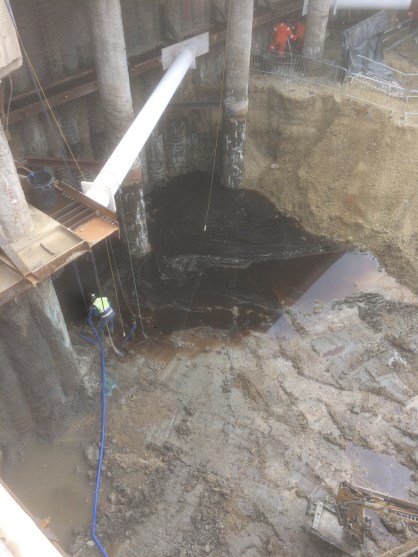 The Keltbray RAMS had a plan to deal with groundwater by managing with sump pumps before installing a full dewatering system, discharging to Thames Water drainage via sediment tank on the suspended slab above. The issue here is that Keltbray have got a discharge permit in place but not a connection to the manhole for the water. This poses the issue of what to do with the water?
Source
The excavation sits on top of an approx. 15m thick layer of London clay and is surrounded by a secant pile wall installed by another piling contractor before Multiplex took over the site. The wall has a number of out of tolerance piles and gaps in it (as previously blogged by Fred Kiddie). There is also an adjacent Zone B currently at B1 level which has a contiguous wall separating the zones, therefore gaps between the piles. This means there is about a 5m head difference in the zones. My assessment is that this groundwater is flowing from Zone B to Zone A due to the newly established head difference. There is also the likelihood of groundwater flowing from outside the site, passing through some of the gaps in the secant wall into the excavation ie finding the shortest flow path. The site is in Hackney and is located in a former mainly industrial area with mixed uses for the land around. This means to me that there is a fairly high chance of some contamination in the groundwater. The final option for where this water is from is that the pilers have been experiencing more polymer being used in Zone B piles than has previously been experienced. This could mean that the new head difference from the excavation could be causing more flow from the polymer fluid out of the pile and into Zone A.
Options
Option one was to sump pump the water to a hole in the excavated material before mixing it with the spoil and removing using muck-away trucks.
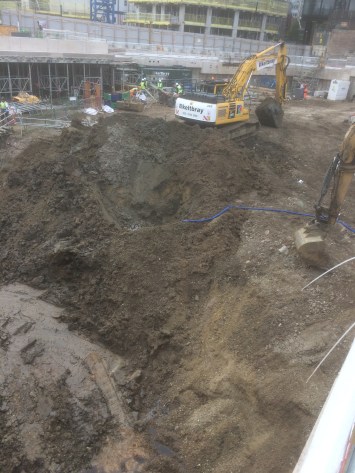 Issues with this option:
- It is a slow process.
- Some of the water flows back into the excavation.
- The muck-away trucks leave a trail of wet dirt on the road with very wet spoil being carried in the trucks – likely to cause complaints locally from the dirty roads even with one road sweeper employed full time.
- Each muck-away truck is tested for contaminants which would pick up any issues with contaminants in the groundwater.
Option two was to use the polymer pump and pump the groundwater into some of the polymer tanks and use it with the polymer for the ongoing piling. The polymer tanks can act as sedimentation tanks and ultimately conserves using mains water.


Issues with this option:
- Much faster at pumping the water from the excavation compared to a sump pump therefore making the excavation safer, quicker.
- The large amount of fines in the water cause the tanks to block up over time. However, these fines are contamination if not filtered out.
- The water needs treating to increase the pH before being mixed with the polymer.
- The water needs testing for contaminants as you could potentially be putting contaminated water down a pile and into a separate groundwater course much deeper down, causing wider contamination issues.
- There is a limited volume of the tanks for removing the groundwater as the piling ultimately reuses the water.
- The tanks don’t fully act as sedimentation tanks as their outlet valve is at the bottom therefore fines will pass through.
Summary
I have been discussing with the sustainability team here on the project who have cautiously approved the polymer tank method as it sort of allows for sedimentation of the water. The water isn’t currently being tested for contamination and the volume of the tanks has nearly been used up. I will be inspecting the water for any traces of polymer this afternoon to see if this is the source. If it is, then recycling the water through the polymer tanks isn’t such a bad option.
This issue only exists because a connection to the manhole has not been established yet. This is an item which is sitting with the local council and is an ongoing task to get approval.
 Holdfast Training Services Trial Blog
Nice pictures:
Some thoughts
When the permit to discharge comes there will be three controls:
1 That the water remains within certain contaminant limits
2 That you can only discharge a certain volume and
3 That the solid content is below a certain level.
Do let me know if I’ve missed anything there.
So on 1 and 3 you can do something now- a sedimentation trial to find the solids content and Thames Water normally provide and analysis service
On the latter… you do want to know whether the water is predominantly from a potable source , a foul source or either and land contaminated. A water analysis will give you clues.
The first to could be a sign of a disturbed main or sewer..all bad nothing good. But check
Next – passive softening. One risk when you allow water close to the excavated toe of a retaining wall is that the passive resistance that may have been used in the short term design is rapidly lost…be careful!
Next …and its TMR type of stuff… if the wall was designed as a cut off what would have been the expected inflow.? If the piling was out of spec and you’ve now got this what lien have you through the original contract with the piling sub contractor?
Hi John,
I agree with the controls which come with the discharge permit. What hasn’t been done yet is the placing of specific sedimentation tanks before it is discharged, something which was in their RAMS to do. I think they haven’t done it as they don’t have access to a manhole yet. It turns out now that using the polymer tanks for storage has unsurprisingly caused problems with the polymer pumping system and so they have stopped doing this.
Yes reference the water on the passive side of the wall, is see this would reduce the effective stress of the soil, therefore the passive resistance. I haven’t been able to go into the calculations from Wentworth House (part of the Keltbray Group) temporary works designers yet as the risk sits with them for the design.
I have previously looked at the boreholes for the site and the summary from Keltbray for the piling, all of which didn’t experience much groundwater – only isolated pockets at the extremities of the site. I understand the perimeter secant wall is predominantly designed as a retaining wall for surrounding buildings which sit adjacent to the site. However, the subterranean river Walbrook runs across the site but this was mainly culverted in the sixteenth century and became part of the London sewerage system in the nineteenth century and only leaks into the groundwater locally when the water table is high enough. There are also some geekishly interesting links to the local names which link in with the water. Names such as Shoreditch which translates to sewerage ditch, is from when the Romans built their wall around London, which in conjunction with deforesting the area and clogging the rivers with rubbish, disrupted the natural watercourse, namely the ancient Walbrook river (now subterranean), making the water back up into the Shoreditch area causing a swampy marshland. This caused the area to be covered in marshland (hence Moorgate nearby) for about 1400 years, of which make up a 3m layer, at a depth of 2m below the ground level, which can be seen in the excavations on site. This also means that there is little presence of Saxon or medieval remains as the area was flooded and eventually drained for fields through the sewerage ditch (Shoreditch). The first interesting developments in the area is that of the Curtain Theatre, first mentioned in 1577, and later developed on, of which historic maps have recorded. Anyway got a bit side-tracked there with the archaeological side but in essence there’s not expected to be much groundwater on the site, but accounts for the silty gravels, hence the retaining wall design. As a summary the secant wall is a retaining wall design for constructability.
With regards to the out of spec piles, I understand that it was part of the contract with Keltbray for them to take on the warranty of all old piles on the site, something I imagine they charged well for. This means that they have to do the remediation works as they discover the as the piles are exposed. This was part of a previous blog by Fred involving 3D surveys etc but is an interesting one commercially and will hopefully throw up some good issues as the excavations progress.
Ed – good blog.
What kind of depth are we looking at where the water is and are they anywhere near the final excavation depth yet?
If you go for the polymer pumping option could you add a silt tank before it enters the polymer tanks to reduce the sediment in the water?
We had a similar issue on site with regard to a discharge permit but nowhere to discharge. In the end a temporary connection was made into an old road drainage system that ran through the site prior to the permanent connection being installed. Is they anywhere on site that a temporary connection could be made?
On a separate note – what are your thoughts on the 2 guys in the back of the first picture at the top of the excavation? As a general rule on our site all barriers must be 2m from the leading egde of an excavation – seems like that walkway is precariously close to the excavation.
Alright James,
Surface level is at +15m AOD, the collars on the piles you can see are at +9m AOD and that surface level was at +5m. Formation level will be at +1m AOD.
Yes a sediment tank is what they were planning to use and was written in their RAMS. It certainly would work in terms of getting usable water. This all how only just been taking place and I am in the process of dissecting their RAMS which is on Aconex and putting together the case that they aren’t following their RAMS correctly. It turns out they only really react if you put it on Aconex which is Multiplex’s chosen archiving/emailing software. This is a commercial reality I have learnt whilst being here.
The site is particularly badly connected regarding drainage connections. A survey of the surrounding pipe network has only just been done and discovering things such as manholes missing in roads which Thames Water think should be there. That’s how early on this project is – Multiplex still aren’t in contract with the client. It’s all stuff I would have thought should be sorted before they take on a project – although I guess they haven’t yet actually taken it on.
Ref those 2 guys on the top photo – I agree, keeping an eye on the guys etc is an ongoing issue for the whole site team. Keltbray planned to always have a 30 degree batter which clearly isn’t the case here. Like I said before it is a constant issue making sure they are sticking to their agreed RAMS. It’s a bit of an issue which I’ll follow with another blog to do with H&S.
Ed
We are in a similar situation here but have our permit to discharge in place and discharge through a local manhole which is connected to the mains sewer and is inside our site boundary. It is interesting you state that for the permanent solution Keltbray intend to use settlement tanks; will this achieve the required standard prior to discharge or is this an aspiration? Especially if the water does turn out to be contaminated.
Here we need a full filter press system and regularly take samples in order to meet with Thames Waters discharge consent. As John stated the consent lists the threshold values of substances and volume of discharge, for interest with two discharge points we can discharge 1312m3/day.
All the systems can be in place and someone from the TBM team will still put a pipe into the man hole and fill it full of grout!
Hi Henry, yeah same detail here. They definitely aren’t testing it or using settlement tanks as they stated in their RAMS. Like I said to James above, it’s a constant issue with them and I’m putting a piece together on Aconex which will hopefully force them into it. They really try to cut corners all the time to either save time/money etc. I agree with your last comment completely – I found the discharge of water from some hydro-dem going down the closest manhole they could find – which had been previously filled with concrete at the bottom and put out of use. Ironically they had settlement tanks on site for that!
Great piece and follow on discussion. I note your comment along the lines of dry when we went home and this is what we found in the morning. Last time I saw that on a large site with ground water arriving overnight it turned out to be rainwater that had nowhere else to go. Did it rain or do you have a continuous inflow i.e. is the level being lowered by pumping without replenishing or not? I guess it is the later ‘cos it’s not a new concept and thereafter I’m with the above, although in my experience the norm for a discharge consent is a flow rate rather than a volume, am I very out of touch?
Rich, I can answer your last point. On our discharge consent it states a permitted volume per day (m3/day), a permitted rate (m3/hour) and a permitted flow (l/s). However they are all the same if you multiply the permitted flow up to an hourly or daily volume.
Thanks Henry. The thing I take from that is that someone has foolishly added two unnecessary figures and introduced opportunity for numerical error to confuse things and opportunity to try to take advantage of interpretation! If constraint had been left at flow in l/s all others follow so why make it harder? Could you deliberately take a fixed volume per hour to imply average flow rate and therefore discharge at twice the l/s for half an hour based on compliance with criteria No.2?
I agree that they are the same in principal but what we don’t know is the wider demand on the network in terms of time. By limiting the discharge by different time constraints I guess it means you can’t, for example, empty 2 large tanks in one day, (limit it to a total quantity per day) or empty a whole tank (acceptable in the day) rapidly in the critical hour which all the local students decide to flush the toilet in a break whilst watching Hollyoaks (or whatever the kids are watching these days) – limiting to hourly flow/rate.
Henry, how are these actually measured/monitored on site? Is it closely controlled/monitored and what are the repercussions? Is it the same as setting off a noise monitor or does it incur an immediate fine for any breaches?
Hi Rich, it didn’t rain over night and it has been the same for a few days now. You can see it flowing (very slowly) out of the granular soil above a thick layer of clay. The groundwater isn’t being actively lowered at all at the moment. It is purely flowing into the excavation due to a head difference of about 6m caused by the latest excavation. separating the levels of the site is a contiguous wall with clear gaps between the piles (intentional). This means it serves as a retaining structure for construction purposes but allows groundwater to pass through. At the time of writing the piece it hadn’t rained but more recently there have been a few showers so we can expect that to slowly percolate through the ground to the excavation (catchment area within the wider secant perimeter is about 1 hectare).