Archive
Smoke without fire
A relatively long post on Fire Stopping, not fashionable but an issue that can cost project success if ignored.
I am currently, among other things, managing the fire stopping design and installation for the Skanska-Astra Zeneca site in Cambridge. Like most large scale non domestic construction at the moment, the project is unable to conform to the approved documents (Approved Doc B (part 2: buildings other than dwellings). This is in large part due to the approved documents not keeping up with the requirements of the industry, electrical installations are becoming more complex and IBMS systems are adding huge volumes of cabling over traditional sites.
In order to gain building control approval, my project is being delivered via a Fire Engineered Solution. We are governed therefore by a Fire Strategy that has been designed by ARUP Fire, in consultation with the client and building control.
We have engaged an independent fire consultant (International Fire Consultants Ltd) to approve our designs, which are then signed off by building control. Where we are unable to meet the required standards, we attempt to work within previous fire tests, or adapt designs to meet pre certified layouts or equipment. Where an issue cannot be resolved through changing geometry or material, we can apply to use an Expert Assessment, a technical assessment made by either a product manufacturer or the Fire Consultant and based on relevant test data from which an assessment for a different layout or usage can be made. When we cannot convince the Fire Consultant that a solution is adequate however, the last resort is to conduct an independent test to prove that a suggested layout and equipment can be used safely.
Due to the cost of fire testing (around £15,000 per test sample for a 3mx3m wall section) and more importantly the delay (earliest available tests are currently January-March due to increased testing following Grenfell) various Skanska sites are sharing test data to gain consultants approval.
This week, due to the absence of the package manager on a nearby site, I went to Warrington to witness a test commissioned by Skanska to test an array of cable and containment combinations.
The tests are relatively simple, you build a wall to the same construction as you intend to use on site in a 3mx3m frame, install all the services you require, and fire stop the wall with your designed solution, generally a mixture of Ablative coated Batt and Intumescent Mastic. You then hand the wall over to the independent testing company, they apply the face of the wall to a furnace, add thermocouples and set fire to it.
This test was to gain a 60min fire rating for both insulation and integrity. Insulation being defined as not exceeding an increase of 180K in temperature on the non-exposed side and integrity meaning that the construction of the wall, services and fire stopping does not fail during the test period.
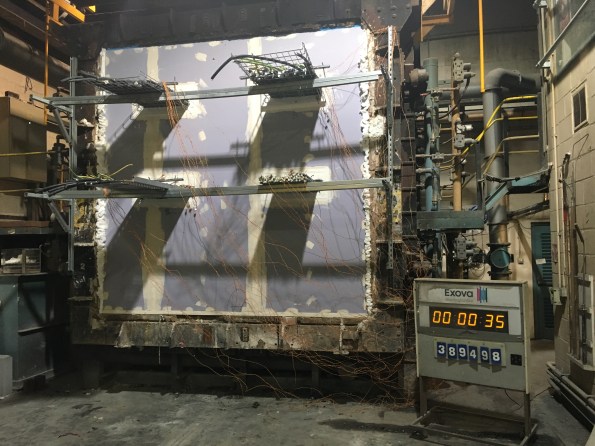 Figure 1. Test sample at start of test, trailing wires are thermocouples
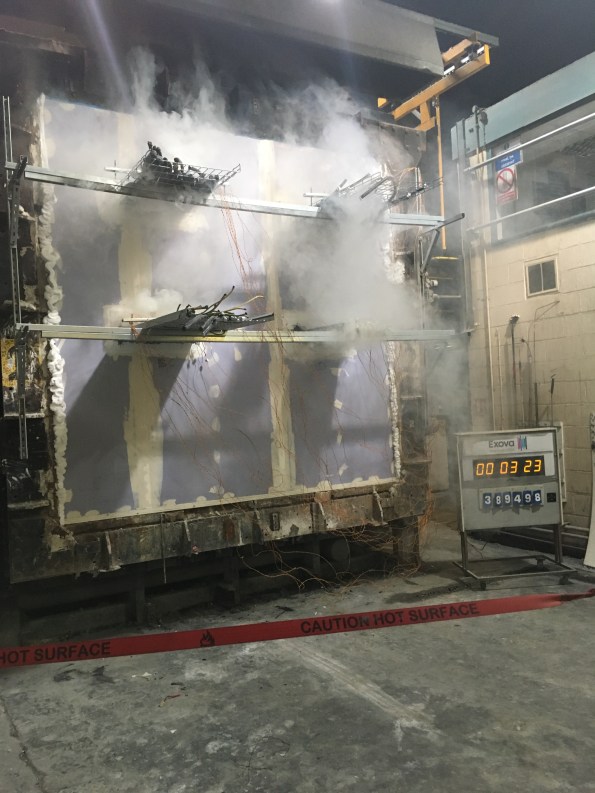 Figure 2, Wall after only 3 mins of exposure. Large amount of smoke on non-exposed side.
The large amount of smoke experienced early in the test was surprising, however this was due largely to the amount of time it takes for an intumescent material to react to the heat and the amount of space between cables that cannot be reached with mastic.
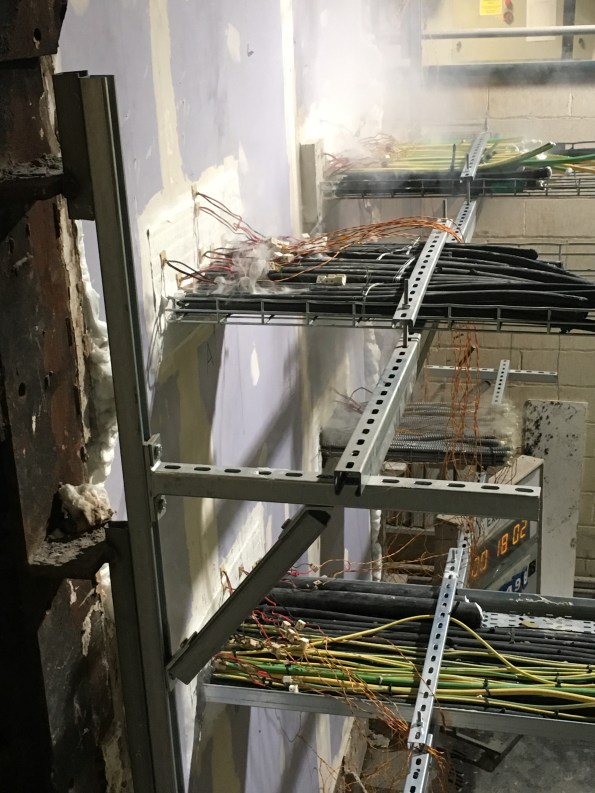 Figure 3. 18 mins Smoke penetration almost stopped.
On the lower two penetrations a black mastic was used. Black mastic uses graphite which offers increased expansion and is often used in fire sleeves to crush plastic pipes (but it much more expensive than traditional fire stopping mastic). It can be seen that the smoke ingress through the two penetrations treated with black mastic has almost entirely ceased by 18 mins into the test. The two penetrations treated with a traditional microporous carbonaceous foam continued to leak smoke throughout the test.
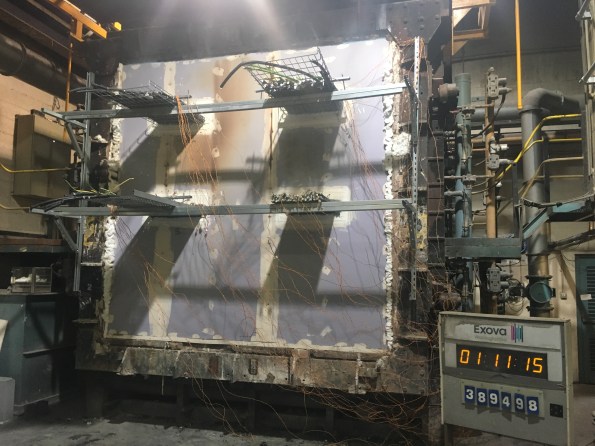 Figure 4. Wall at end of test.
By the time the test was completed, all of the samples had maintained integrity, however the bottom right sample had failed insulation after only 24 mins. This was a modular wiring system and the metal outer sheaths conducted the heat very quickly. It can also be seen that the wall construction its self was close to failing by completion, and in fact as soon as the furnace was stopped, the change in pressure led to fail along the seams.
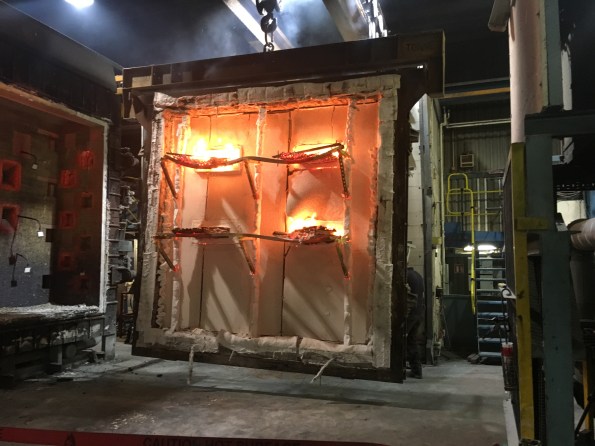 Figure 5. Exposed face immediately after test stopped.
Reverse of wall after removal from furnace. Note the amount of deflection in the unistrut system. It often seems like the regulations or guidance lead us to over engineer solutions, however after only 60mins the support system had almost catastrophically failed, as soon as service supports fail in a fire situation, the weight of the unsupported services crushes the fire stop material and possibly the wall construction its self, leading to rapid fire spread.
A relatively long post about burning down a wall, but good experience in escalation of solutions to overcome design or regulatory issues. The cost of gaining a bespoke solution is relatively low for a large project, however the time taken to complete a test (from booking to report issued) is often too long for a project, especially is the issue is identified late. This solution is generally a last resort or when a costly risk has been identified early and the completion of a test can stop the risk becoming realised.
 Holdfast Training Services Trial Blog