Smoke without fire
A relatively long post on Fire Stopping, not fashionable but an issue that can cost project success if ignored.
I am currently, among other things, managing the fire stopping design and installation for the Skanska-Astra Zeneca site in Cambridge. Like most large scale non domestic construction at the moment, the project is unable to conform to the approved documents (Approved Doc B (part 2: buildings other than dwellings). This is in large part due to the approved documents not keeping up with the requirements of the industry, electrical installations are becoming more complex and IBMS systems are adding huge volumes of cabling over traditional sites.
In order to gain building control approval, my project is being delivered via a Fire Engineered Solution. We are governed therefore by a Fire Strategy that has been designed by ARUP Fire, in consultation with the client and building control.
We have engaged an independent fire consultant (International Fire Consultants Ltd) to approve our designs, which are then signed off by building control. Where we are unable to meet the required standards, we attempt to work within previous fire tests, or adapt designs to meet pre certified layouts or equipment. Where an issue cannot be resolved through changing geometry or material, we can apply to use an Expert Assessment, a technical assessment made by either a product manufacturer or the Fire Consultant and based on relevant test data from which an assessment for a different layout or usage can be made. When we cannot convince the Fire Consultant that a solution is adequate however, the last resort is to conduct an independent test to prove that a suggested layout and equipment can be used safely.
Due to the cost of fire testing (around £15,000 per test sample for a 3mx3m wall section) and more importantly the delay (earliest available tests are currently January-March due to increased testing following Grenfell) various Skanska sites are sharing test data to gain consultants approval.
This week, due to the absence of the package manager on a nearby site, I went to Warrington to witness a test commissioned by Skanska to test an array of cable and containment combinations.
The tests are relatively simple, you build a wall to the same construction as you intend to use on site in a 3mx3m frame, install all the services you require, and fire stop the wall with your designed solution, generally a mixture of Ablative coated Batt and Intumescent Mastic. You then hand the wall over to the independent testing company, they apply the face of the wall to a furnace, add thermocouples and set fire to it.
This test was to gain a 60min fire rating for both insulation and integrity. Insulation being defined as not exceeding an increase of 180K in temperature on the non-exposed side and integrity meaning that the construction of the wall, services and fire stopping does not fail during the test period.
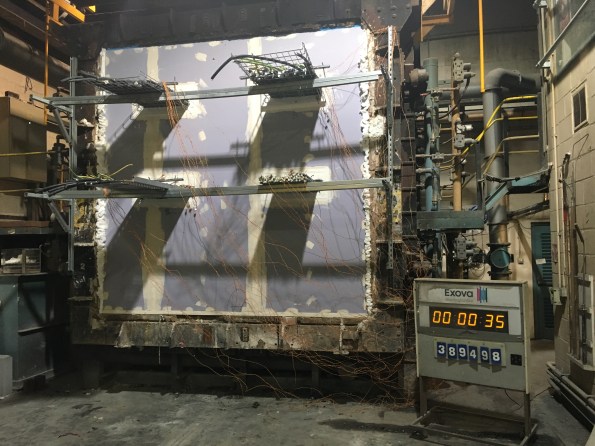 Figure 1. Test sample at start of test, trailing wires are thermocouples
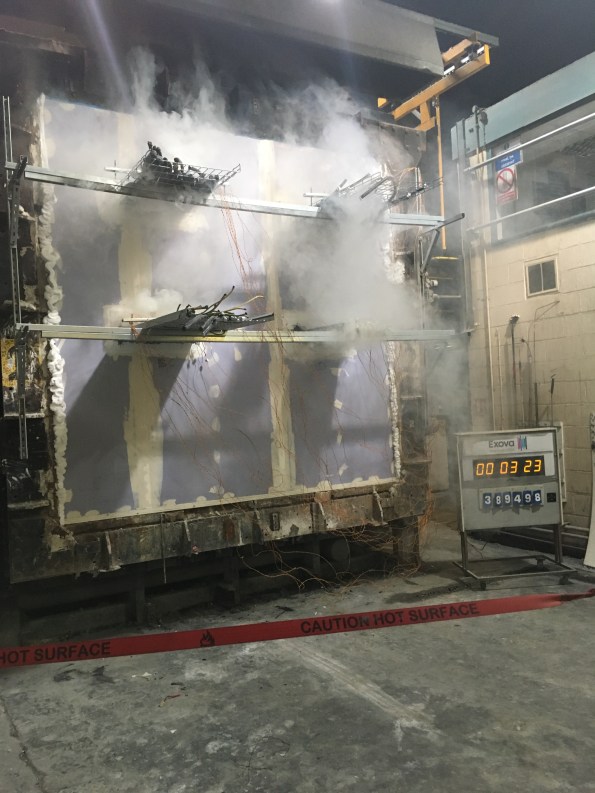 Figure 2, Wall after only 3 mins of exposure. Large amount of smoke on non-exposed side.
The large amount of smoke experienced early in the test was surprising, however this was due largely to the amount of time it takes for an intumescent material to react to the heat and the amount of space between cables that cannot be reached with mastic.
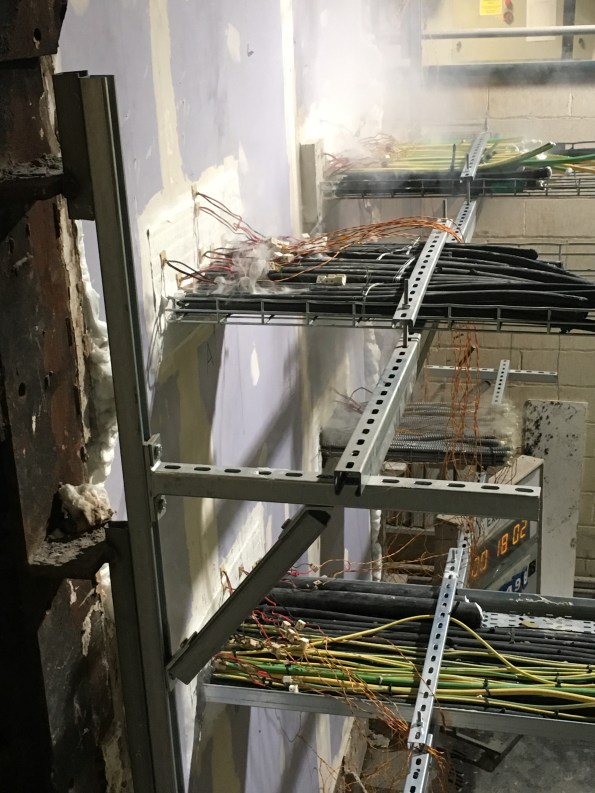 Figure 3. 18 mins Smoke penetration almost stopped.
On the lower two penetrations a black mastic was used. Black mastic uses graphite which offers increased expansion and is often used in fire sleeves to crush plastic pipes (but it much more expensive than traditional fire stopping mastic). It can be seen that the smoke ingress through the two penetrations treated with black mastic has almost entirely ceased by 18 mins into the test. The two penetrations treated with a traditional microporous carbonaceous foam continued to leak smoke throughout the test.
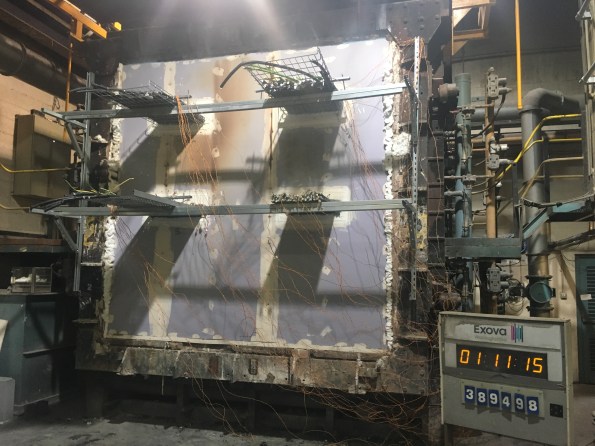 Figure 4. Wall at end of test.
By the time the test was completed, all of the samples had maintained integrity, however the bottom right sample had failed insulation after only 24 mins. This was a modular wiring system and the metal outer sheaths conducted the heat very quickly. It can also be seen that the wall construction its self was close to failing by completion, and in fact as soon as the furnace was stopped, the change in pressure led to fail along the seams.
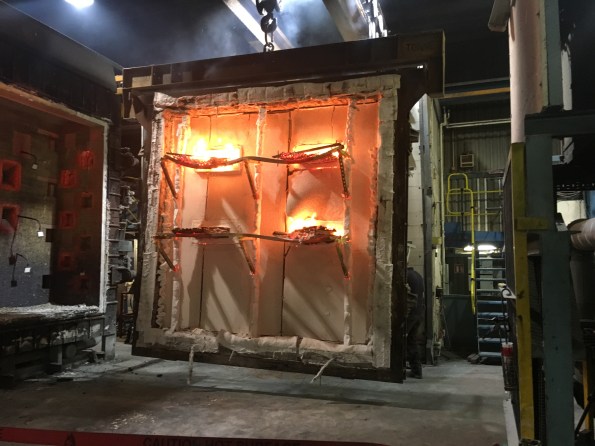 Figure 5. Exposed face immediately after test stopped.
Reverse of wall after removal from furnace. Note the amount of deflection in the unistrut system. It often seems like the regulations or guidance lead us to over engineer solutions, however after only 60mins the support system had almost catastrophically failed, as soon as service supports fail in a fire situation, the weight of the unsupported services crushes the fire stop material and possibly the wall construction its self, leading to rapid fire spread.
A relatively long post about burning down a wall, but good experience in escalation of solutions to overcome design or regulatory issues. The cost of gaining a bespoke solution is relatively low for a large project, however the time taken to complete a test (from booking to report issued) is often too long for a project, especially is the issue is identified late. This solution is generally a last resort or when a costly risk has been identified early and the completion of a test can stop the risk becoming realised.


I would have thought that a small amount of smoke leakage at the start of the test was a good thing in that it would trigger alarms in adjacent areas and presumably smell without killing; thereafter, clearly the less the better because containment might suffocate the fire. I do wonder if the failure of the structure on test cessation is a cautionary tale that might be well heard by the fire fighting community because it would suggest cooling without combating could actually increase spread rather than reduce it. With regard to the unistrut deflection, I was given to understand that this should be attached to a continuous cable tray, unlike the stubs necessarily used in a test such as this, so heat applied to it would be conducted away rather like reinforcement in concrete is self protecting to an extent. However, just how continuous you guys make your trays is not something I know anything about and they could, of course, also conduct heat in if the gradient is unfavourable, making matters worse.
What was the wall construction for this test?
Richard, It is a fair point about the continuous cable tray, however in terms of support, the only regulated support distance is to be supported within 500mm of the penetration on both sides, the ability of the tray to effectively dissipate the heat of course relies on the fire scenario and where the whole zone is subject to a similar heat loading it cannot be assumed.
The wall construction was single 15mm Knauf Soundshield Plus, either side of a 70mm Knauf C-Stud with no deflection head. Designed for 60mins, we ceased the test at 72mins which provides 20% above the rating. There was actually a reluctance to push the test to failure in case it proved that the construction was over engineered and a better value solution could have been offered (eg if the wall had survived for 90mins),
Thanks Will,
That’s pretty light weight construction, although I’d be concerned about the lack of deflection head in most construction scenarios. Presumably the white book would give me a fire stopped deflection head solution (I’ll have a look if I get time)… I wouldn’t have worried too much about the over engineered suggestion because there’s not much less that could have been done and it might have yielded a useful result for future requirements for R90 solutions as well. It is also sensible to avoid suggesting over engineering on the basis of one variable; it might be that the construction detail is dictated by sound or structure borne noise considerations.
Interesting blog Will. £15k must be small fry on a project of that scale? The point about the deflection head is quite relevant to my site. A tall building founded on highly variable ground with a complex construction sequence results in complex axial shortening and settlement estimations. Due to the length of the defects period MPX are looking at ways to mitigate this. One way is to mitigate the impact, i.e. Deflection heads for partitions to prevent cracking. I had wondered how compartmentalisation was achieved with a larger gap than normal.
We also have a fire rating of 60mins which surprises me given the hight of the structure. But I haven’t looked into this in much detail, just being inquisitive.
Brad, you are quite right that £15k to make a problem go away is considered cost effective in this area, there is one project I know of that has so far cost £60+ million to retrospectively correct fire stopping issues, post handover, which is why the spotlight is so bright on the issue within my company.
In this case the omission of the deflection head was actually due to the test frame, which degrade heavily through continued usage and make fitting a deflection head difficult. On the project we have deflection heads throughout and it is just the case of specifying a fire stop material with the appropriate flexibility or with proven expansion sufficient for the task.
Speaking of deflection however, the bigger issue in fire is deflection of the wall towards the fire, which in this test was around 80-100mm across 3m horizontally so you can imagine the deflection over a much longer distance. This is what caused the seams to fail as the heat was removed and the deflection had deformed the studs considerably.
Will
My experience of and concerns about fire stopping (and other preventative strategies like fire dampers) is not so much in the conception and engineering, but in the execution. All over Gatwick, I used to come across fire dampers that weren’t set into the wall, because the contractors would have had to adjust the lengths of duct work, so the things were just left hanging uselessly unsupported and not doing the job intended for them. The other favourite was stopping with materials that looked OK, but on closer inspection weren’t expensive fire rated products. I have also been recently informed that post Grenfell, there is quite a trade in quick registered, fire stopping companies going on that is allowing effectively incompetent contractors to pass themselves off as experts within this field. I often found that people focussed too much on the efficacy of the active suppression systems without giving enough thought to the integrity of the containment via inspections during construction and competence checks of tradesmen.
Jim
Hi Will
Thanks for an interesting blog, being a Widnes lad and a rugby league fan (in my younger days) Warrington was our derby match. Where in Warrington was this test site?
Jim,
I don’t know if it is the case with the industry as a whole now (but suspect it is among most large contractors) that this area is much more thought about (and feared) than previously. I have had interest from senior management throughout the package, and have never been obstructed where I’ve implemented higher quality, more expensive materials (Although I accept that on a cost+ project this is to be expected).
In terms of materials used, all proposals are submitted for technical approval by an independent consultant and spot checked on site. Every single penetration on site (over 2000 so far) is labelled with a QR code which refers to photos of the substrate prior to service installation, service installation, and fire stopping installation, as well as to design drawings relevant to that situation. Every unique design is bench marked and approved by the independent consultant, and the inspection regime that I designed for the package includes 10% destructive testing which can be increased by building control of the consultant if they have concerns.
All services are checked for quality prior to fire stop installation with dampers checked individually (so far around 40% have been removed and reinstalled as the installation was not of sufficient quality for fire stopping). Also all operatives have to have proof of a FIRAS accredited course.
I think there has been a large increase in providers post Grenfell, with many individuals breaking away from established companies to form their own. I don’t think the industry is mature enough to self regulate, however the accreditation schemes are sound and the established authorities are reputable.
The resource in this area is remarkable now for new builds and I suspect many buildings build under previous regulations will soon have a rude awakening.
John,
The test site is Exovia-Warrington Fire, based just north of the R.Mersey close to St Elphins park and Latchford.
It is good to hear that things are so tight on your site, but as you say this is a cost plus contract and the problems I have been told about relate to sites where the profit margin is far less secure. I have also been shown by an established contractor within this industry how you can pass courses designed to provide training in this area without actually attending any training (i.e. by paying others to do it for you) and how trades can buy CSCS cards in this skill from people who also specialise in providing false passports; I was shown evidence on line of an individual boasting that they make more money out of these cards than passports at the moment. There is also a huge legacy issue from a time when the spotlight wasn’t shining sufficiently brightly on this area of practice. Bottom line, it is great to hear that things are running so well on your site, but it is my assessment that there is still a significant problem across the industry with regard to the quality of fire stopping.