Over-Flighting Causing Potential Failure of a Piling Platform
A cofferdam is required for the construction of an Underpass structure beneath a new Rail Bridge. The current rail line has been slewed 5m to the east of the piling platform to allow for the rail bridge piles and sheets for the cofferdam to be installed. The piling pad is at RL +8.0m, made of 800mm compacted DGB. RL 7.2m to RL -7.5m is dense to medium dense sand. Below RL -7.5m is clay. The GWT fluctuates between RL 1.5 to 3.5m, recharged by rainfall.
Difficult sheet pile driving conditions through coarse grained dense sand have meant pre-augering has been used to loosen the sand prior to driving 18m sheet piles for the Underpass cofferdam. A phenomenon from CFA piling has occurred on the rail bridge piling platform where the predrilling auger has over-rotated and excessive sand has been removed, known as over-flighting. In total, there are 29 augered predilling holes in the platform. the total volume of sand removed is 60m³. Therefore on average 2m³ is removed from each hole. Over-flighting of the auger is increasing the voids ratio within the ground leading to the ground around the auger to settle through vibration as the sheet pile is driven and an increased stress applied. Damian Warren experienced a similar issue at his project near the Thames in London.


Figure 1 – Tension Cracks in the Piling Platform due to Settlement from Over-Flighting
Where a coarse grained loose material overlays a stiff fine grained material issues in augering can occur. The stiff clay layer found at depth requires greater rotation of the auger due to its stiffness. The greater rotations of the auger cause loose sands in the upper horizons to be transported up the flights leading to sands around the auger to fall into the flights creating a void. The voids are being created under the sheet piling machines which may undermine their stability. An augering machine with low torque will require a higher number of rotations to penetrate the stiffer, cohesive clay layers. This issue was not encountered while drilling the CFA piles for a previous task I conducted on the site as the piles for the Canal Bridge did not reach the cohesive clay layer.
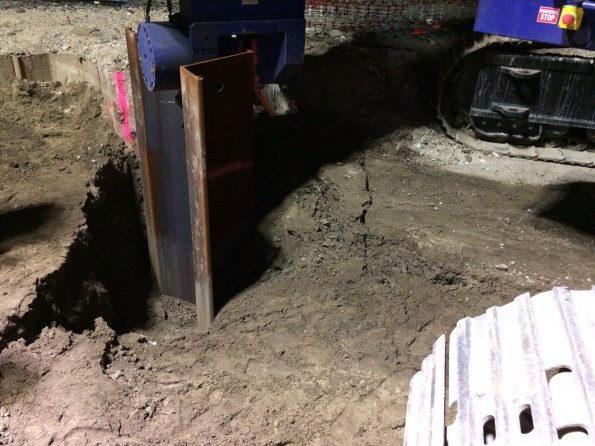
Figure 2 – Settlement of the Ground around the Sheet Pile
The stress history of the soil has been changed by the predrilling. The soil is exhibiting large volume changes after predrilling and during sheet piling suggesting it now has low stiffness compared to the surrounding strata. The stiffness of a soil is very difficult to assess. The differential settlement for across the pad could become an issue for the rigs stability and potentially effect the rail line.
The water table around the piling platform is recharge via infiltration of rain water. Heavy rain over the past few days will have caused the ground water table to rise. A high ground water table exacerbates over-fighting as the soil has increased fluidity in the weak submerged soil particles allowing it flow easier.
The predrilling is being conducted as if it were a secant piled wall, with overlapping bores. The cumulative effect of the close spacing of drilling will increase the settlement issue.
Recommendations
To rectify the issue, geogrid or cement stabilised sand could have been used to reduce excessive ground movement.
Steel plates have already been utilised to support the 72T piling rigs during driving due to settlement issues on the piling platform.
Drill rig selections should be accessed in further piling works to ensure a drilling rig is selected with sufficent torque and crowd combinations that are compatible with auger rotation and penetration into the ground.
Verification
After inspecting the piling platform myself, I wrote a report to the John Holland SPE on my findings. Subsequently a geotechnical engineer came out an observed the piling platform and concluded that the platform still met the design requirements so no further works are required. A rail inspector has also checked the alignment of the railway line, with no issues found.
Are there further issues which should be considered or is this issue normal on site?
 Holdfast Training Services Trial Blog
Presumably uncased boring, what diameter augur?
Keller are using a CFA rig with an 600mm diameter auger to predrill the ground to then insert 18m sheet piles, 1.5m effective width. The auger though is over-flighting as if it was installing a CFA pile.
surely a 600mm dia auger drilling a 15m hole down to clay should remove about 4.2m of spoil so 29 piles should generate 123cubic metres of sand without any over-rotation. Did you mean there was 60 cubic metres excess or are you losing 50% in over lap? Strikes me that a 600 dia auger is also a little larger than might be sensible and I wonder why secant drilling and not contiguous if you’re only pre-augering for a driven sheet? All very curious but at the end of it what boundary do you place on the disrupted soil? Surely not enough to worry the railway?
James
Predrilling is often used be sheet piling contractors and there re a number of issues
Firstly they often do it because it makes driving easer
The designer might be made aware; the soil strengths are being altered so the design should be checked.
There is very little guidance available on how the soil parameters are changed and I have seen calculation for Atkins and Cementation recently that implies there is no standard approach
Pre drilling for sheet piling does not remove soil you may find some soil is brought up on the auger but but it is never done with a continuous flight – you say this is CFA but I recall you got confused in an earlier TMR- The contractor cannot use CFA without really quite serious repercussions
I am concerned you are suggesting that large volumes of soil are being removed- this is not standard predrilling
Once again t I take it that the wall designers are aware?
Sorry meant to add
I have never seen pre drilling in coarse grained soils
You can usually advance the sheet with either vibro and or vibro with flush ( flush tubes are fixed to the inside of the sheet. Predrilling is usually to loose stiff clays
What might be happening is that virbo energy might be being dissipated in ground water. I would use a flush method
I asked them to conduct a test drive of a sheet this morning into non-pre-drilled ground. The 18m sheet was vibrated in with no problems. Leads me to ask the question why wasn’t this test performed prior to predrilling. The sheet piling rig being used is an RG19.
From your comments John, I have looked at the specifications for the predrilling rig being used. Keller are using a continuous auger, specification in the link below.
http://www.entecodrill.com/en/product/technical-data/E5045-CFA.html
The reason they are driving the 18m sheets is due in part to a dewatering feasibility report I wrote. My report highlighted leaving the previous sheets at 11m led to 1.9 million litres per day of ground water entering the cofferdam. Driving to the clay layer to achieve cut-off reduced the flow to 9000 L per day. This was latter confirmed by a consultant geotechnical engineer. Keller have removed the shorter sheet piles and replaced them with the 18m sheets. A previous design stated for no-predrilling as to not reduce the passive pressures. This design allows for predrilling, but the WALLAP design does not seem to take this into account the changing E’ value with predrilling.
James – thanks for the interesting blog and discussion. Looks like your getting some great experience towards CPR.
Nice comment
Any pre-drilling will alter both strength and stiffness
So at the rear the active pressure does up
The passive pressure goes down and, as you say the stiffness goes down *( the deformation goes up)
All bad really
My experience is contractors are starting to do this as a matter of course and designers are sometimes unaware
This is the first time I’ve see pre-drilling with CFA – I simply cannot see that this is anything but a really bad idea
Pre-drilling, as you point out , it to allow them to get the piles in with less effort
Since the wall may be there ( among other things) to limit deformation, removing volume and lowering stiffness seem deranged
Since a bit of vibro worked – more so- or worse lazy and deranged
Still a nice thing for you to bring forward to CPR- good work!