Getting in a TIF with USACE
Introduction
In 2015 the USACE TECH Talk Program was established to provide a platform to highlight USACE personnel and projects that push the limits on industry standards, improve infrastructure, and create efficiencies. After four years and more than 50 TECH Talks, the programme is transitioning to the USACE Technical Innovation Forum (TIF). TIF is an annual event that brings together people and projects from across the Corps to facilitate the exchange of ideas and information.
Last week I attended the 2019 USACE TIF, hosted online by HQ USACE, conducted under the theme “Innovation that Executes”. The two day training event consisted of a keynote speaker (1 hour) followed by breakout sessions (2 hours) each day. A complete schedule is attached, showing the breadth and diversity of subjects.
Highlights
A number of the subjects were very specialised and went over my head somewhat (especially the geology and seismic subjects). I did, however, want to share with you two presentations in particular that could have profound effects on the development of military construction.
1. 4D BIM and Augmented Reality
Speaker: Jonathon Boone, Research Civil Engineer, Information Technology Laboratory, Engineer Research and Development Center (ERDC), Vicksburg, MS
You will probably have heard of Building Information Modelling (BIM) and some may have been using it during Phases 2/3 and beyond. For those that haven’t BIM is, simply put, a step above traditional 2D plans and elevations. It is a way of visualising a facility in 3D including both the structure and the functionality of buildings at all stages of the project life-cycle. For example, it can be used to confirm utilities won’t clash during construction, large pieces of equipment can be brought in and out and there is enough free space around installed equipment for maintenance and replacements. Products might look something like this:


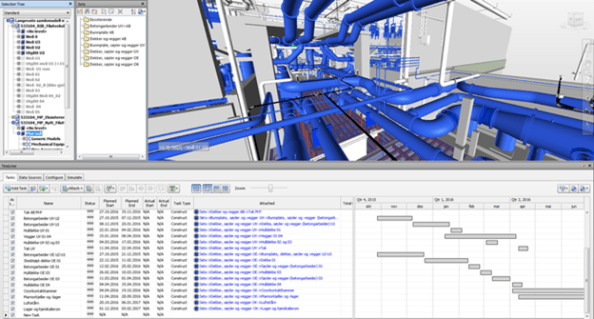
Over the years several dimensions have been added (4D: Time; 5D: Cost; 6D: Environmental/Sustainability; 7D: Through-life facility management). USACE and its contractors have been using 4D BIM successfully in several locations for at least 5 years by linking plans with the schedule in Primavera P2 or P6 software (MS Project can also be used). This allows each feature of work in the construction schedule to be visualised in 3D in the environment that will exist when the feature begins through to the end. For example, the delivery and installation of an Air Handling Unit can be simulated to ensure it will fit through the building openings as construction progresses at a pace. A representation might look like this:
 The most exciting develop which is soon to be deployed to Construction Field Offices is the use of Augmented Reality (AR) with BIM. With AR, it is possible for users to stand on a facility or a site and the BIM model be projected into place through the AR goggles.
This advance will allow clients and stakeholders to be briefed in detail on site instead of in an office with powerpoint; they will be able to visualise exactly how their project will develop without a need to understand plans or technical language. Furthermore, they can walk through a facility/site; physically stand on or point to the area of concern; see through existing walls or visualise the finished product in true scale.
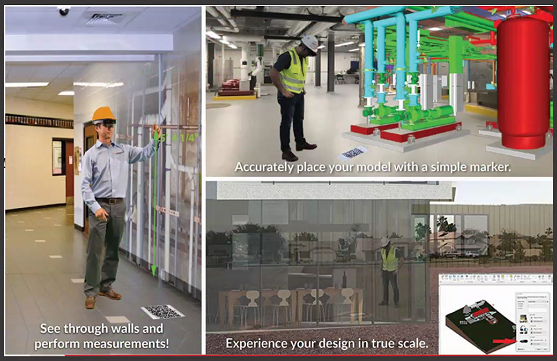
This technology has been tested by ERDC locally using a laptop physically connected to the AR equipment and remotely by individuals wearing the equipment in HQ USACE, Washington DC, while the BIM model is run on a laptop in Vicksburg, MS. The latter will be extremely useful for large national/international projects with stakeholders in several locations.
It must be said that reliable AR is expensive, requiring substantial infrastructure and technical support. However, like all technology prices will fall and understanding will increase. AR is seen as the future of countless industries and businesses, I think military construction is no different.
2. Common Uniform Building Envelope
Speaker: Joey Behr, Technical Point of Contact Envelopes Program, Middle East District Center of Standardization (CoS)
The Common Uniform Building Envelope (CUBE) is a new concept being developed for accommodation or office space during short-medium term (<5yrs) deployments under the “Envelopes” Programme at the Middle East District CoS (https://mrsi.erdc.dren.mil/cos/tam/envelopes/). The complete programme is developing 7 configurations of prefabricated structures for various purposes. The common theme is that they are versatile, fast/easy to assemble and offer pleasant working environments.


Each unit is a modular “Bay” measuring 7.3m x 4.9m, made entirely of wood, which can be assembled and disassembled up to 6 times. It comes in 1x 40ft ISO or 2x 20ft ISO containers with all the tools and accessories required (including 8′ ladder). The speaker described the instructions as “Ikea style”. Civils will be keen to hear the roof’s live and snow load is 98kg/sqm and floor live load is 490 kg/sqm. Wind load is up to 115mph gusts and the foundation has allowable bearing capacity of 7320 kg/sqm.
The first prototype was constructed in Poland in Apr 18 with a US Army Platoon of combat engineers. Their detailed account is here (https://mrsi.erdc.dren.mil/media/36850/cos-cube-build-poland-april2018.pdf). The construction took about 40 hours, which is exactly as expected by the developers. They found a number of issues and time saving measures, to be included in future revisions. It was found that all parts are man portable, weighing up to 90kg (the roof panels, however, are currently 120kg – development is ongoing to lower the mass).
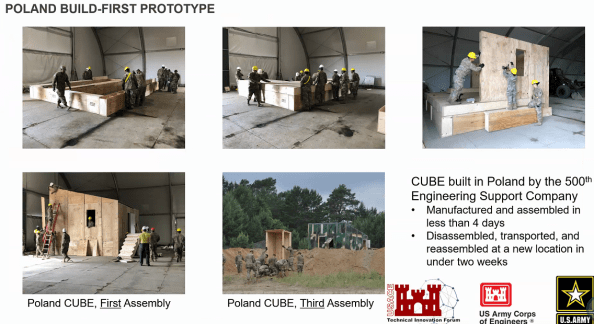
Following first construction, the combat engineers disassembled and repackaged the unit for an MP Company to re-build it. With some guidance they had only two panels left at the 40 hour point, showing that it is suitable for non-combat engineer soldiers with some training.
The units are manufactured in Camp Pendleton, CA taking about a week each, including packaging for shipping. When using the NATO Stock Number (NSN) ordering system they cost $8,200 but can be purchased and installed by contractor for around $16,000. Special requests such as extra width; finish (try and spot the camouflage in “Third Assembly” in the figures above) or tin roof can be specified but add to cost and manufacture time.
This is an interesting concept, which I think has some merit for the future. There are many options for deployable technical accommodation from tents, through ISO container based structures to semi-permanent/permanent, which all offer advantages and disadvantages. A detailed requirements study is of course required but this option creates a healthy, structurally sound environment in a fairly short time for a reasonable cost. Some of the applications, I can see CUBE being used are across the “operations other than war” spectrum: disaster recovery; humanitarian assistance; training missions, for example.
Further Information
I saw on the BBC, another interesting innovation by Ten Fold Engineering which may have application in military structures in the future, “The Amazing Homes that Build Themselves”: https://www.bbc.com/reel/video/p06ywmw9/the-amazing-homes-that-build-themselves
If any presentations in the complete schedule are of note to anyone please let me know and I will approach the speaker.
The majority of USACE research is conducted by ERDC or their subsidiaries around the country. Fortunately, a PQE Sapper is based permanently there, who can find the right POC for any information you may require.
I would be keen to hear any comments people have or first hand experience of similar technologies/projects.
 Holdfast Training Services Trial Blog
Yup,
We used AR in the Wing last year with the Tp Comd course for briefing FPE. Unfortunately although we can use it as a teaching aid it is not on any Role Performance Specification and so not in the Course Scalars and on ISpecs. The Infantry TDT have an interest and ongoing project related to augmented reality that the Engr rep is trying to piggy back on but there is no sign of any RE cap badge drive from above; in fact it’s quite the reverse. Pity.
P.S. Who is alit1987?
Thank Richard. That is a shame to hear that there doesn’t appear to be much interest in taking AR forward yet. USACE is putting a lot of resources behind it (probably because of the drive from HQ).
Ali Thompson (E&M 59)
Meant to say, look on the ELE under courses for ‘Visualisation’
Nice blog Ali.
https://rsme-insite.co.uk/course/view.php?id=2005#section-0
This what you are talking about Richard?
The NEB looks like a really good teaching model – never heard of this resource before.
Yes, that’s the resource location. I keep meaning to find the time to create a monolithic concrete structure that breaks down to show integrated slabs and T beams but….
Agreed Ali, AR seems to be the future. AR was used extensively on the Melbourne Metro project where I worked for Phase 2. Everything from training the TBM and Roadheader (underground mining machine) drivers to the public interface. A ‘Metro Hub’ was set up near one of our sites that allowed the public to come in and put on a pair of goggles and explore the stations and underground tunnels. Was very popular and great for local schools. Obviously a very expensive undertaking, but as a publically funded project, engaging the local community was paramount. Think there are still some videos of the AR at this link;
https://metrotunnel.vic.gov.au/library/videos