Childhood dream made reality – Lego meets construction
Whilst doing a bit of additional research for my CI paper presentation I came across a recent interesting news article. It seems that you can actually construct buildings out of giant plastic lego blocks! The pictures below show an urban training area being constructed at Camp Taji, Iraq by an Australian and New Zealand task group (news article here – 13 June 2019). The buildings were made using a system devised by a company called Everblock (official site here). The blocks claim to be durable and reusable which makes them potentially of interest to military construction. The blocks are also lightweight meaning faster construction, less operator fatigue and potentially less risk of lifting injuries.
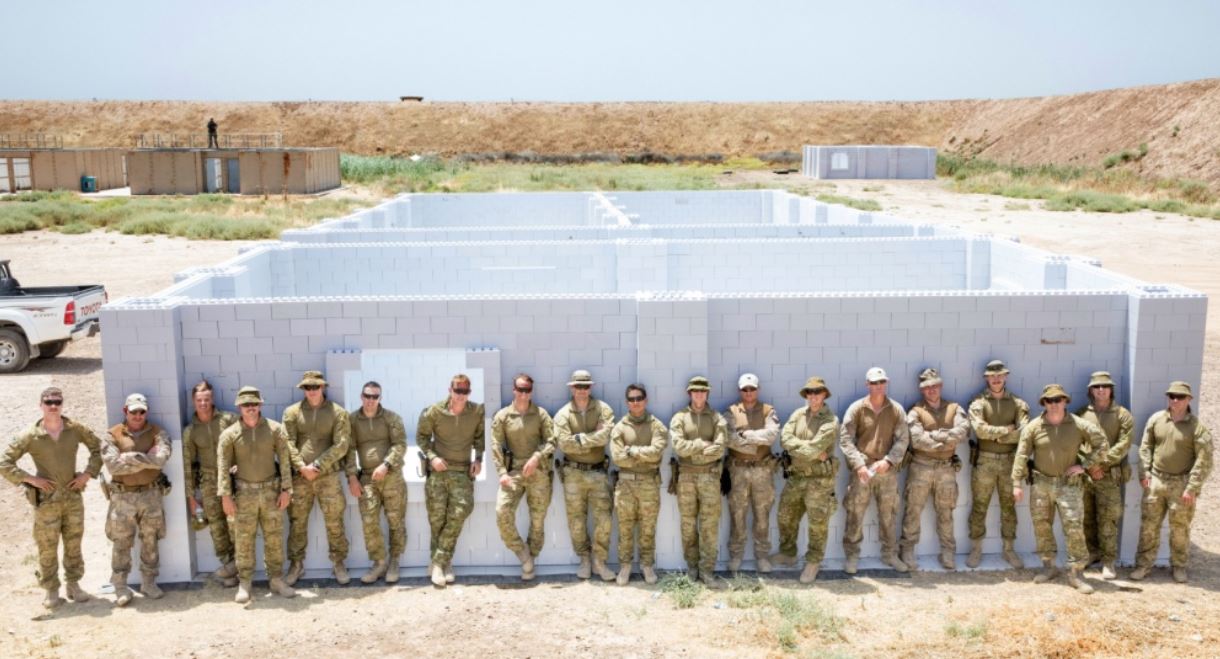
Having looked at the specifications it would seem that there are some fairly obvious limitations. These include poor thermal resistance and a limited resistance to fire (including toxic chemicals that may be released in the event of a fire). Whilst the system includes a dowel option to improve the building strength, I would be a little hesitant about building greater than one storey without more information. For these reasons I can see why they have only chosen to use this system for urban training at Taji, rather than as habitable structures. If anyone knows anyone working at Taji I would be very interested to get in touch to get further information on this project.
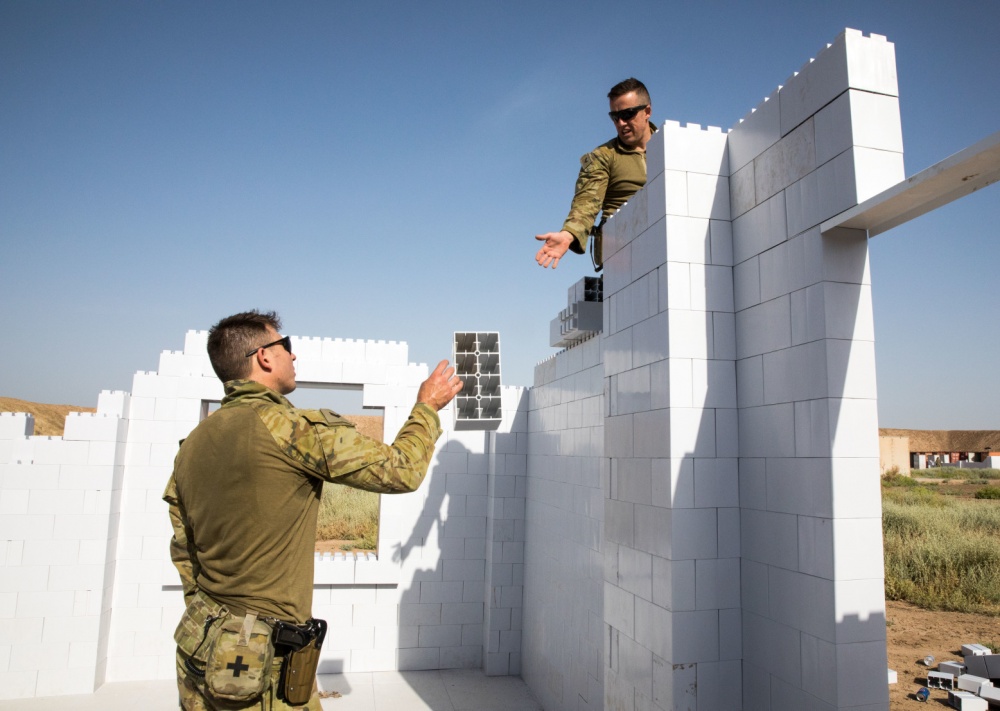
Limitations also mean that a roof structure would need a separate design. I’ve seen examples using timber or steel stringers with corrugated sheet roof cladding. Everblock also produce modular flooring though I would think that foundations might provide a challenge due to the minimal tolerances of building this way.
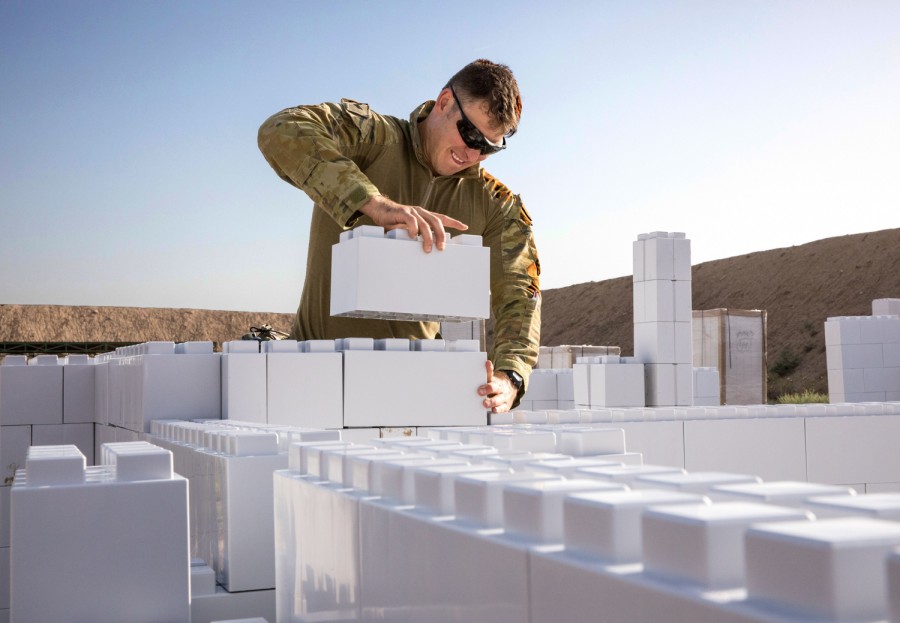
One option that might be interesting to explore is using recycled materials to make in-situ blocks similar to the Everblock system. Cement could be mixed with recycled plastic to potentially produce concrete blocks similar to this with improved thermal and fire resistance characteristics.
Finally Everblock have an online block builder here where you can relive part of your childhood and design your very own giant lego construction!
 Holdfast Training Services Trial Blog
Hi Al,
My boy loved your article. The UK STRE(ME) does a lot of work in Taji and is collocates with the RAE in Minhad. They might be able to get some info for you. Will Stott is the 2IC of the team at the moment.
Having recently returned, I wasn’t aware of the this project but, a US contractor (SOSI) has monopoly of Facilities Management and Infra Delivery on site. I suspect the RAE got away with this because it was for trg.
Given the IDF threat at TAJ this wouldn’t be my first choice for construction. Personally I am a big fan of plywood for FIBUA houses. Easy to come by and repair when you shoot through them. This seems excessive. I’m surprised as the Aussie have a good chippy capable there.
Regards,
Doug Nelson
Doug,
Thanks for your comments, I hadn’t considered blast damage; I can’t imagine these blocks would stop anything and just create additional fragmentation. Plus I’d hate to be the guy who has to take a large part of the building apart to replace one or two shot-up blocks!
Might have more legs in a more passive environment like disaster relief, building temporary shelters or storage.
Al
I think a big problem for use in a disaster relief area would be the logistical footprint of bringing them into and moving them around theatre. An ISO full of these blocks would be carrying a lot of air. Similarly there is a perception issue that displaced persons like living in something that feels like their normal dwelling (see page 14 A2.2 https://www.ifrc.org/PageFiles/71111/D.03.a.01.Plastic%20Sheeting_Englis.pdf).
Do you know what the cost of these is? As you say there may be more mileage in it as an idea if they can be produced locally using appropriate waste material.
Colin
Colin,
Each full size (30x15cm) block is around $7.30 (around £6). I made a very simple structure the same size a a 18′ x 24′ tent and it worked out at 1500ish blocks at around $9,300 (£7500). That is without the roof! That means you could fit two 18×24 structures (without roofing) into one 20′ ISO. Compare this to your standard tent of the same size and you can get five into the same ISO. Don’t know how much they cost though I would think a bit cheaper than £7500.
Al
Yeah that is expensive. The UNHCR Shelter design catalogue gives you some idea of costings (https://cms.emergency.unhcr.org/documents/11982/57181/Shelter+Design+Catalogue+January+2016/a891fdb2-4ef9-42d9-bf0f-c12002b3652e).
For example a RHU shelter from the Ikea foundation (approx 18 x 11ft) is $1150. A permanent L Shape shelter from Iraq in concrete/blockwork with electrics and plumbing was $7145.
I imagine the cost could be reduced significantly with higher volumes or if you could make them yourself using recycled materials instead of relying on the manufacturer.