Tearing it up
Having spent over 3 months watching 5no 13tonne excavators peck and break at my structure level by level (my first blog) a change in tactic has excited me enough to share.
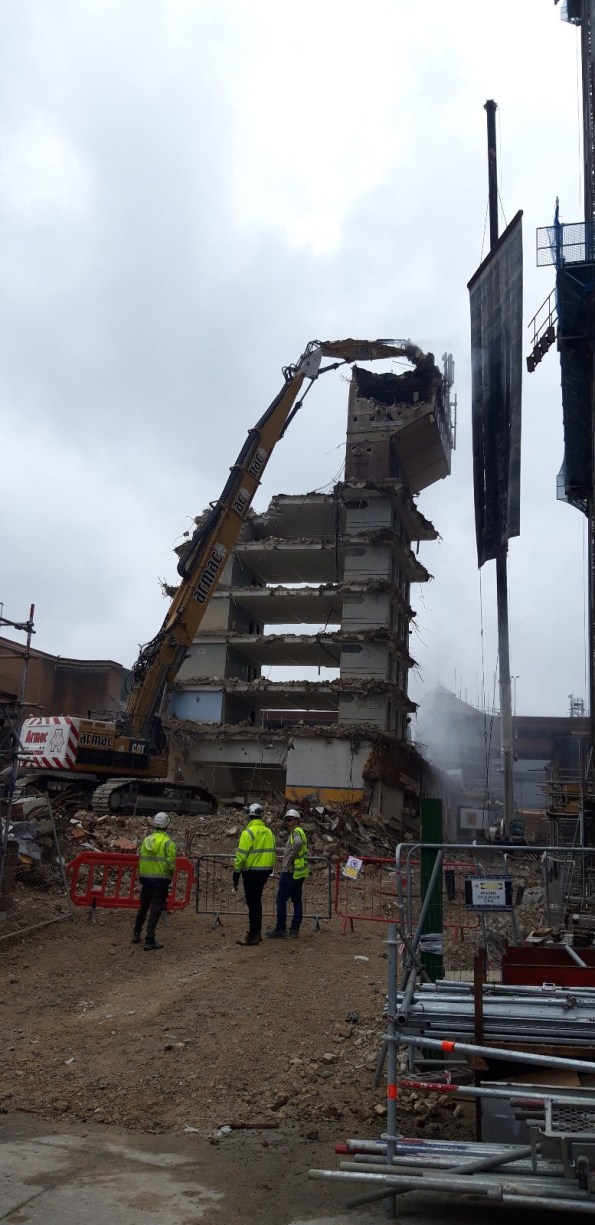
Effectively due to the phone masts fixed to the central core not being decommissioned in time the central core remained upright while the rest of the building was demolished down to ground floor. This left the quandary of how to demolish the remaining core after the masts were finally decommissioned 3 months late.
The same tactic could not be employed as there was no ramp in the core which the plant could drive down so a crane would need to have lifted them from floor to floor. Also an entire scaffold wrap would have needed to be constructed around the core to offer edge protection, dust suppression and access to the workers. All of this was not impossible but potentially long winded.
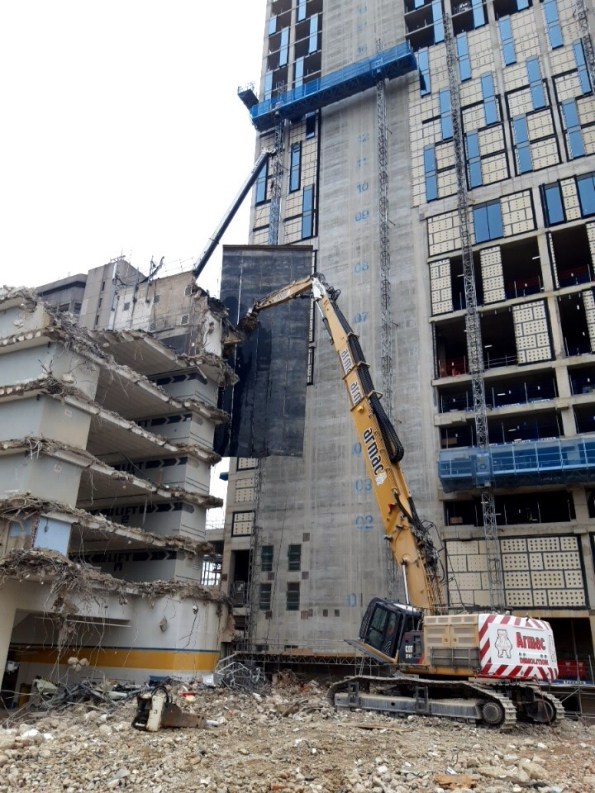
Instead the decision was made to pay for a 110tonne monster to come to site with an “extra long reach excavation arm” and demolish everything from the ground. This raised issues such as trying to suppress dust from the ground would have been impossible and flying debris at 40m flying around site. The solution- the long reach arm has a host attachment that sprays water from the breaker onto the slab as it goes. A large crane will hold up a rubber Matt to prevent debris hitting adjacent construction with an exclusion zone at ground level.
The site of this bad boy on site has produced a bit of a viewing gallery and some buzz on site so I thought I would post pictures. Any questions on the decision making or added risks feel free to ask.
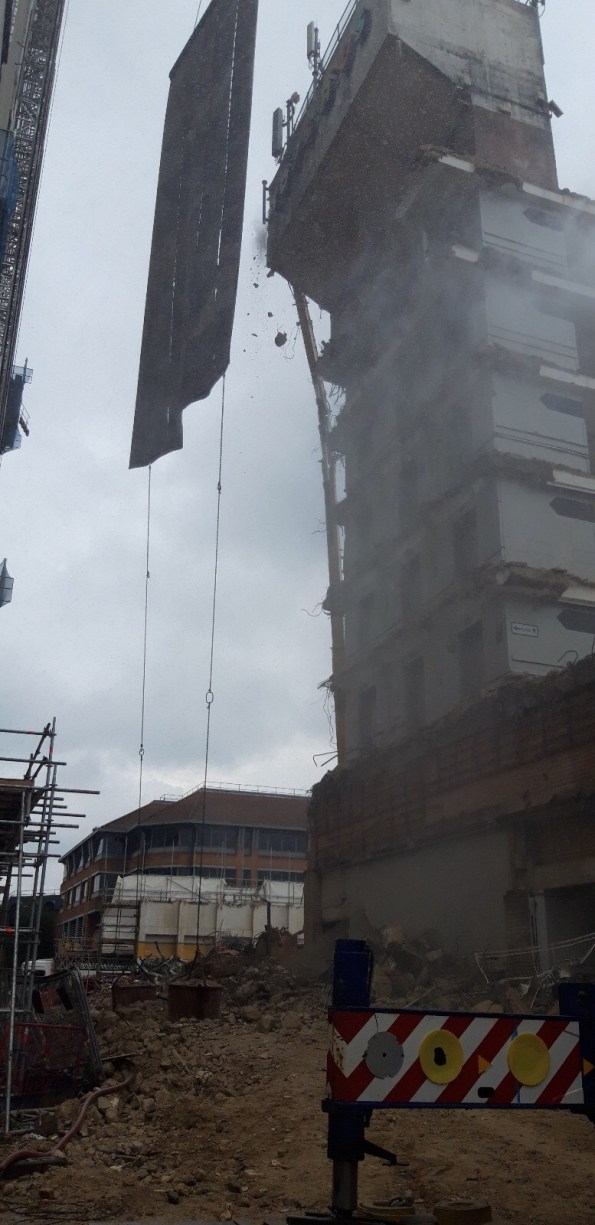
2 concrete sacks preventing the rubber matting twisting or glittering into adjacent construction

 Holdfast Training Services Trial Blog
Ok that’s quite a demolition beast. What attachment is it using breaker or nibbler, i.e. how is the actual fragmentation done? Presumably the opposite tower and linking floors were retained as some sort of concept that the tower required stability to be provided externally despite the fact they have just slip formed two on site? Does much debris actually hit the rubber mat?
It switches between the two attachments. It prefers the muncher but where it can’t get its jaws around the bit it wants it switches to the breaker. The switch is fully automated and quick.
The machine works in a Type writer style movement across the whole width as the slab and second tower are assumed to provide stability.
Not much concrete debris is hitting the mat tbh however the lighter elements of the structure coming down (plasterboard, sheet metal) do tend to. The loading calcs for the mat were based on wind loading rather than impact loading.
Ash, I have recently just started reading the blogs again and was glad to see someone else is being subjected to the mad world of demolition. I did a previous blog on this here – https://pewpetblog.com/2016/04/05/some-demolition-gratification/
I remember on our site there was a requirement for the mattress (aggregate layer) to have a plate bearing test to determine its suitability for taking the load from such a large rig – have you had any issues like this?
We also had issues with structures under the site – a dual carriageway and some service tunnels – which had to be frequently monitored to reassure the council we were not damaging their pre-existing infrastructure.
All the best,
Chris,
We did not do a plate bearing test on the services protection for the crane as the calcs determined that 750mm of arising would distribute the load so much that it would not be more than normal road traffic, when the actual piling mat is constructed we will be doing plate bearing tests.
We have surveyed points on all our existing structures that we monitor and also strain gauges at points too to give the client peace of mind (and to protect us from claims)
I am interested in your blog that the decision was taken to go let’s call it ground level demolition rather than top down demolition. There was clearly a different risk appetite regarding adjoining infrastructure on your site than mine (something I am planning on writing my next TMR about). I know Birmingham well and I find it interesting considering the proximity to some significant infrastructure on your part. Even in that video the size of the arisings that were hitting the floor would have been completely unacceptable on our site. Was any of the demolition on your job done top down and if so what were the reasons given for the change?
Ash,
Roger that, the concern was around the Bearing Capacity of the mat to support the rig effectively so it was not unstable.
You’re right, there was some significant infra near that site – the Town Hall and the Museum & Art Gallery predominantly. That video captures probably one of the largest arising to fall from the structure in a single drop, it was probably the contractor getting excited there was a drone on site. Along with the “piling mat”, the ground was protected with huge polystyrene blocks to dissipate the forces from impact – combined with a significant exclusion area around the demo site, this was deemed sufficient.
I didn’t consider top down construction, I would have thought either the floor space to operate a rig from was too small, or the loading capacity for each floor not sufficient. The type of structure is likely to be a consideration too. Each floor was a ring with an open atrium in the centre that raised up 7 floors.
I would guess there were cost implications too, the initiation costs of getting two UHR (Ultr-High Reach) excavators on site probably made it more cost efficient to use them as much as possible.
Chris,
What were your experiences with dust and vibration monitoring? Did you get many complaints?
I see your ultra long reaches had water cannons attached on the arm as did ours, however we also had huge dust buster cannons around the site to prevent dust leaving site. It seemed that even this was not sufficient as we still had constant complaints. Our vibration tolerances are very low due to the live substations underneath the demolition. So we have 5 monitors around the site as well which are set to a sensitivity of 3ppv.
We had monitoring stations for dust and vibration around the site, not sure what our tolerance was for PPV though, I thought it was higher than 3. Each station had a traffic light system for visual alert when either dust or vibration was too high – if it alerted it was the responsibility of the demo sub-contractor to notify us and rectify the issue. Green – good, amber – rectify, red – cease works and come up with a new plan. The demo subby also had a audio alarm in their container which would alert in line with the traffic light system.
We got loads of complaints, mostly about noise as we were next to a hotel. But we also got complaints from the BMAG and the Town Hall too. The Birmingham Conservatoire is adjacent to the site, so we had to stop during recitals etc. The site had a liaison manager who had to smooze all the local stakeholders to get them on side – worth his weight in gold in keeping most of the locals on side. He was in this dedicated role, but no reason why a polite, well turned out construction manager or other couldn’t take it on.
In certain locations we had portable monitoring stations (just the size of a deck of cards) for vibration – this was an easy fix to allay fears of adjacent landowners etc that the demolition wasn’t going to affect them.
As far as dust went, we also had canons on the site – the issue we had was the supply of water to them. We connected into a stand pipe for the water but later had issues with the bulk meter on this which led to commercial issues when paying for the water. Worth getting a look into who is providing the water and who is going to pay for it – yourselves or the sub-contractor.
Chris,
would it be possible for you to send me your AERs as I would like some more detail about your job as I will be referencing it in my next TMR. My email address is ash.c.dale@gmail.com