Precast pile de-heading
Hi all! I just thought I’d put up a quick post about a new technology/process I have been involved with this week.
Having almost completed the first stage of precast pile installation on my site, we are ready to start de-heading piles in preparation for pile cap construction.
Pile de-heading is recognised as a risky activity within the construction industry. Eventually, approximately 4500 precast concrete piles (13,500 individual pile segments when considering spliced piles) will be installed across the east zone of the West Gate Tunnel Project. Given the inherent risk of the deheading activity, a concerted effort has been undertaken to investigate the safest ways to undertake each stage of the process.
A lot of thought and consideration has gone into the different methods available to remove or reduce the people and plant interface, a High Risk Construction Work Activity under Victoria Worksafe (Vic State version of HSE), which are activities involving people working in close vicinity to items of plant.
De-heading or pile-trimming refers to the practice of cutting piles to a pre-determined level after they’ve been driven into the ground to the required depth or capacity, which is around 30 metres generally across the East Zone and 12m-14m across the scope of works conducted thus far on my area of responsibility.
Traditionally a number of methods have been used to perform the de-heading, including workers using hand-held ‘demo’ saws in combination with plant to support and remove cut sections. Typically, this activity involves a crane holding the pile, while workers saw cut the concrete and corner longitudinal reinforcement This involves a lot of people/plant interface and other safety risks such as: falling concrete segments, potential silica dust inhalation, injuries associated with repetitive tasks (such as ‘White Finger’ vibration injuries) and exposure to loud noises.
After investigations into safer options with the piling subcontractor ‘Keller’, it was decided a much safer method for these works was to use an excavator with a de-heading attachment.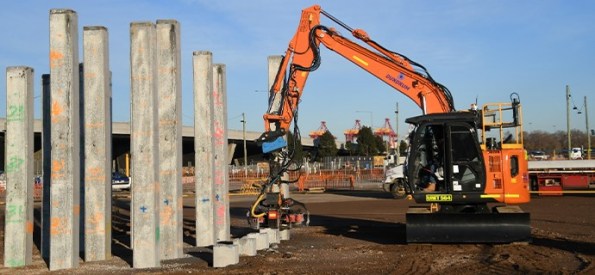 How does it work?
In simple terms, after the de-heading attachment is connected to an excavator arm, it connects to a pile and its blades cut through the reinforcing steel at each corner. Another excavator then moves in, grabs the pile and snaps it at the cut-off point and then carries the excess length of pile directly to the waste skip for removal. This technology is not entirely new and has been used before in Australia, but rarely, as it suits projects with a large-scale piling requirement, such as ours due to the increased costs.


The main benefits of using this pile-trimmer method include:
1. Safety: as this process is undertaken via an excavator, it completely removes the people/plant interface.
2. Environmental improvements: it’s quieter than other options, such as jackhammers, while dust dispersion is mitigated as the device ‘self-doses’ water during cutting.
3. Increased productivity: this method is quicker than other de-heading methods, meaning increased cost of plant/technology can be saved against traditional methods through saving in time and project schedule.
4. A better result: the end of the cut-off pile is ‘cleaner’ than it would be using other methods.
What’s next after the pile de-heading?
unfortunately, the plant trimming method cannot be used down to the final cut-off level of the pile. After the piles have been trimmed to the correct height (300mm above the surface), the next step is known as breaking-back the pile. It involves digging around the piles to the cut-off level, then chipping away the concrete to exposing the reo bars.
This is another process that will be performed mostly by excavator, with only minimal use of a jackhammer at the final stage, to expose the reinforcing steel. Again, reducing the risks to workers on site.
This method of pile de-heading is a big step forward for safety across the industry and will likely see increased use in the future, especially with Tier 1 Contractors.
 Holdfast Training Services Trial Blog
Dan,
Looks like a good attachment when you have lots of piles to trim back. We have had less than 60 to do on our sites so have gone down the labour intensive routes. When you get to the break back stage it might be worth keeping an eye out for the workers using angle grinders to cut a level around the pile to prevent breaking back too far when jackhammering as this will create silica dust issues. Also any excavators used for jackhammering on a JH site are supposed to have mesh window covers to prevent concrete from shattering the windows/injuring the operators. Not sure if it will be the same rules on your JV site but the sub-contractors are normally non-compliant.
Hi Mark.
A cost analysis is important to assess if this method is worthwhile. The key drivers are safety and time in this instance. To complete to pile groups of 18 piles (36 total) took only 2 days, which is ideal for keeping the programme going. As mentioned, 4500 piles is Some serious time in the programme so was a clear option to move forward with. We will be jackhammering and using angle grinders to control break back also. How did you QA this effectively, given the volume of piles? We Plan do mark levels with survey and work from there. The silica dust suppression was a big part of getting the Construction Procedure over the line with our Third Party Auditor and control measures are in place to ensure adequate surpression. With the Unions in Victoria having so much influence, it is something we will be controlling on site, and is another reason for using the deheading machine. Not sure if you have such a strong union presence in NSW? But they apply a lot of pressure on safety over here.
We are working under CPB operating processes on the West Gate Tunnel Project so slightly different from what you’re under. But as similar Tier 1 contractors the systems in place are very rigorous (and some time onerous and time consuming), but ensure high levels of safe working practices and control.
With a small number of piles at the precast yard we used the site surveyor to set the levels on each pile with the subcontractor using a laser level to check their work.
For the main bridge piles we cast in hollow tubes so an expanding chemical compound can be used to break the top of the bored piles. The system wasn’t installed correctly for the first pile so a specialist subcontractor has been engaged to conduct the works. They should be starting on site in the next few weeks.
We’ve had the unions turn up on site a few times causing issues but I’m told they’re not as bad as down in Melbourne.
I take it that this is a pile cropper- they have been the only way of reducing the pile to near cut off level for 15 years in the UK? I pretty sure the same there.
Hi John. No, this isn’t the cropper. The cropper comes in once the pilecap is excavated. The pile de-header seen here reduces piles to existing ground level to allow for pile cap excavation; many of our piles refused far earlier than expected requiring significant trimming. The cropper will get us to 300mm above finished level.
Careys have been using a similar hydraulic pile cropper on my site. They seem pretty successful however the only problem noted was the hoses have a tendency to burst, leading to fluid leaks.
Dan, you mentioned that you have to hand break near the pile cut off level to maintain the integrity of the rebar. On our job (although it won’t start for a few weeks yet) we are using debonding on the rebar to the length required so that the concrete can still be stripped mechanically by the cropper to full height. Have you seen anything like this around your site. We are using CFA so it’s easier to manipulate the cage going in than a precast but surely it isn’t impossible to do?
Hi Ash, apologies for the late reply. The rebar hasn’t been de-bonded prior to casting; possibly due to uncertainty of cropping required as exact pile depth can’t be known as piles are driven until refusal/capacity is reached as per set requirement.
We cut the piles to existing surface level, then use a cropper to get to the 300mm above, after which hydraulic jack hammers are used – an issue for H&S and programme given time requirements but proving successful on other areas of the WGTP. The de-bonding agent sounds far more useful, and something we can consider for our CFA piles later in the project.