Home
> Uncategorized > Pile Cap Anchorage
Pile Cap Anchorage
We are currently constructing some pile caps on site. 3,4 and 5 group caps varying between about 1.2 and 2m squared and between 500mm and 1500mm deep. The piles are in place and are being broken out to leave 800mm anchorage standing proud.
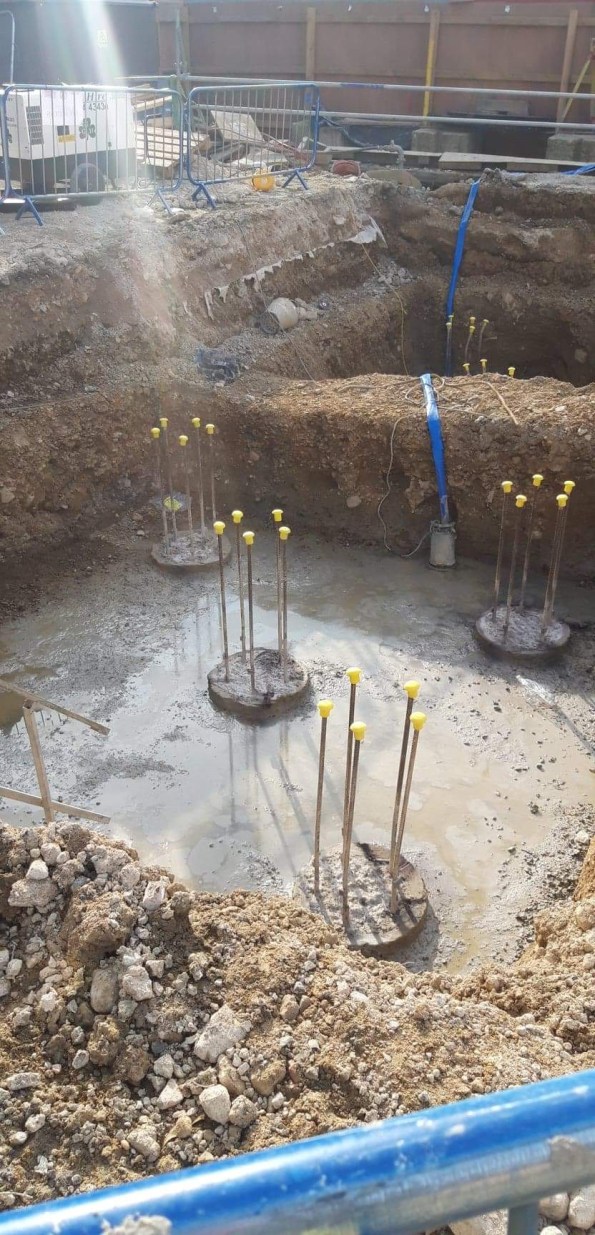
The problem is that because of time pressures the caps are now prefab and dropped in as this is a faster process. The challenge is, how do you bend the Anchorage once an entire cage has been places on top?
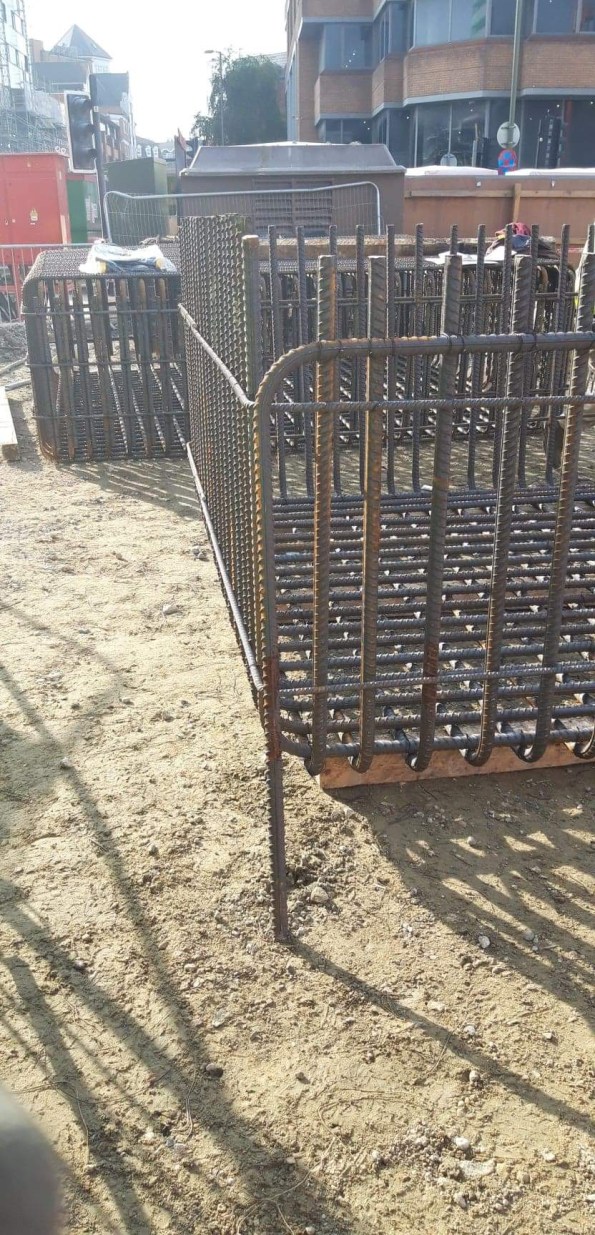
Does the Anchorage NEED to be bent? The 800mm Anchorage does actually stick out above the smaller pile caps as seen below.

Has anyone encountered this and seen a solution?
Categories: Uncategorized
 Holdfast Training Services Trial Blog
What is the anchorage to achieve; and as a rule of thumb , if the bar needs to anchor in tension( say) have you got the 40 diametres or so for it to develop
If there is only compression, then draw the fbd of the cap and tell be what lap you need and where?
The anchorage is 800mm which is 40D of the 20mm dia.
And 40D is a load of rubbish when designing concrete to EC2. OK as a quick check if you think the anchorage length looks ridiculously low but otherwise generally unsafe. You should know this. I believe you should be looking for about 55D in this situation depending upon the area steel provided versus area steel required.
So to Johns Question: Is the pile going into tension or compression and is there an applied shear? What purpose does the anchorage length serve? 40D is great rule of thumb but not correct for design to EC2 – you can calculate the required anchorage relatively easily as long as you know what the steel is doing. Small pile cap implies lower loads so I suspect reduced stress in the steel therefore less requirement for anchorage length.
That particular pile cap was in compression. Also that cap should not have an applied shear. The pile schedule suggests only the piles in the cores are designed for horizontal loads. There are tension piles on site but not on the smaller pile caps like you see in the photo. You’re right about the smaller load. They are 400kn capacity piles rather than 2000kn capacity piles in the bigger caps.
P.S. I’d check the drawings as a first port of call, surely not shown like this!
Ash on our site the pile anchorage bars have been left straight into the pile cap.
The pile cap steel is tied-in situ with cranked longitudinal bars to fit around the pile anchorage bars. The pile caps are about 3m deep so protruding bars are not an an issue for us. To improve production rates and reduce working at height risks the pier base and pier arm reinforcement is pre-fabricated on site using special jigs and then lifted into position
So to clarify mark, it doesn’t matter if the bars are bent or straight as long as they’re incorporated into the cap?
Go and look at your concrete notes or EC2 (which is very easy to read on this) and you will recall that it doesn’t matter if an anchorage length is straight or bent but that a bend must be at the limiting radius or greater in order to avoid stress concentration on the inside of the bend. A bent bar reduces the required length to achieve anchorage. Similarly you can also fix transverse steel or adopt other means of reducing the total length.
Ash, similar to Mark’s comment here, pile caps on my site are also left straight into the bar. To be fair, these pile caps are much larger than yours – up to 3m deeps in some cases and carrying ~21MN into the pile.
However, we have post tension (PT) bars that protrude out of the cap and into precast columns and up to the crossheads. These sit at least 1000mm into the top of the cap which clashes with the pile anchorage in some cases. In these cases we are bending the bars to suit – no detailed design on minimum bend, just maximum radius not to be exceeded – as Richard has highlighted above, radius must be checked on site to ensure stresses aren’t exceeded at the bend. I have some snips of the design drawings if you want to see. The positioning of the PT bars is far more important with very small tolerances on position (5mm in plan and no more 0.2% horizontal gradient on the anchor plates).
I can’t speak for all cases, I can only say what I’ve seen here. As our pile cap is so deep I don’t think it is an issue. I think bars are normally bent when you can’t achieve the anchorage length you require by leaving the bars vertical. (When I did the precast yard foundation the pile bars were bent over due to the shallower thickness of the slab).
On my site the same method as described by Mark has been used. I would be concerned however at the shallow pile cap where the bars protrude out the top, a problem you will have to go back to the designer on. They might make you strip the cage and put couplers with L bars in.
Agree, lifting the cages off, cutting the bas and using couplers to L bars would be a potential solution but one would also suspect that the shallower pile cap is indicative of lower column loads so the steel might not be working that hard and the actual stress versus design capacity could well mean that there is a reduced anchorage length requirement…
Not possible due to the prefab cage. You wouldn’t be able to place the cage back over the Anchorage if they were not straight up. Fortunately I have discovered the cap in that picture is 900mm thick so the Anchorage was too long. They just cut the Anchorage down to size and they are now just sitting straight in the cap.
OK so a solution is arrived at but at risk that little is learned if not careful.
Had the need been to fit L bars the lift cage off, cut back and fit couplers would have left a vertical bar. You then reposition the cage before inserting L bar. Simples.
So how was it that the bars were not cut to the correct length and why did this have to come to the attention of a site engineer before the foreman had checked such simple details as drawings and actual dimensions?
Supposedly the original design had the cages were built to a spec of 50D but the design changed so the pile caps changed to incorporate this change however the pile cages had already been fabricated so they knew they would be too long.
I might add this is all second hand information because I am not the package engineer for this, I simply saw it on site and have had to just ask around.
Ah, so that makes sense. Nice post and a good discussion arising. Well done.
And 40D is a load of rubbish when designing concrete to EC2. OK as a quick check if you think the anchorage length looks ridiculously low but otherwise generally unsafe. You should know this. I believe you should be looking for about 55D in this situation depending upon the area steel provided versus area steel required.