Geopolymer “Earth Friendly” Concrete
It is well known that the production of Portland cement (OPC) is highly damaging to the natural environment. It is high in embodied carbon and embodied energy and its production creates noxious waste emissions – globally, production of 1 tonne of OPC produces roughly 1 tonne of CO2. Reducing the OPC content of concrete mixes has been standard practice in construction for many years, through the use of cementitious replacement materials such as blast slag (e.g. GGBS) or fly ash (e.g. PFA) derivatives, but an Australian company is now marketing a geopolymer based concrete which contains no OPC at all.
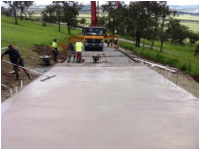
EFC pavement
Wagner’s Earth Friendly Concrete (EFC) uses an alkali chemical powder to activate other pozzolans – cementitious content (GGBS and PFA) – to achieve the binding effect of cement. If you accept that GGBS and PFA are waste materials (which is a separate topic) then EFC can see 80-90% reductions in carbon carbon emissions when compared to a full OPC mix.
Crucially, this product is now able to match concrete in many applications and appears to be commercially viable. The fine and coarse aggregate content remains the same in terms of performance it shows:
- 30% higher flexural strength
- Very low heat of reaction
- Very low shrinkage
- High sulphate resistance
- High chloride ion ingress resistance
- High acid resistance
There are a number of case studies available (wagner.com.au) which show good performance in pre-casting and pavements in particular (including airports) with an interesting foray into sewer tunnel lining. The low reaction heat, leading to low shrinkage, is an ideal characteristic for pavements (especially I imagine in Oz where curing must be tricky in the heat?) and the high resistance to chemical attack makes it a good choice for sewers or other corrosive environments. It even has a clean white finish.
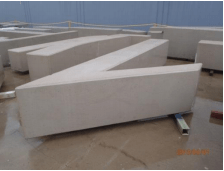
EFC precast
There certainly seems potential for use in the UK in mass concrete applications at least e.g. piling and ground bearing slabs, but I haven’t seen much evidence yet of it’s use for in-situ superstructure pours. I imagine this is a result of the low reaction heat leading to longer curing times (or vice versa at the chemical level). In a concrete frame longer curing means longer shuttering, more back-propping and slower jumps between floors – i.e. it means money – but this doesn’t apply so strongly to unpropped steel decking (composite) slabs so perhaps there is potential there too.
Has anyone seen this in use yet, especially you guys Down Under?
 Holdfast Training Services Trial Blog
Tom,
We didn’t use Wagner concrete on my site although I note their website says they have worked with John Holland. The company grew out of Queensland so might have a stronger footprint up there.
The concrete supplier for my bridge project was Boral who from memory provided a blended mix of OPC and GGBS (I think there may even have been some PFA in there too). This was done to improve durability and reduce Alkali-Silica reaction from the constituent materials. Although primarily for durability reasons I’m sure some of the other benefits you mentioned were an added bonus.
What might be interesting to note is the temperature is closely monitored during summer pours and limits set on maximum concrete temp so we had all kinds of probes and data loggers embedded in trial mixes and large pours to show compliance with the standard. I’m not sure what would happen if the temperatures were exceeded mid-pour. I suspect an NCR and plead acceptance would be the site approach.
On the project there were also maximum limits on 28 day concrete strength (100MPa) as they were worried about the concrete becoming too brittle. This required lots of technical mix design and concrete trials to get the mixes approved. There were also lots of admixtures used which resulted in some interesting concrete behaviour.
Finally it’s worth mentioning for those not out here that every state has its own equivalent to the Highways Agency. Although there is the national Australian Standard each organisation has their own standards for road design and highway structures which takes precedence. Each organisation has its preferred concrete specification (mix requirements) and a lot of work has to be done by contractors to get a new mix approved for use. The consequence is that it is easier and quicker to use the a ‘pre-approved’ mix using the same supplier and constituent materials are available than seek new approvals. This can stifle new material innovation. As I imagine in the UK the contractor will specify the performance criteria to the supplier who will design new mixes to match the requirement. I guess if Wagner had been engaged we may have gone down the route of no OPC concrete.
In your research did you find any information on how the no OPC concrete behaves in comparison to the normal stuff and if any different labour skills or equipment are required?
Interesting to see their website promises earlier strength gain as well but no mention of stiffness. Are you using it on a project?
Not heard of it…as with all market entrants there will be trepidation on knowledge of long term performance I’d guess
Of the 2500kg of stuff in concrete about 300kg is the pozzolan; 150kg is water and the rest is aggregate.The greening of the aggregate might therefore be fairly important; in the last years I’ve seen re-blending of ground glass with waste rock fines to give a sand with appropriate grading; the use of ggbfs with rock fines and pressure treatment to give a vermiculite-like coarse , but lightweight aggregate.
Up in these parts, of course we don’t produce pfa as a waste product anymore and the amount of ggbfs is steadily dropping. Interestingly the ggbfs is largely associated with old Bressemer process steel making – if you want carbon footprint look no further!
The steel industry ‘gets away with’ exhibiting better green credentials by leaning on the fact that electric arc furnance re-use scrap…unsurprisingly these furrnaces produce less than one third of the slag…..