A blog on blogging…
The PET Blog so far for me has been a scary place, full of complex Civil treatises about mud and concrete. So I questioned – what do PEW want from a blog?
Now that I have moved to Phase 3, I’ve discovered a similar concept at Arup. Called ‘Yammer’, it seems to be an avenue for the sharing of short dits that could be useful across multiple project disciplines, or to succinctly frame a problem and ask for advice from across the company. Being a much larger organisation (c.14,000 personnel), the blog is split by discipline/area and includes Project Management, Building Services, Bicycle Users Group etc etc.


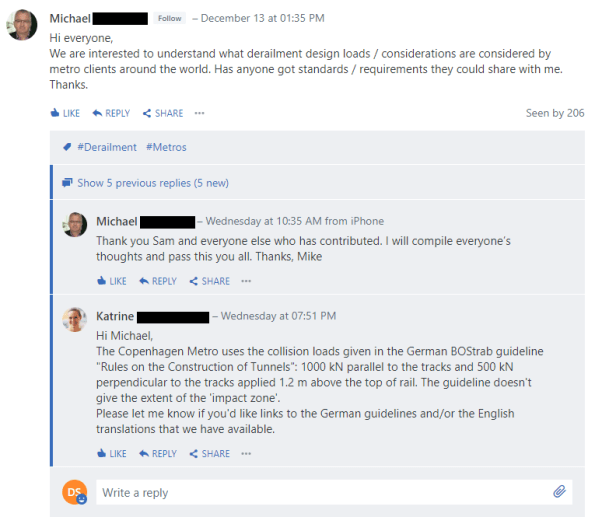
Arup blog examples from ‘Yammer’
It has made for some interesting reading and has demonstrated, at least for me, how useful a blog could be as a knowledge sharing device. The short, quick nature of their posts takes little from their day, but the benefit is obvious. I also think that keeping it short promotes involvement from a wider audience. But this is just their way of doing things.
I’d be interested to hear what you guys think about what the PET blog should be – What do we want from it? Is it being used in the best way? How should we be using the blog? Should we set Cheese and Groom a word limit?
Have a good Christmas and NY! Back to the beach…
 Holdfast Training Services Trial Blog
Yammer is also used by BP. It is used as a community site for sharing ideas, highlighting success but also for leaving feedback and requests for development of IT programs and the like.
In the wider BP and more specific groups, the comments can be helpful, people share similar situations and how they dealt with them. I say situations as the topics vary considerably.
Helpfully there is even an IET page for people who are looking to charter (very limited in what has been shred on this though!).
I think there is lot of similar stuff about – which is great as it can be tailored towards what ever it is you’re interested in. Specifically I’ve been using the “Laser Scanning Forum” and the BIM forum on the “IET Engineering Communities”. I like glancing through the PET blog to see what everyone is up to and what challenges they are facing, but I do feel like guys are just dumping AERs on there, it’s not very appealing.
As the majority of these blogs/communities are focussed around niche areas, I think the PET blog needs a clearer definition – which in my view should be based around some common ground – the UK Spec. What competencies are guys struggling with, what ways have you found to achieve these?
Not that I don’t love a bit of re-bar.
The blog replaced a requirement to provide a daily site diary in every AER. Believe me producing a site diary specifically for AERs on top of any other requirement to record observations and decisions was a pain you don’t want to go back to. The idea, therefore, was to remove the diary and allow a blog every two weeks or so in its place. The idea is to share experience in a pithy post that describes interesting activities and challenges. There was no expectation that the post would come with a full blow by blow account or a solution. One advantage of moving from diary to blog was that it goes part way towards the professional obligation to assist others in their development: an opportunity to remain aware of other disciplines and the current hot topics on sites. guidance given before leaving Brompton was post little and often; more photos with captions and less acreage of text is good. Does that help?
Forgot to say – I have thoroughly enjoyed reading Toms and Dan’s posts and all the others. I feel I actually know what they are seeing and doing and my own CPD is assisted. There are far too many would be professional engineers out there that I know nothing about in terms of their development and from whom I have learnt nothing.
Although the project I worked on at Fort Meade was small (relative to a company) the workforce was spread out across different security areas.
As a solution to aid in ‘partnering’ they set up a secure blog similar to what you have mentioned with Yammer. This worked quite well at encouraging short sharp discussion and prevented finger pointing etc. It also allowed everyone across the project to develop and understand what was happening under different disciplines, which was vital as inevitably there was crossover.
It was regularly brought up in team meetings that it should be kept that way to encourage everyone to use it, the final in-depth discussions were expected to be face to face. Occasionally people were told to rein it in to preserve the accessibility.
When I originally came up with the idea of the Blog, it was intended to be used very much as Richard has outlined. It was also my intention that as we used and became familiar with what the platform had to offer in terms of the professional development of the students, it would evolve and new types of contribution would start to emerge. This has happened with the very technical treatises that some of the civil students are currently posting and this is really gratifying to see. There will always however, be a place for the quick photo of something on site of interest, or some yet to be posted idea that encourages all of the students to engage with the Blog.
My intention was to have a platform that shared the learning being gained on the various sites around the world, cultural (who can forget Matt Fry’s country and western posts), technical, managerial and personal. The stuff Yammer is being used for looks very much in line with this intent and I am sure that there is yet more great stuff yet to be found that will find its way onto these pages.
What I hoped it would never been seen as though is a chore. The act of discovery and sharing the insights gained through the process of discovery is in the DNA of every engineer I have worked with, whether they realised it or not at the time. I had intended and been gratified to see over the years, the Blog has become a place where this can and does occur. When it started, I wasn’t interested in prescribed formats, recommended word counts or even a formal time table for posting. I just wanted people to dive in and share. What ever and when ever a student or member of staff places something on these boards that is exactly what is occurring and I get a tremendous amount personally and professionally from these contributions.
Have a great Christmas and a Happy New Year you all. Jim.
According to the Cambridge Dictionary, A Blog is a REGULAR record of one’s thoughts, opinions or experiences.
To stimulate your thoughts and opinions we could provide a monthly prompt; sustainability, contracts, innovation etc. In my opinion this would constrain the freedom of thought that a Blog is meant to promote.
I would like the Blog to be an area for open discussion on engineering topics, free from criticism., but not alternate views.
Sounds like we all agree that short, pithy and regular would be preferable for blog posts (it also sounds like a description we could put to at least one member of our respective social circles). For me the key phrase however is “regular” as MT highlighted.
Personally I find it very difficult to read long posts, I have the same problems with long documents and involved text so I gain more from the discussions that are held in the replies than the post itself; the post will typically have some kind of bias which usually ends up being challenged by others so the OP also has to reflect on what is said rather than a “fire and forget” approach.