Italian Bridge Collapse / Textbook Demolition Job
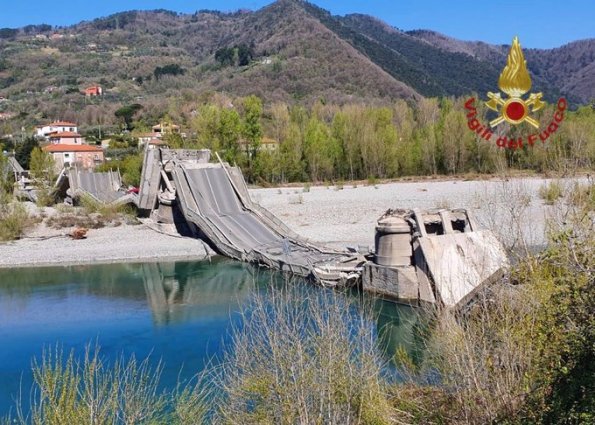
Thanks to lockdown in Italy only 2 people were injured when this 240m bridge collapsed at the beginning of April and, perhaps as a consequence, it has seen less media coverage than the Genoa motorway bridge collapse in 2018.
The bridge had six 40m RC arch spans between stone piers. All spans collapsed completely and at least two of the five piers were toppled in the process leading to a pretty thorough demolition job.
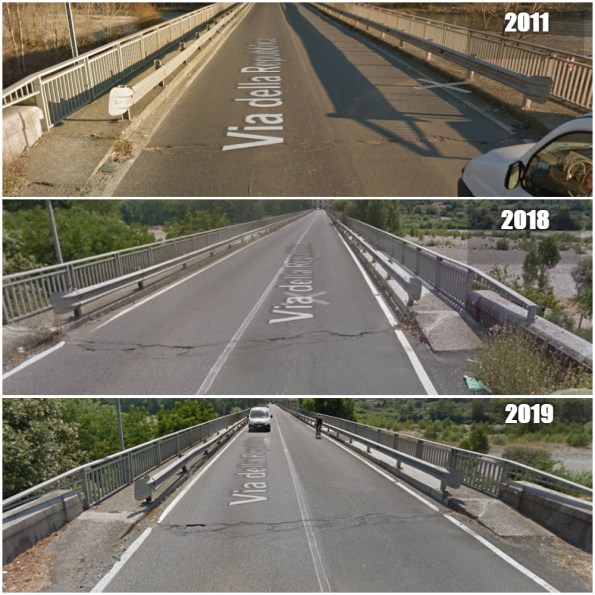
The state of repair of the Italian road network is clearly under considerable scrutiny and it seems likely that this bridge collapse is, at least in part, due to poor inspection and maintenance. Cracks appearing in the deck can be seen on street view and have been growing since 2011. These cracks were inspected in 2019 but no action was taken.
There is still no official report on why the bridge collapsed so spectacularly but there are two interesting NCE articles on it here and here. The suggestion in the articles is that one of the piers was undermined and once the first span collapsed the end thrust from the neighbouring arch caused the pier to tilt further leading to a progressive collapse of each subsequent arch.
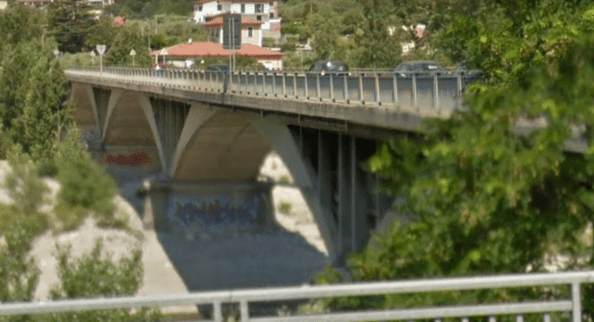
We would classify this as an open-spandrel concrete arch bridge and, although the spans are structurally separate, the bridge has elements of continuity in that all spans are required to be working to hold up the rest. Clearly this bridge has not been designed with consideration for robustness as we now know it (construction finished in 1908) and the design appears to harness the weaknesses of both simply-supported and continuous bridge design; it relies on neighbouring elements for global stability but without gaining any benefit to load transfer through fixity and tie forces which could have saved several spans.
Ultimately this textbook bridge demolition appears to be the result of a fairly simple geotechnical failure. In Pam 4 terms, how much PE would be saved by demolishing a single pier compared to dropping each span, if an accurate assessment of the bridge’s failure mechanisms could be pre-determined?
 Holdfast Training Services Trial Blog
Very interesting Tom.
In Phase 1 we discussed how critical post tensioning is. On my Phase 2 project I was told the biggest risk to PT bridge erection is fire causing the PT to relax and the bridge to fail under self weight.
A similar approach could be used to relax the permanent PT but may be harder to achieve if the tendons have been grouted. An alternative approach would be to target the anchor blocks/blisters with PE for a similar effect.
Key to a more efficient demolition would be understanding the PT design to determine the most vulnerable place to target. This is particularly important when non-continuous PT is used to provide additional redundancy against structural failure.
Hi Mark,
Funnily enough, we’d had a brief discussion about this in work before I’d started digging into the articles and one of the Directors suggested it might have been a PT failure to lead to that level of damage. I do know that the Pam does not differentiate between PT tendons and rebar but it does caveat that with the option to apply the principles using your own knowledge.
Considering this further, the greater risk to the hypothetical Tp Comd sent to dem this bridge may not be using more PE than is needed but causing more damage than intended with limited PE. For example, if you only need to drop two of these spans to give a suitable obstacle (80m gap), you could achieve that with the demolition of a single pier; based on this example it seems likely that such an attack would give you 6 spans for the price of 2 and unknown further collateral as well.
So not good if you’re planning for the long-term social needs and reconstruction…
Assessing the bridge loads and treating the arches as 2-pin or 3-pin would enable the determination of the horizontal loading at the pier. If this could be resisted you may prevent complete structural collapse.
I can’t see any practical alternative in this case. Propping between the piers to prevent disproportionate collapse of subsequent arches is one option but impractical for most combat engineer scenarios and the props may not be effective for explosive demolition. HESCO could be used to add additional horizontal restraint to a pier via mass and friction but I envisage challenges with the terrain, flowing water and keying it in.
Any other ideas?
Crater the approach, cover it with observed fire or destroy a less critical asset on the same route. You simply don’t want to mess with it explosively unless you want to rebuild te whole thing afterwatrds. I think, however, that there is likely to have been an issue with the piers en masse such that the failure of one necessarily lead to the dominoe effect. Had they not been close to failure the progression might not have arisen.
Surely the greater challenge here is to ask if the deck level cracks at expansion joints have anything to do with this failure at all, and, how might it have been possible to foresee a stability issue with a pier before any movement occurred. Is the design necessarily flawed by lack of resiliance, and if so, shouldn’t this be apparent without any need to look at the actual bridge itself?