A night in the life on a rail project: how much time do you have to work on the night shift and how many people does it take to do anything? Spoiler: not a great deal and flipping loads.
As part of one of my ongoing jobs, I have been asked to facilitate and manage the surveying and site investigation of Sunbury station and surrounding areas for a future upgrade and track widening.
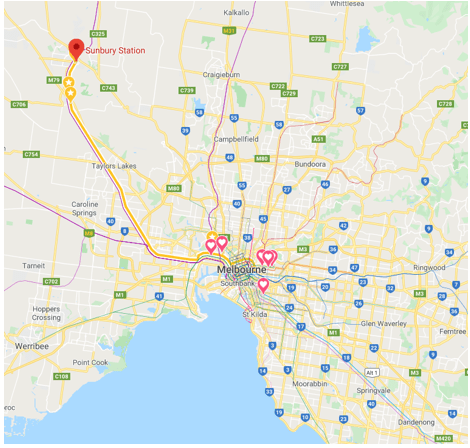
As part of this project, there was a requirement to capture the last 10km of track from Sunbury towards Melbourne digitally. This involved mounting a machine onto a ‘hirail’ modified ute and driving up the track. The data capture is akin to google street maps but captures enough data to create a 3D model of the surrounding area and skinned with high quality photography. Accurate to about 5mm. I can write another little blog on this kit if people want to get their geek fix. Photo below shows the data capture machine mounted to the rear of the ute.
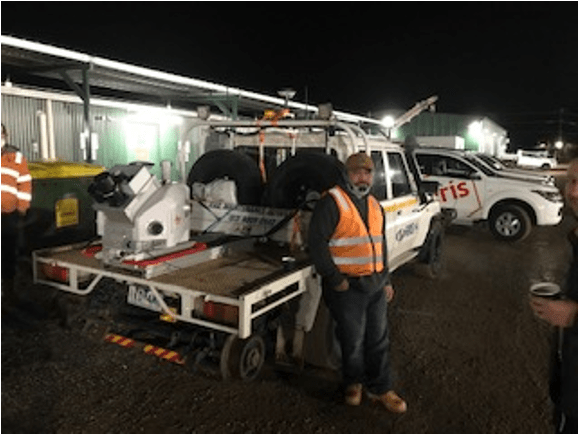
The hirail modification can be seen in the photo above too. The ute operates like normal, but once over the rails the steel wheels that are raised in the photo at the rear of the vehicle then lower and engage with the track. The ute’s normal wheels drive the vehicle forward, the rail wheel keep it on track.
Working on the track is called an occupation (occo for short; Aussies abbreviate everything). This type of occo that occurs over night is called an ALBF (After Last train at night Before First train in the morning).
Originally, I had thought I would need a lot less manpower and have a lot more time than I actually did for this simple job. I’ll run through what we actually needed.
The Plan
Manpower and Resources
- HiRail Ute
- TVO (Driver)
- Data collection wizard (Veris)
- HiRail Unimog
- TVO
- Signals Engineer
- Traffic Management
- 2x vehicle with 4 crew (Holden Road Xing)
- 2x vehicle with 4 crew (Gap Road Xing)
- Free running Vehicles (each in their own Ute)
- Project Manager (me)
- Track Force Protection Coordinator (TFPC)
- Survey Manager
- Track Certifier and Supervisor
- Level Crossing Controllers
- 1x TFPC at Old Calder highway
- 1 x TFPC at Watsons Road
Permits and Certifications
- Permit to Work
- 2 x HiRail Vehicles must be track certified, John Holland inducted, isolation checked and PlantGuard checked. (All different online systems, need VRN of vehicle)
- Each member must ‘sign on and have their ‘Rail Industry Worker’ Card checked for currency.
- 35 page Works Group document.
(Lets skip to…) What happened
At midnight I briefed the workforce of the plan, H&S and all that good stuff. Then they had a bit of time to get into position. When planning these things, you don’t actually know exactly when the last train will pass AND the safety team have put out their signage. The last train, I learnt, was 0130hrs, the works group plan told me that we must be off the track no later than 0400hrs. This gave me 2.5 hours to play with.
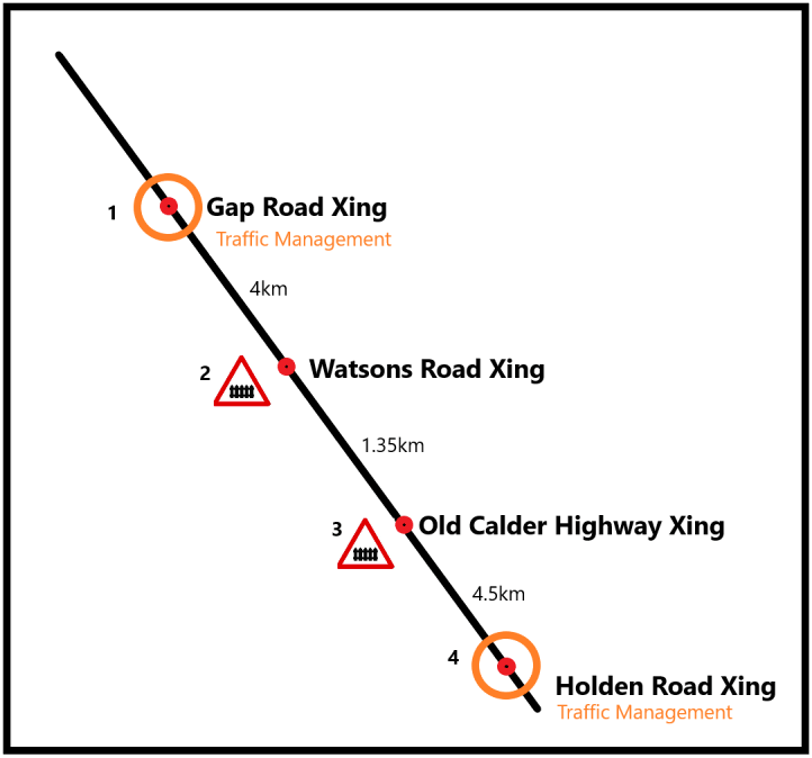
At the given time, the two HiRail vehicles would get onto the track at Holden Road under traffic management. They would start to move up the track, optimum speed would be at least 20kph, but for the first run on a new track the signal engineer had to check the signals were ‘ok’ (more info if anyone would like me to explain) before moving on. The two crossings would have the booms manually operated to allow the two vehicles to pass without slowing down. At the Gap Road crossing, under traffic management the two vehicles will turn around and return.
One loop (there and back) would be ok, but every other extra loop would increase the quality of the data capture and reduce the chance of repeating this work. A workforce that knew this and knowing their part and everyone else’s parts would give us the best chance at getting this evening to go smoothly.
We waited for the call that the rail line was clear to drive on. 0140hrs, 0155hrs, the time went on. At 0205hrs we got the call. Oh, and just before the formal briefing to the workforce I also learnt that we would have to be off the track at 0330hrs. My 2.5 hour window was reduced to 1.5 hours. Within this time, we just got in 1.5 loops which was acceptable. No one was hurt and we didn’t prang a vehicle, so I consider this a success.
Summary
For 1.5 hours worth of work and a simple plan, it took 12 vehicles and 14 people to enact. I spent 1.5 days in preparation as well as plenty of random actions to tidy up loose ends. I was massively surprised that this seemingly simple job took so long in planning and sucked in so many resources. Bed for 0430hrs, back in fornt of my computer by 1100hrs. zzz, apologies for any typos caused by sleepiness at the keyboard.
 Holdfast Training Services Trial Blog
Iain- can definitely echo your sentiments and frustrations regarding seemingly simple tasks taking bloody ages. I think there’s a balance to be struck somewhere; on the one hand an acceptance of the frictions of construction tasks in a live environment (delete railway, insert off shore platform) but on the other hand, one has to wary of opportunistic contractor looking to capitalise on this industry wide acceptance for their own profits.
Nearly up to double figures now on the amount of times I’ve been met with “but that’s just how long it takes” in response to queries about timelines, and as if by magic there’s a few hours/days shaved off when you push them.
I seem to remember doing something similar with my time estimates when BG Comds asked me how long it was going to get my bridge in.
I accept that this task needed all the resources I ended up giving it. It was done in a safer way than it would have been done 20 years ago and that’s all the project hears. Whatever is the safest option regardless of cost or time.
One of the factors that increased the time for a run up the track was because the road traffic control manager misread my request (you’re only allowed a few lines in an excel spreadsheet) and did not notify the authorities that I wanted traffic management at Old Calder Highway (refer to map). I had to move the traffic management 4.5km down to Holden Road crossing because it didn’t require notification (we own the land). This almost doubled the track distance.
Traffic Management notifications require 5 days, I didn’t give them that, end of story as far as the TM manager was concerned. The time to notify the local council, rather than a rail safety issue.
Fair enough, but in this circumstance the TM was required at 0200hrs, not 0800hrs; rush hour. The population of ‘Diggers Rest’ is 2,800. He was within his rights to say no, but it cost the project valuable data collection time.
If this sounds like a rant, you’d be right.
I do accept that you require ‘straight down the line’ people in jobs like that. I, I admit, would be terrible at that job. So if the right person is in the job, and he followed procedure then perhaps the fault is mine, and I need to get over that.
Iain, it looks like the sometimes military adage of ‘just make it happen doesnt translate’! i can echo you and scott and say that wfh for Heathrow brings up similar occurrences. Heathrow do the majority of their engineering install and maintenance work through a small (~5) number of principle contractors. These principle contractors hold the keys to the kingdom when it comes to competencies (delete Rail Industry Worker Card/John Holland induction and insert Air-side security clearance/Heathrow confined space access/Heathrow LV plant room access etc etc). Accordingly, a one-person job for a subcontractor with expertise will soon grow arms and legs in time and cost to once the ‘middle-man’ has had their part. Both educating and frustrating but alas, I remember Rich Farmer saying that ‘there’s nothing wrong with honest profit’. Worst case, corners are cut in the airline/rail/natural resource industry and something goes awry purely due to cost saving.
I stand by the nothing wrong with honest profit but do stress the honest aspect to that (although it was probably Mark Hill who said it)! Thanks for the blog and responses. I think it fair to say that there is learning all round and middle ground to be found between squeezing till the pips squeak and being taken for a ride.