Smiling Assassin or Shrewd Business Practice?
After several months and now experience of several sub-contractors (and then sub-sub, sub-sub-sub ad infinitum…) I thought to reflect on a few observations I’ve found from the world of civilian business practice. As graduates of the esteemed RMA Sandhurst , we live by the Values and Standards, drilled into us from day one to the point that personality is surgically removed and replaced with a code of conduct – I find it strange that it seems such a code of honour can be more negotiable in industry.
Now to be clear, I have not witnessed anything outright illegal or amoral but perhaps a few instances of “collaboration” which appears in conflict of the NEC approach where one party may mislead another through varying versions of the same truths, revealed at carefully stage managed points in time. This has come at increased surprise to me as any contractor on site must be, as a minimum BPSS vetted if not SC, and so come withs a modicum of implied trustworthiness.
An example –
During Client inspection of concreting works where tolerances were tight (-0/+5mm on plan). It was known by a subbie (and sub-subbie) that they were just over, by 1mm. The decision was made, through some implied comms and impressive framing of the problem that we were all better off if the client was led to believe that the slab was on tolerance and the offending non-conformity was shaved off by the night shift to achieve tolerance – as if it had never happened. My question was this;
“Why not declare the non-conformity in good faith but also how you plan to remediate and keep the client happy that we’re a diligent contractor?” (Or words to that effect…)
The answer, whilst simple, seemed almost a lie of omission;
“Paperwork”
I can see the pragmatism of such an approach where hours have been saved by removing the need to submit TQs or NCRs and the bureaucratic process therein. Does integrity have a price? My gut tells me no – one must always do right by the plan and contract, less you end up tangled in a web of lies. Apart from patting myself on the back for the DS answer, it did raise another thought – at the root of this, is it not a slippery slope where there may be other dangers lying beneath? Errors compounding errors (think of the Swiss cheese risk model). Thoughts that were shrugged off by the majority of project staff.
Perhaps I have been lost in the woods too long and suffer from institutionalised naivety but I wonder if others have experienced similar?
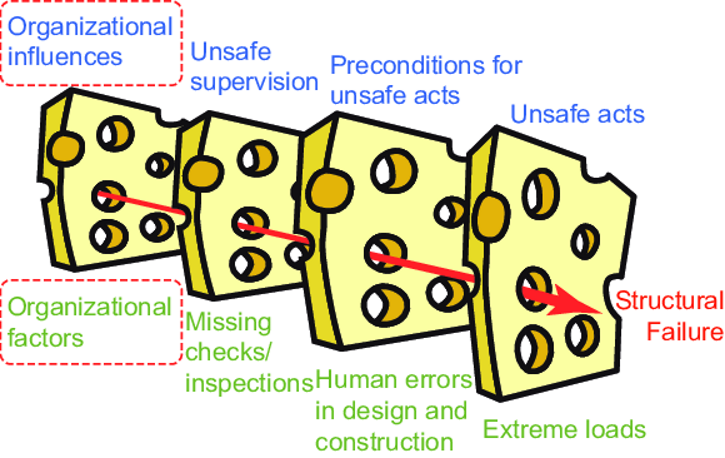
(Image From: Ren, Xin & Terwel, Karel & Nikolic, Igor & Gelder, P.H.A.J.M.. (2019). An Agent-based Model to Evaluate Influences on Structural Reliability by Human and Organizational Factors.
Conference: Proceedings of the 29th European Safety and Reliability Conference
 Holdfast Training Services Trial Blog
Very similar at HPC, despite all the mountains of regulation by the ONR and the vast paper trail required to prove compliance (Nuclear License condition 6) – there is often attempts by the contractor to “game” the inspections with Surveillance (the QA department). This can be awkward as both me and the surveillance guys are NNB (the principle contractor) so are on the “same side” but I’m also trying to push forward with progress on site.
I’ve had a similar experience out here in the US, but more working for the client side and inspecting the contractors output as QA. We have a third party who technically inspects the structural elements, but multiple times the contractor tries to convince them to adjust tolerances so they can rush through construction. One case was a failed slump test, the third party hovered the ruler above the concrete to show it was an 8 inch slump, within the tolerance. When in reality with the hovering, the slump was actually about 10 inches and therefore we rejected the concrete, and the contractor went back to sulk in their cabin, stating that we’re slowing them down.
It seems that contractors trying to pull the wool is the same on both sides of the pond.
Ali,
Some very interesting observations and looks like it is mirrored elsewhere although not surprised.
What is the ‘so what’? Was action taken? either against sub or on your side to encourage non-compliance to be notified. Also if ‘process’ is behind reduced honesty, does it need looking at? can it be refined?
Chris, given the extreamly close working relationship between BP and Wood (Group), have you seen anything similar?
I suppose these are conditions that we can often see on Ops overseas with partner nations who may not prescribe to the same professional standards or indeed the same RoE as ourselves which in turn lends itself to the issue of, “…better to be inside the tent “looking” out…etc.
In this example I raised the concern, and was surprised that the Client was actually fairly complicit – or at least the Construction Manager was anyway, knowing that would happen would indeed happen.
The initial fallout is to ensure quality is ensured from the outset with better pre-works and during works inspections so that in theory the issues are identified and rectified as they go – rather than need remediation works.
As far as the process goes – the short answer is unfortunately a fairly emphatic “no”. As it is a project under the nuclear umbrella the quality tolerances are rigid and therefore the paper trail that comes with it equally so.
My take on it is to impress on the subbies that they need to be paying attention and getting it right first time, admittedly easier said than done. Supporting this is to not break the integrity standpoint, after a few runs of the NCR process I would imagine the subbie either starts getting it right or they get replaced. The tolerances are there for a reason and I wouldn’t want to be there as and when the cumulative errors come to raise their ugly head…
I appreciate that I come to this party rather late, but for what its worth…
I hold with the doing the right thing concpet and support entirely the ‘report the issue and the proposed rectification plan’ option and, hopeflly the subsequent within tolerance result notification will follow. The fly in the ointment is the holistic perspective that says the ‘right’ pathway, met by a client that recognises the honesty and accepts the plan, can lead to a contractor perspective of “don;t worry too much, if it goes wrong we’ll just let them know and then fix it”, whereas the non-declaration and secret fix can lead to a position of “we got away with it once but lets make sure we never have to try that again.” i.e. sometimes it is better to pretend you don’t know what’s going on if it leads to no long term error and a greater intention to avoid the situation in future. It’s about managing the peole that are delivering the product to get the best reult you can. It also leaves them in a position wherby, in any future repeat, they can be told that they have ‘never had a problem before so this is unexcusable.’ My personal honesty and integrity position puts me at odds with saying what will achieve the best reult in the long term over being truthful, which is probably a gremlin I should deal with!