Archive
Mini blog – plant tracking and machine control
ON Tuesday I was called in to a meeting with the project director and Carillion’s head of “Survey and Drone research” – sounds cool but it’s definitely not. Apparently my experience of GPS within the military was my golden ticket in to this little shin-dig.
With regards to an exclusion zone on this site, the PD is keen to ensure that all plant be monitored and prevented from accessing areas they could cause damage to the tunnels below.
The suggested solution is to use the same GPS monitoring that is used on plant during road construction. A system that can control the plant as well as give feedback as to the position and angle of the blade etc. This is a brilliant system, but I fear it may be overkill and it is tres expensive (£30k per system plus £10k for a box on the roof to correct all the GPS readings). Rental prices are available, but for a 2 year programme, purchasing may be the way to go.
The actual customer requirements are:
- Warn operators when they are approaching an exclusion zone
- Ability to identify location of plant to confirm if issues in tunnel are plant related
- Maintain a record of locations for legal purposes (arse covering)
Problems:
- Demolition area is an exclusion zone to all non-essential personnel – ie operators only
- Physical barriers are likely to get covered in arisings or crushed any way
Has anyone experience of anything like this, or are there any suggestions for a different system?
I’ll update with the winning solution!
Paradise Circus, Birmingham
Welcome to Paradise
On the 22 February I started work with Carillion PLC on the Paradise Circus Demolition/Construction in Birmingham.
The development scheme involves the transformation of 17 acres at Paradise Circus in the heart of the city centre. The £500m development is being brought forward through the joint venture company, Paradise Circus Limited Partnership (PCLP), a partnership between Birmingham City Council (BCC) and BT Pension Scheme, managed by Hermes Real Estate with Argent as development manager. In addition to the developer other interested parties include Amey who maintain the A38 Queensway Tunnel on behalf of BCC.
The project is currently in the Phase 1; primarily demolition of the RC concrete structure of Library and office buildings. Phase 1 also includes some large bore piling, up to 1200mm and the construction of a podium deck car park. This will be the platform for future development (contracts that Carillion are highly competitive for at the moment, but have not been awarded). The future development aims to bring over 300,000 sq ft of grade “A” office space to Birmingham City Centre.
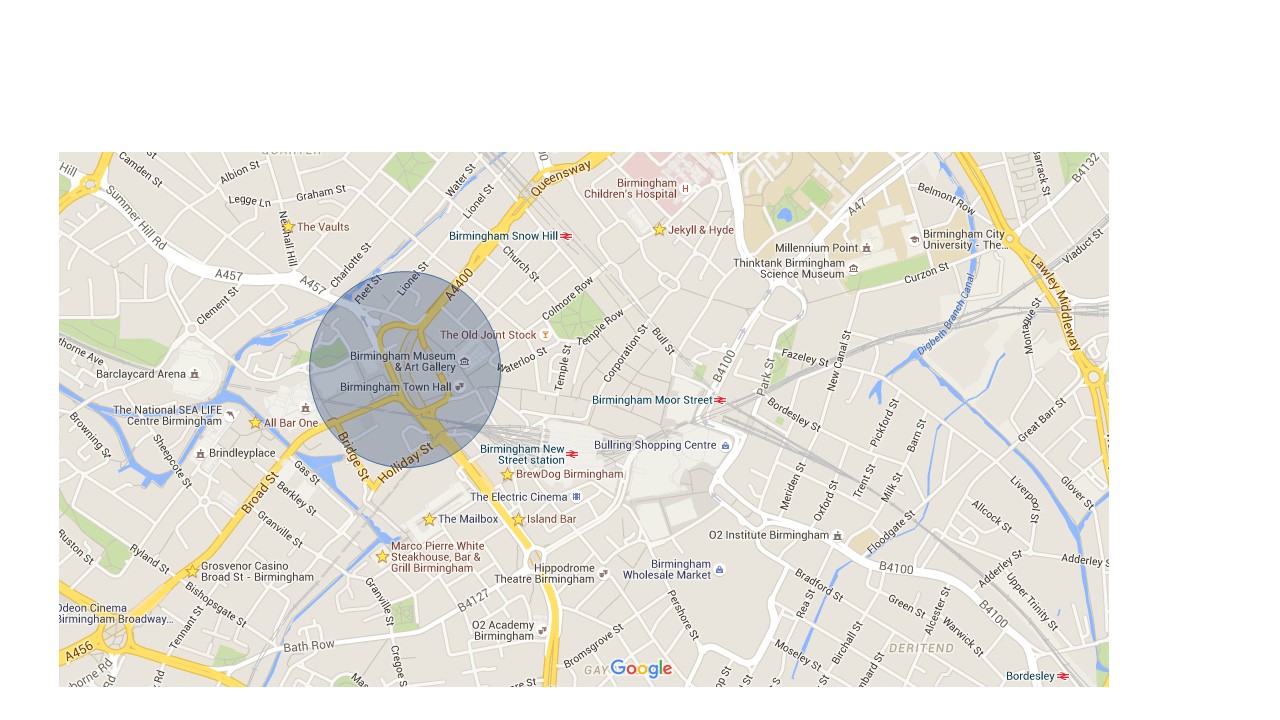
Area in blue includes the 17 acre redevolpment and road improvement scheme
Demolition of the main building, the reference library, is primarily being completed through use of a high-reach excavator. This plant weighs in excess of 1600kN with the potential to put a very large point load on the ground beneath.
I have been tasked with the monitoring of the A38 (Queensway bypass) that passes under the site through a combination “cut and cover” and bored tunnel. The majority of the tunnel has a precast pre-stressed inverted T-beam roof. These are infilled with concrete and laid edge to edge.
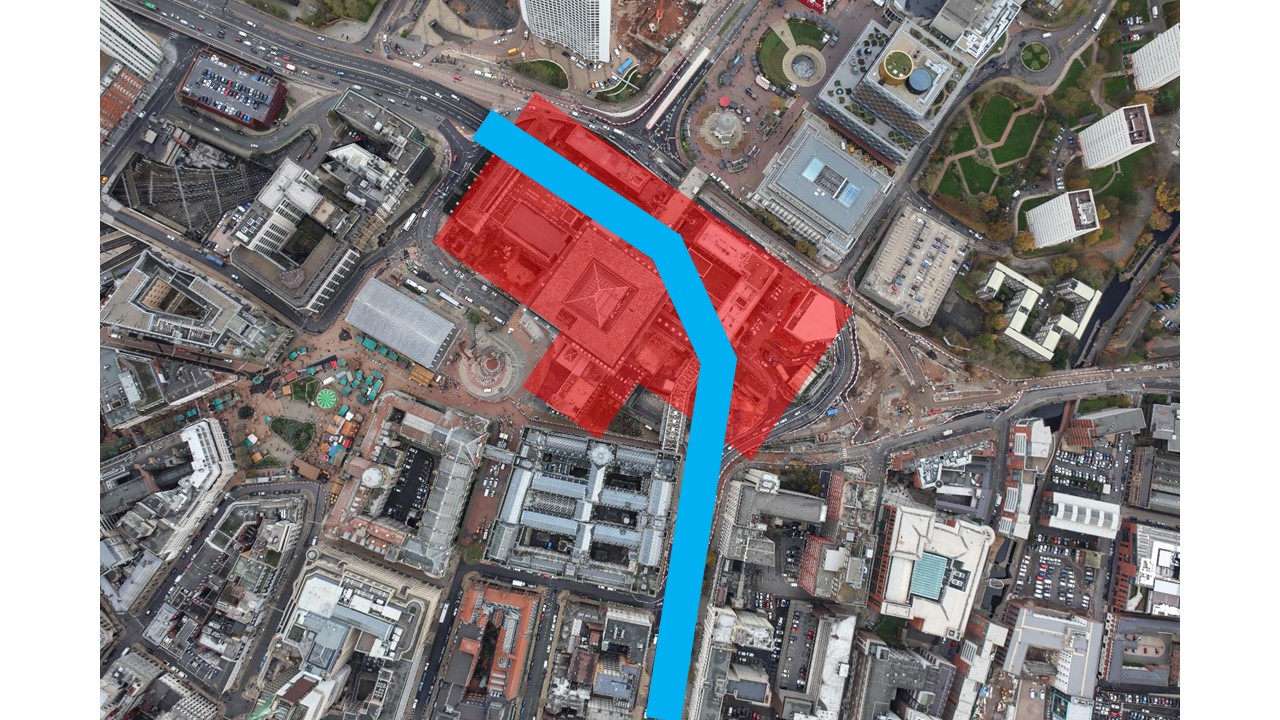
Demoliton zone – Red; A38 Queensway tunnel – Blue
There is a concern that the high-reach excavator is too heavy to use in proximity to the tunnel. To mitigate the risk of the plant load, the site has been divided in to zones 1-4. Zone 4 not requiring a specific RA for the tunnel, down to Zone 1 which needs a full RAMS and approval from the BCC Engineers. Zone 1 is above the tunnel or within a 45 degree angle from the base of the tunnel.
Trigger levels have been set by theoretical modelling of the tunnel. Remaining capacity of the T-beams is calculated and the Red trigger level is set around 80% of the ULS (evidence of this is assessment is elusive). Monitoring has been installed in the tunnel and the normal deflection pattern established (this is over a 2 week period, but I cannot seem to find any evidence or analysis of this). Interestingly – or not – the normal pattern of life seems to move the tunnel through twice the deflection that has been set as the Red trigger level. This has resulted in the Section manager and project director receiving upwards of 300 alerts last week alone (I haven’t received my work phone yet so I’m dodging that bullet at the moment). The tunnel hasn’t collapsed…yet.
A load test is being conducted on the inverted T-beams to test the theoretical model. Type 1 Aggregate is compacted in layers over the course of 4 days. The first three days, 2 layers are compacted with two layers of 150mm compacted on day 4. Each morning a materials technician from Environmental Services Group (ESG) carries out a Nuclear Density Test on the aggregate to ensure the sub-contractor has reached 90% compaction density.
The final layer of aggregate is currently being placed by the sub-contractor. The senior engineer and I are responsible for checking the levels of the beam – currently we have 0.5mm deflection throughout. This is done through a series of 3m rebar pins that have been set in concrete on the roof of the tunnel (as well as the automatic monitoring inside the tunnel).

I am still trying to get my head around the expected outcomes and controls that have been applied to this test. It seems to me that the trigger levels have been set too low and the equipment monitoring the deflection in the tunnels are not that accurate (influences such as temperature, traffic flow and pollution can impact the results).
I will add an update when the test is complete and we have the results interrogated.
 Holdfast Training Services Trial Blog