Self Made Issues
A temporary blip on the blogging last week where I just plain forgot, so apologies all round to anyone that reads them!
A few issues have cropped up over the last 2 weeks in and amongst the frantic push to meet a $20m milestone payment by the end of June. I think my last post eluded to the colossal amount of work that was required to meet the deadline and the equally large chance of a storm pushing through to make meeting it that little bit harder. The long and the short of it is that it was an uber busy week but we eventually poured the 4th slab in 7 days – for those of you who are interested, that’s approximately 100m3 of concrete. Good efforts all round.
The fallout from the epic push is that whilst all attention was focussed on reaching the milestone, very little was actually done to plan for future tasks. The following issues have arisen as a direct result of simply not have enough time/manpower to keep up with construction.
- Stair 9 Internal wall. The initial pours of Stairs 8 and 9 had many errors and were quite out of plumb in places due to an initial rush in the early phases of the project to get them poured. We have reaped the rewards of this by slowly closing out NCR’s with structural engineer input to bring them back into tolerance over the next few levels with no significant effects. The particular issue that could easily have been avoid was a lack of starter bars immediately next to the door (see image). I had a look at the initial setup of the formwork and discussed the missing starters with the steel fixers. I left it that if required, the error was theirs and they would have to drill and epoxy new bars in. As it turns out, they were not missing, the internal door had been set out wrong by the formworkers. By the time I had investigated this the steel fixers, pressured by site managers, drilled and epoxied and fixed the steel in the form. I had to order them to rip it out and cut the bars off when I found out. Sad faces all around. The issue now is who pays for the work conducted by the steel fixers. JHG won’t stump up because the work was conducted without JHG approval, so it looks like the formworkers will pick up the tab. I am speaking with commercial this week to discuss.

‘Missing’ starter bars at the edge of the wrong door set out
- Stair 10 Landing. When stair 10 was poured the couplers/starters were not installed as they were not delivered in time. The decision was to drill and epoxy new starters around the perimeter. A site instruction was written to the steelfixers to conduct the workswhich were detailed as N16 bars to be drilled 225mm into the wall (to internal edge of external steel) at 200 centres top and bottom of the landing. This work was completed and JHG informed that all work was in line with design and standards. On inspection it was noted that the bars were not at the correct spacing (but that could be put down to drilling around wall reinforcement) and also the ends were not aligned. ON closer inspection and a slight tug, a couple of bars came off in hand! To put this in context, the building is designed as a post disaster structure that feasibly could have a large imposed loading if people are rushing to evacuate the building. The landing is solely held up by the drilled and epoxied bars. This negligent work could have potentially caused additional collapse of the building. We are currently awaiting the outcome of a further investigation to ensure the work is completed adequately. To me this highlights the lack of personal pride in ones job and a complete lack of understanding of why they are doing something. It further highlights the problems with hiring 3rd tier contractors and the lack of any checks to ensure competence when hiring.
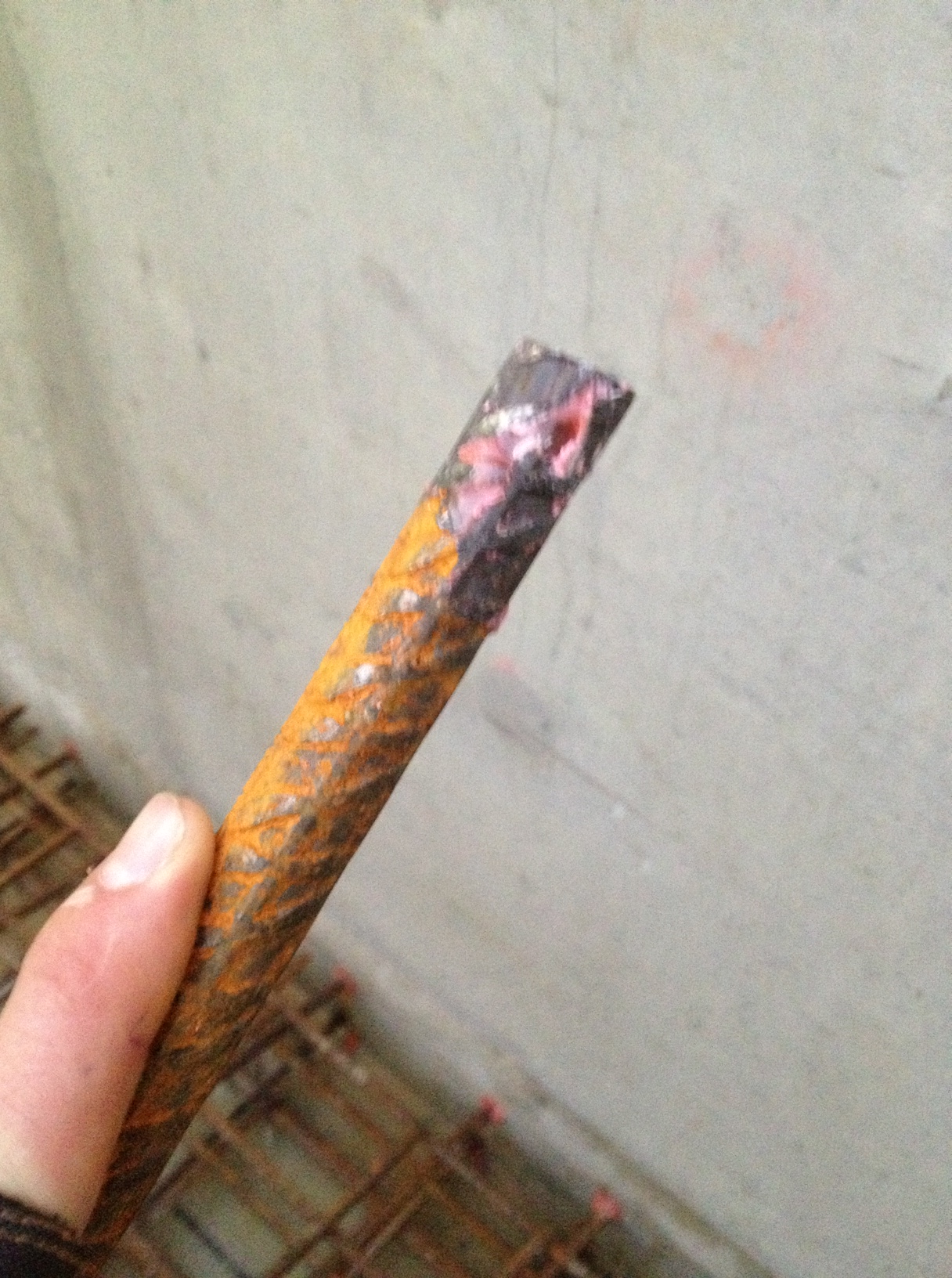
The hand removed N16 starter. Now I’m no good at estimating length (Nicky tells me) but that ain’t 225mm!
- West Block column. After the long drawn out negotiations with the client to decide the method an of pouring and finishing columns the following occurred 1 week afterwards. To top it off the Clients representative was at the stripping of the formwork with his Ipad looking for the density of blowholes in the surface finish – he got a bit of a surprise! It is assessed that the concrete was not vibrated adequately and the consistence was not sufficient. Therefore both JHG’s quality assurance and the concrete contractor for not carrying out the task correctly. The issue was escalated by the state to the WA Ops Manager who personally emailed the site engineer to express his dissatisfaction – not I would argue good management. A suggestion that it would be a good feature column in the X-Ray department was not taken well.
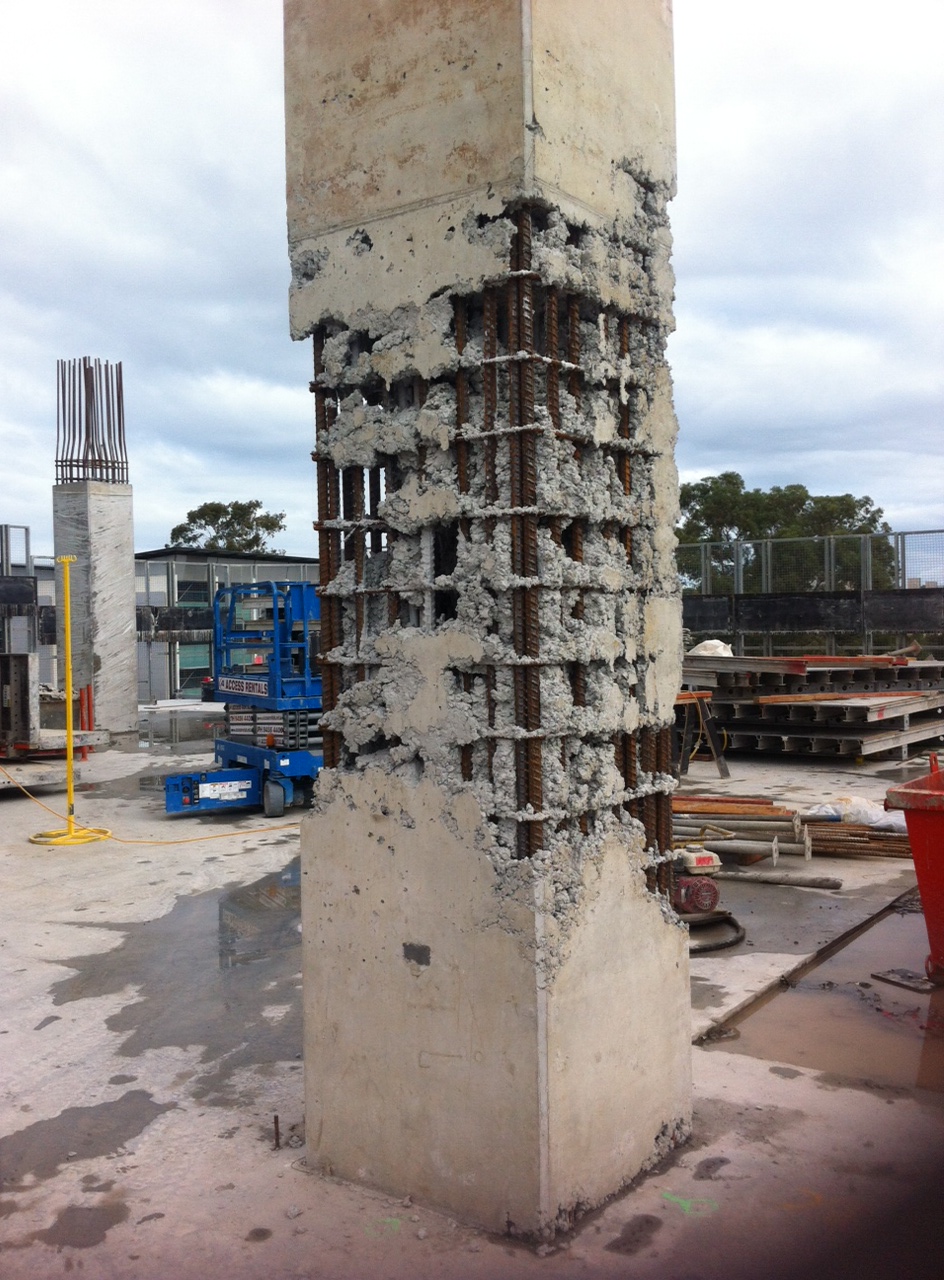
The X-Ray Column
What this highlights to me is that a project must be adequately resourced to match the construction programme in both management and workforce. To not resource a project effectively is to delay the decision making process which will have a detrimental effect on progress.
The Construction Director who was pushing the programme (I think his job may have been on the line) has finally accepted that 2 engineers for the whole of the South block is simply not enough. A new engineer started who will be solely responsible for the Core C riser and jump form, and the rumour on the jungle drums is that a further engineer who was destined for the basement may be poached temporarily to reinforce the South team until the basement kicks off. Time will tell.
In other news, we had the Dollimore’s over for their last night in Australia this weekend. We had a fun night out with a few guys from the NCH to say goodbye, and a final breakfast at the beach in Cottesloe. Then it was time to head back to AER for me so I had time to finish in time for the Lions game. We set up the projector in the house and had a few mates over for a BBQ – Great game! Actually looking forward to work tomorrow now after the abuse I got last weekend!
Home Cinema – al the better result when surrounded by Aussies!
Dream Beam
The final installation of the transfer beam was absolutely perfectly. The use of the steel angle to set out the bolts was the right choice and the beam sits within 3mm of where it was designed to be. Below is the article I have written for the Company update, Osmosis, much like Blackadder’s ‘King and Country’ and our very own Soldier it’s pretty much propaganda but they seem to like it.
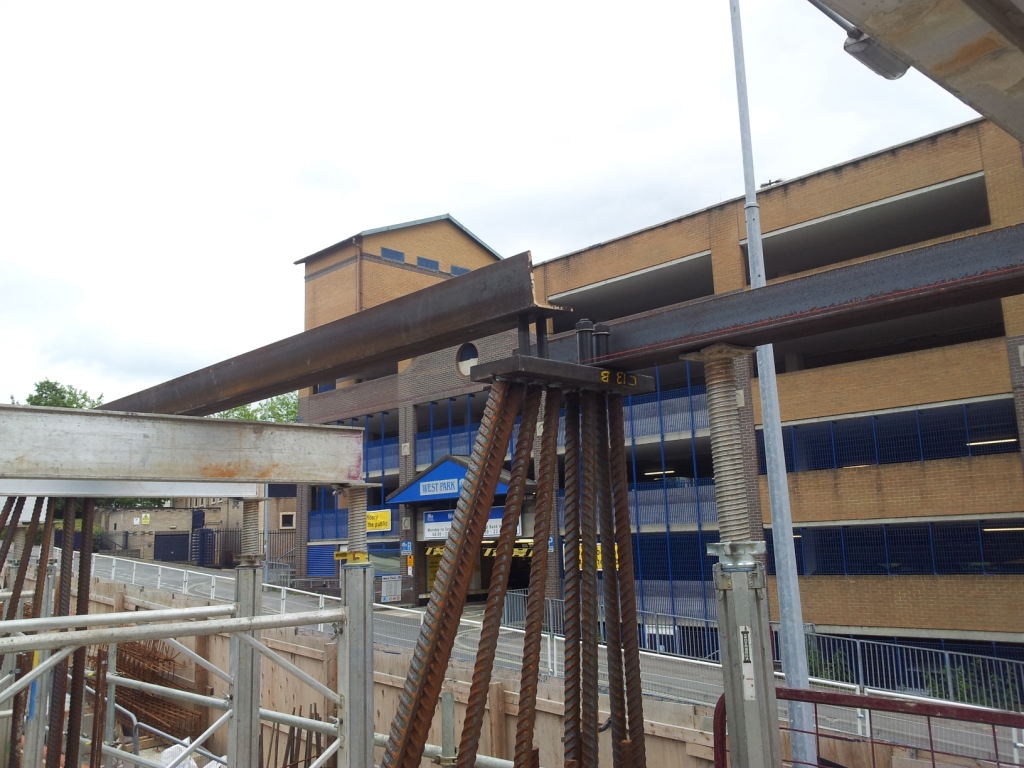
Steel plates and 40mm bars that were tied into the columns, note steel angle fixing the 30mm diameter bolts in place.

100 tonne mobile crane lifting one of the beam sections into place.
Dream Beam
An out of hours road closure and crane lift on Monday, 1st July saw a critical element of the Mayflower Halls project completed smoothly and in half the time allowed.
A large transfer beam was required on Block B, the tallest of the blocks on the project at 17 stories, due to a change in the column lines on Level 02, with so many floors above the beam the actions involved necessitated an enormous beam. Originally a specially made plate girder was designed, however in order to reduce procurement time a standard Universal Column section was used with additional plates welded to key areas. The main beam was delivered in 3 sections that when spliced together totalled over 23 metres long and weighed in excess of 15 tonnes.
In preparation for the beam eight steel plates with four bolts welded on were tied into RC columns using a steel angle as a template, once the columns were cast the steel angle was removed ready for the installation of the main beam. Rigorous setting out and checking by Senior Site Engineer Phil Dowling ensured the holding down bolts had been positioned with the precision needed.
Careful planning and liaison with Southampton City Council secured a partial road closure on one of the City’s busiest bus routes for four hours on both Monday and Tuesday evening. A 100 tonne mobile crane was used to place the sections of beam on the columns. The beam located perfectly over the holding down bolts and was in place within a single evening avoiding the second road closure and extra crane time. Site Manager John Wild said, “It was great to see so many different people working together to ensure success.”
Something that won’t be appearing in the next newsletter is the 4.5m high 7m long, 300mm thick retaining wall that sits directly below the transfer beam that will be removed in the near future due to a design error putting it 75mm too far in the footway and forgetting to include the louvres that were required.
Engineer and Accountant
I declined to blog last week as quite frankly I was too busy learning how to be an accountant coupled with the fact there has been little progress on site due to monsoon rains. It rained everyday last week which meant no work went ahead – the subcontractors seem to be very good at sensing rain long before it actually arrives and will often not bother turning up. One thing I have leant is that the weather forecasters over here are even worse than the UK, not even close at times!
Last week I reviewed the programme of the bridge build as when I arrived it said completion would be the first week of Sept. Last month we revised this to the end of Sept and knowing the FRP subcontractor and what effect the rain has on site progress I think we will be lucky to complete by the end of Oct. In order to keep work continuing at a steady pace I proposed to the FRP subby that we could start on the deck in between backfilling each abutment that way his steel fixers would have continuous work moving from the deflection walls to deck to wingwalls. He has told me that the company has very little work on in the Sydney area and that Dickson Rd bridge along with a few retaining walls at the station is just about all the work they have at the moment. I thought he would be keen to keep his work force going and initially he was. However the company owner came down and sacked half the workforce and so now they don’t have that problem! They say they will not work anymore saturdays – which is fine with me – and I get the impression he wants to delay progress as much as possible to take the job up to xmas. I asked him outright if that was the case and he assures me it isn’t and realistically it doesn’t serve them well to do so as this is a lump sum contract. If his blokes are not working he just doesn’t pay them so the quicker he does this job the quicker he can sack everyone if he wishes!
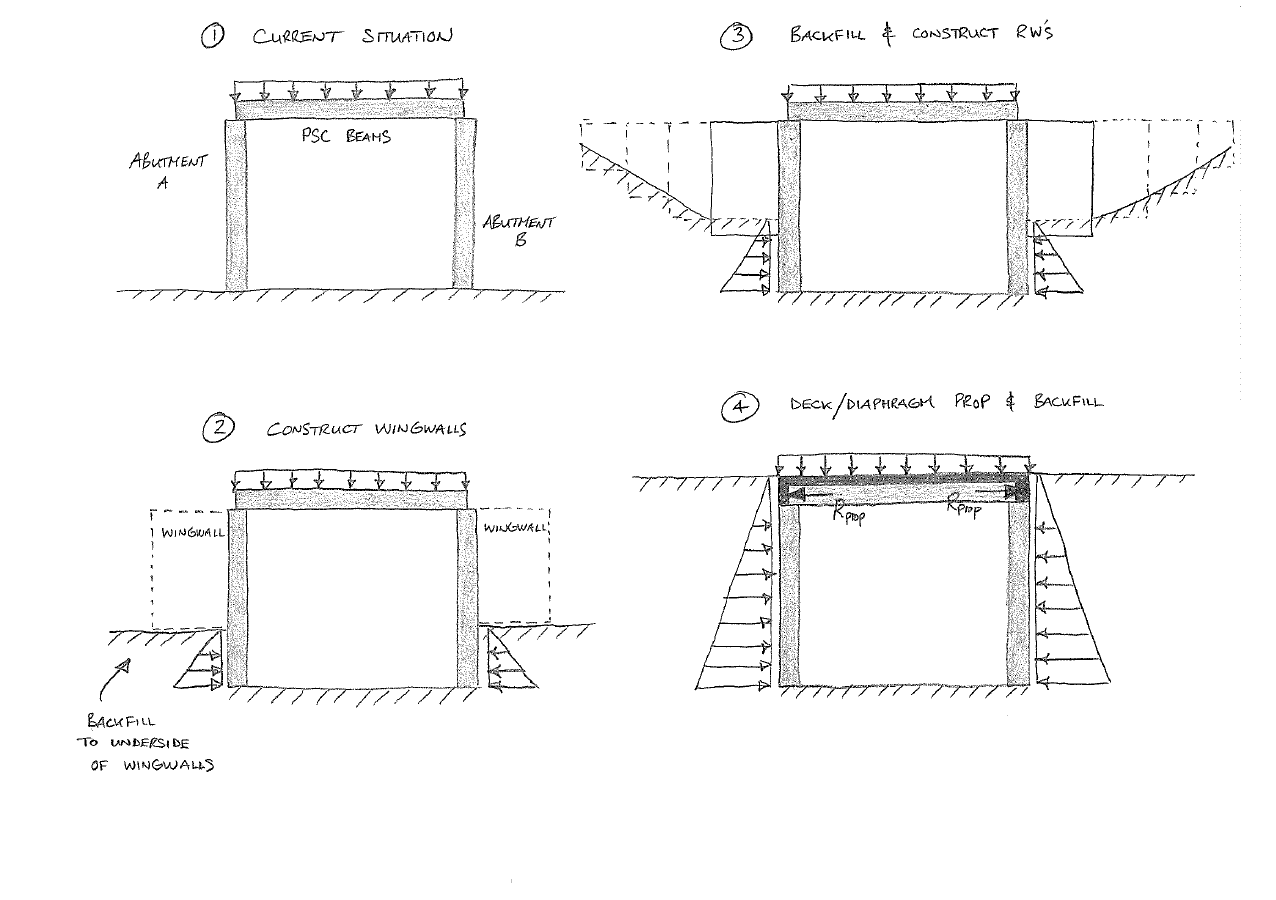
Anyway, I am going to attemp to get a little technical now with regards to the design. At present we are still constructing the inner portions of the deflection walls that butt up against the abutment wall and once we complete these we can then start to backfill material behind them. Depending on the concrete test results we are looking at about 4 days from finishing the walls before we have enough strength so that we can backfill. By staggering the work we can be working on one side while the other is curing and then backfill the first side while the other is curing. The bridge is designed as a propped structure which means we can not backfill the entire height of either abutment until the deck/diaphragm is cast, this then ‘props’ the abutments apart which reduces the bending length of the wall. We can backfill to the underside of the wingwalls without casting the deck slab but once we have backfilled we can then erect scaffolding on either side to access the deck while simultaneously working on the wingwalls. Once the wingwalls are complete we could backfill at a certain batter from the underside of the wingwalls out so that we (structures team) are conducting detailed excavation only of compacted fill for the subsequent retaining walls. This would add a surcharge onto the earthe pressure load although the backfill heigt is not going past the underside of wingwall height, so it may be sensible to cast the deck before doing so. Hopefully the below sketches explain where I probably haven’t:
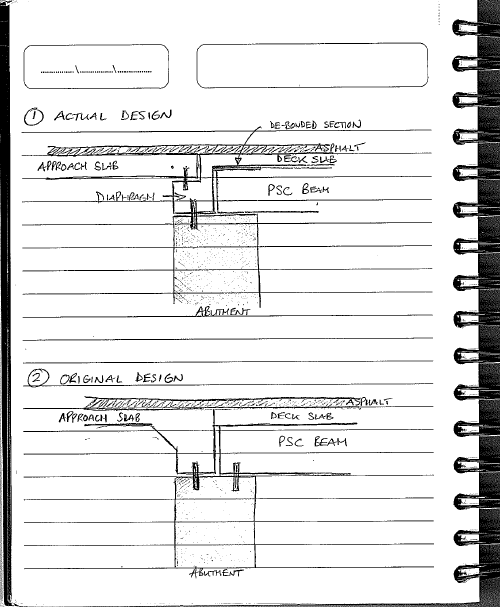
I noticed in the design report for Dickson Rd that the end dowel joint arrangement was different from the AFC drawings and so enquired to the designer about why. He pointed me towards Eastwood Rd design report which has the same diaphragm/deck detail. The original design was for the PSC beams to have a slot for the abutment dowels to sit into with rubber spacer rings around the dowels to allow for movement. The dowels restrain the deck laterally and longitudinally and what I can figure out is that there seemed to be a concern over the combined effects of flexural bending and shear on the dowels. This seems to be why they repositioned the dowels to the rear of the bearing strip and out of the PSC beams. The debonded area at the end of the beams and the 50mm gap between beam and diaphragm means the beams can flex with minimal transference to the dowels. Consequently the rubber spacers have been omitted and a PVC conduit is placed over the dowel with a snug fit to ensure debonding and so taking away any torsional actions that could occur on the dowels.
The past week with the rain has mainly been spent on catching up on QA paperwork and the laborious task of uploading ridiculous amounts of paperwork for eack worklot onto the JH project pack system. I have also spent a great deal of time both work and weekend getting amonst the costing procedures I need to fully understand before next week when I will be the sole engineer on the section. My new responsibilities will include the costing of all four bridges which equate to about 62 cost codes – 15 on Dickson Rd which are all active but quite a few on the other bridges now not. The end of the month comes at about the 15th oddly enough and the forecast comes out a week after. For that missing week when dockets and invoices are not processed by the commercial team I am required to accrue work I know has been done and estimate what I think we will do until the actual end of month including what work the subcontractors may claim for so that JHG can put that money aside in their current account and keep the rest in their savings account! Invariably the estimate is not perfect and so next month you will have to place in the correct figures aginst your estimate. A week before the end of the month the forecast spreadsheets are published by the commercial team usually on a thu evening and by mon morning all Senior Project Engineer’s and me are required to submit their forecasts which shows all cost codes for all the bridges and make that it all adds up. A large part of this and what the Construction Manager is interested in is the cost at completion forecast. If any single cost code varies +/- by $5000 then you are required to explain why and I then produce a summary sheet for each bridge so he can see what state they in! Thi is also the time to ask for the budget to increase if you needed which is what we have had to do mainly because of the very low budget for craneage that was initially set aside at tender. It took me all fri to complete 5 cost codes and sat to do another 5 this month so I am not sure how next month will go considering I will have all 62 to do. Despite the extra work load I have found it surprisingly enjoyable intermingled with massive frustration when things don’t add up but I already feel like I have a very good understanding of costs related to the work I am doing and it has meant I have had to dive into alot of sub-contracts looking for rates which again is improving my contractual understanding. One thing I did pick up from the FRP subcontract is that the deflection walls have not been priced this has been forecast. I estimated the additional cost in the region of $150,000 but I am not entirely sure the subby knows that this work has not been included. Apparently it was not included in Eastwood Rd either and they have claimed for all their contract work but have mentioned nothing about the deflection walls. It will be interestig to see n a few months time whether they do realise as the commercial manager seems to think they haven’t got a clue and is secretly hoping to pocket a few hundred grand – it will certainly make my costing reports look very healthy if they don’t!
Progressing like an asthmatic tortoise……
Since my last report the project has not really advanced. In 2 weeks we have had enough conduit installed that we can now think about putting in the first Big Ass Fan. The Contractor is still claiming that we are slowing him down by actually reviewing the submittals he sends us and rejecting them. However he has finally admitted that he would like my team to review the submissions prior to official submission or in other words can we do his job for him! He has employed a new Safety Officer and the quality of submissions has improved 10 fold and yet we are only just in a position to let work go ahead.
One stumbling block has been how the contractor is going to install the roof drain in the 85ft high bay storage area. The design contractor stated a hydraulic platform “must” be used to install the pipes but gave the wrong dimensions for the storage shelves in the building on one diagram (although it was caveated approximate dimensions). There is no platform small enough to fit between the shelves so the contractor is claiming a change in site conditions because he based his estimate on this drawing. In reality the contractor only discovered his mistake in May as he could not be bothered to do a site recce to confirm his requirements and now he looks foolish. This change means the Government will owe him money and no one here wants to give this guy any more because of his appalling attitude. As the contract managers were discussing how to deal with this I was given the chance to find a solution with in the contract (thus saving money!). These shelves go up to the ceiling and access to the shelves cannot be denied for longer that 8 hours so a permanent scaffold is out of the question. In half of the building there are horizontal beams in the shelves 6ft from the roof on which scaffolding planks could be placed to create a walkway down the aisle (325ft long). In the other half of the building the beams are not present. The Contractor has spent weeks trying to find the manufacturer to get custom made beams fabricated so he can use the scaffold boards in this half of the building but nothing could be found. Having looked at the problem it was simple: use the “required” platform (as per the contract) to get up and install the planks in the area with the beams, starting from one end and working out because of the limited access, then use the same platform to install wooden beams in the other half of the building, again working from the accessible end out, so that the planks could be laid on these when required. I took the news back to the office, ran it past the project engineer who saw it was viable and would actually be a solution at cost to the Contractor with in the contract and not us. However the managers decided to give the Contractor the money for the modification ($30,000 so far for the planks ) especially as he has now found the original shelf manufacturer and is having custom made beams produced (bill to follow) as a goodwill gesture and show that we really are partnering. They will be using the scaffold plank concept.
However this week I have been going through the contract, working on ways to deny the contractor any further chance to blame us for his delays. This has taken the form of an enormous spread sheet which details when all submittals were handed in, when they were meant to be handed in, how long we took to review and the knock on effect any delays had on the project. A great piece of work which has taken me all week and has lots of hi lighting to illustrate points. Most importantly it shows that despite some of our delays the contractor is still taking months to action any of the returns. A further letter is being drafted that now states the Contractor is solely responsible for all delays and will be getting an interim project report of “Unsatisfactory” unless there is a radical change in attitude and a revised schedule showing how they are going to make up 8 months of in activity. This is actually a big deal because if they overall project report is an “Unsatisfactory” then the Contractor is banned from bidding on any Government contracts for 5 years and the grade is published in Engineering circles. Nuff said.
I was invited to attend a Solicitation Site Visit too. This is when Contractors are invited to a potential site to access the ground prior to putting in their tenders. A fairly unremarkable experience as it is just lots of people looking at a waste water treatment facility (that was interesting) that needs up grading with very few questions allowed. It did get really interesting when one guy stepped in to a ground hog trap (think a smaller version of a bear trap) and could not escape. It took two guys to get his shoe back whilst the rest gingerly crept out of the long grass.
As work is drying up here I am investigating Aberdeen Proving Grounds next week. This is a huge project that is similar to Ben’s Biological Research Facility in that it is a Chemical Agent Research facility of equal, if not greater, complexity and with a shed load of E & M stuff going on. And they have already asked if I can help!
Road Kill Round Up
2 deer
1 Racoon
(It is 35 degrees with thunder storms everyday – I don’t go out in that!)
And in other news..
We have had quite a few parties including Warrick’s Pre Kindergarten Graduation the Baltimore District Picnic, numerous leaving function for Matt, Ulli, Ben and Sarah as well as Warrick’s 5th Birthday party. We have gone to the beach at an old quarry and the timing belt in my car went which cost me $2600 and a new cylinder head.
And it is set to get hotter. Time to plan a summer vacation.
Sittin’ On The Dock Of The Bay (or the hard at Peterhead).
I’ve been trying to get this post up for the last 2 weeks, but after a slow start, things are really motoring along in the North. Summer has arrived, which means the heating is now only on in the evenings and it only rains every other day.
P 60 Bridge inspection platforms
This project is starting to see a little more life now. At about 51% completion I am on target for close out of Define by the beginning of September, although with no funding in FY 14/15 all the work will get kicked into the long grass. With Cessation of Production for Bruce sitting around the 2017 mark, there is no appetite for this work, the asset is more interested in squeezing the field for all it is worth.
At 51% most of the design work is now complete and the engineering is about to take over. My input has been limited to ensuring off-shore involvement and digging up answers to design team queries i.e. what are the standard railing panels used on the installation, will the current design allow sufficient access, are we too close to the process lines….with the general low profile of this project, getting answers to these questions has been like getting blood out of a stone.
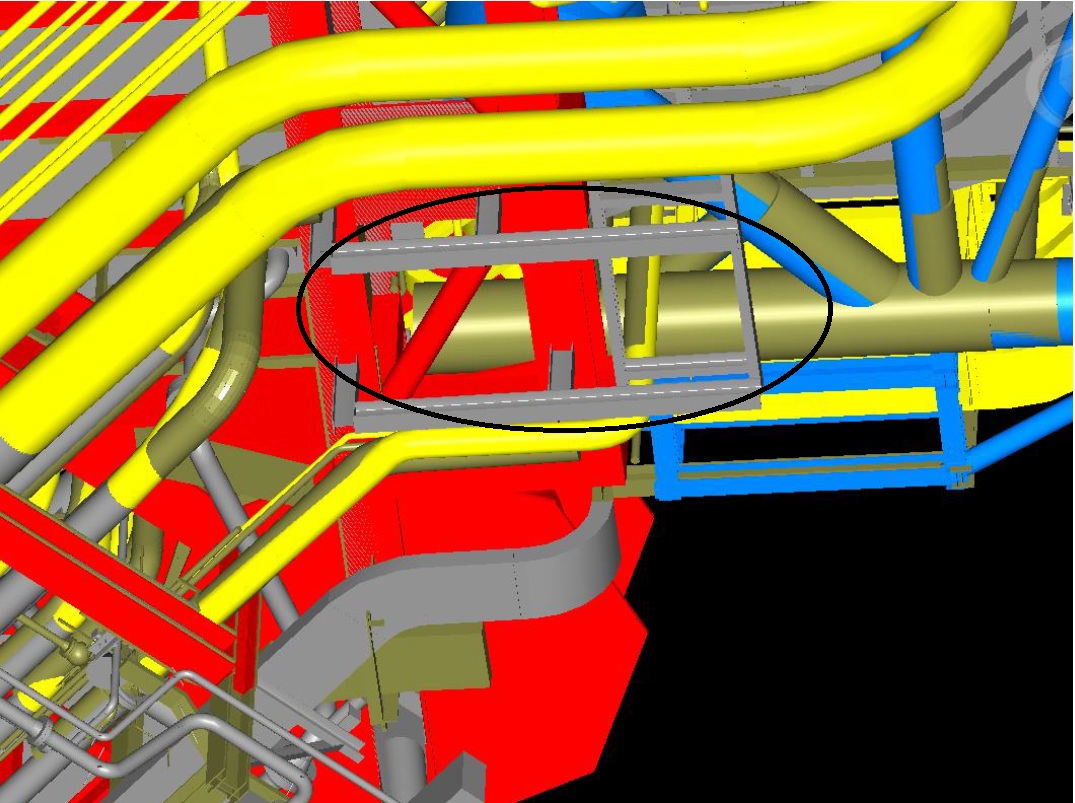
The picture about is the layout of the inspection platform (inside the black circle) beneath the PUQ side of the P60 bridge. The query has been around the proximity of process flow lines (in yellow) and whether the jacking procedure can be conducted within the constrained space. My answer is yes, mainly as this is where the original scaffold would have sat anyhow, but getting confirmation from the inspection team is not going well at the moment. At the end of the day the design will go through a constructability review and the HAZID where an representative from the asset will be able to comment on these issues, but it would be preferable to put them to bed earlier.
All in all, it’s a fairly easy going project and it has been mostly running in the back ground. 16 July will see the HAZID (Hazard ID) meeting take place although I am yet to see any forward movement from WGPSN Tech Safety who are contractually obliged to run this process. Chris has warned me that if the Tech Safety rep is a dud, I will probably need to chair the HAZID, but I am fairly happy with that as my recent experiences with the Clair Coolers project have set me up well to step in should the need arise.
Bruce Caissons
Due to the project below, this one dropped off my radar the last couple of weeks until it appeared on the weekly Engineering Services update where specific projects and task are highlighted as a specific priority. Getting the decision to defer the re-instatement of the C13 Caisson has now become a high priority and so I am re-applying myself. I originally put together the document and analysis that brought together structural and operational reasons for deferring this project until 2015. While the decision to defer was taken verbally, nothing was documented leaving the collective Project and Mods arse flying in the wind. However, over the last couple of days I’ve re-invigorated the issue and look to be on track to get the decision signed off over the next few weeks.
Clair Coolers
This has had almost all of my attention over the last 3 weeks or so. From being brought into the project, I effectively took on the job of developing the Management of Change strategy in order to close out the project. BP has a relatively robust MOC system, but it is not designed for emergent projects such as this. Originally cited as a ‘like for like plus’ replacement this should not have been an issue, with very limited actual change being brought about. However, various opportunities to add value to the project surfaced and as previously described, the project is like for like no longer. Whereas a normal project would have had an Appraise, Select and Define stage prior to Execute, in this case Appraise and Select were skipped (Appriase – No project=no gas production=no money / Select – ‘Like for like’ = Previous version lasted 10 years, Life of field is about 10 years). Define and execute were essentially compressed into about 9 months with the Prime contractor responsible for the overall project, but with BP mech and process teams designing the coolers themselves. My role has been to manage the output of the most recent risk assessment, drive forward the process of ratification of these risks by the BP technical authorities, develop the strategy for engaging these individuals, examine technical issues surrounding residual risk and compile the evidence supporting the mitigation of said risks.
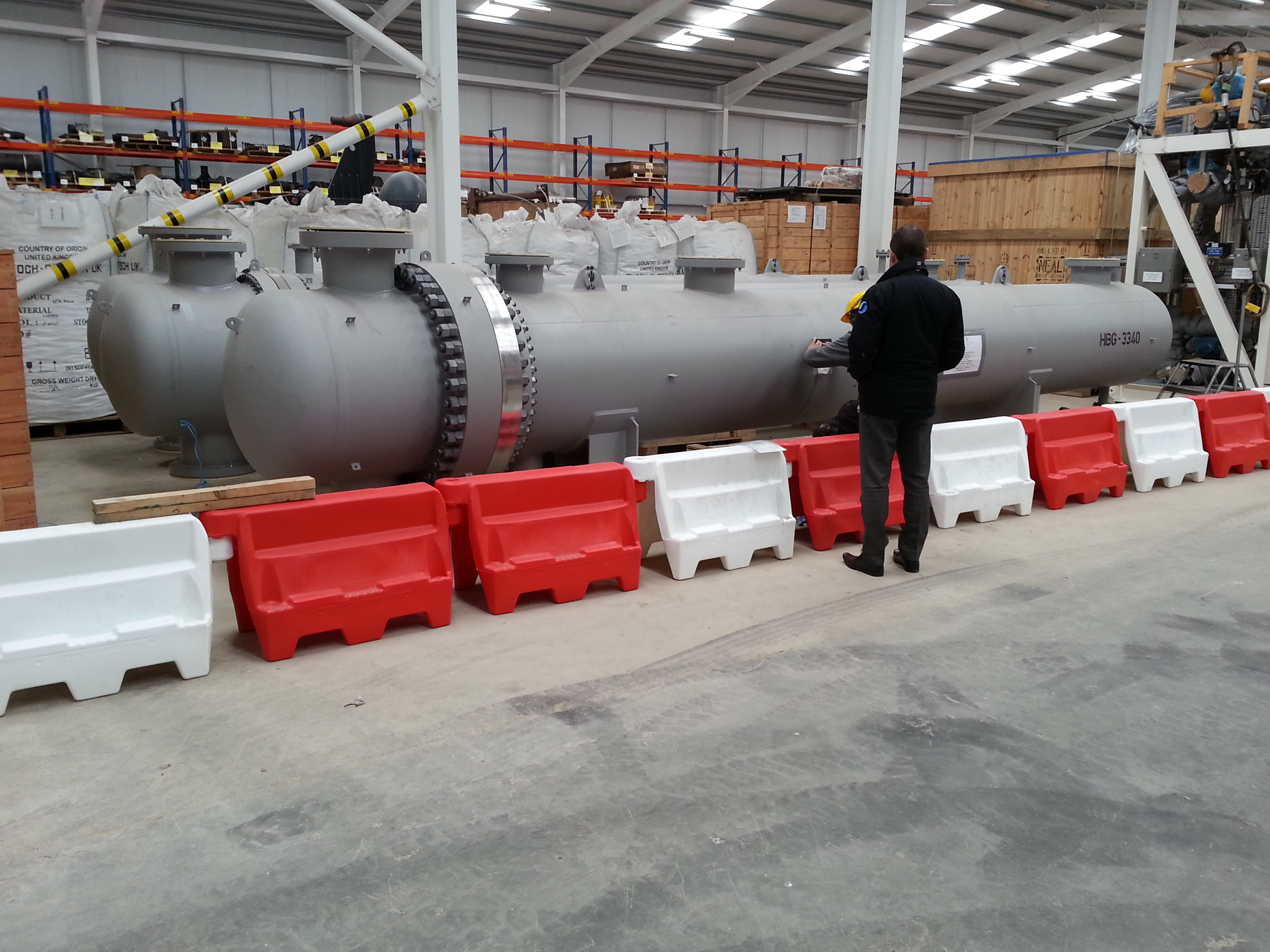
Picture of the Clair Coolers sitting in a hangar at Peterhead.
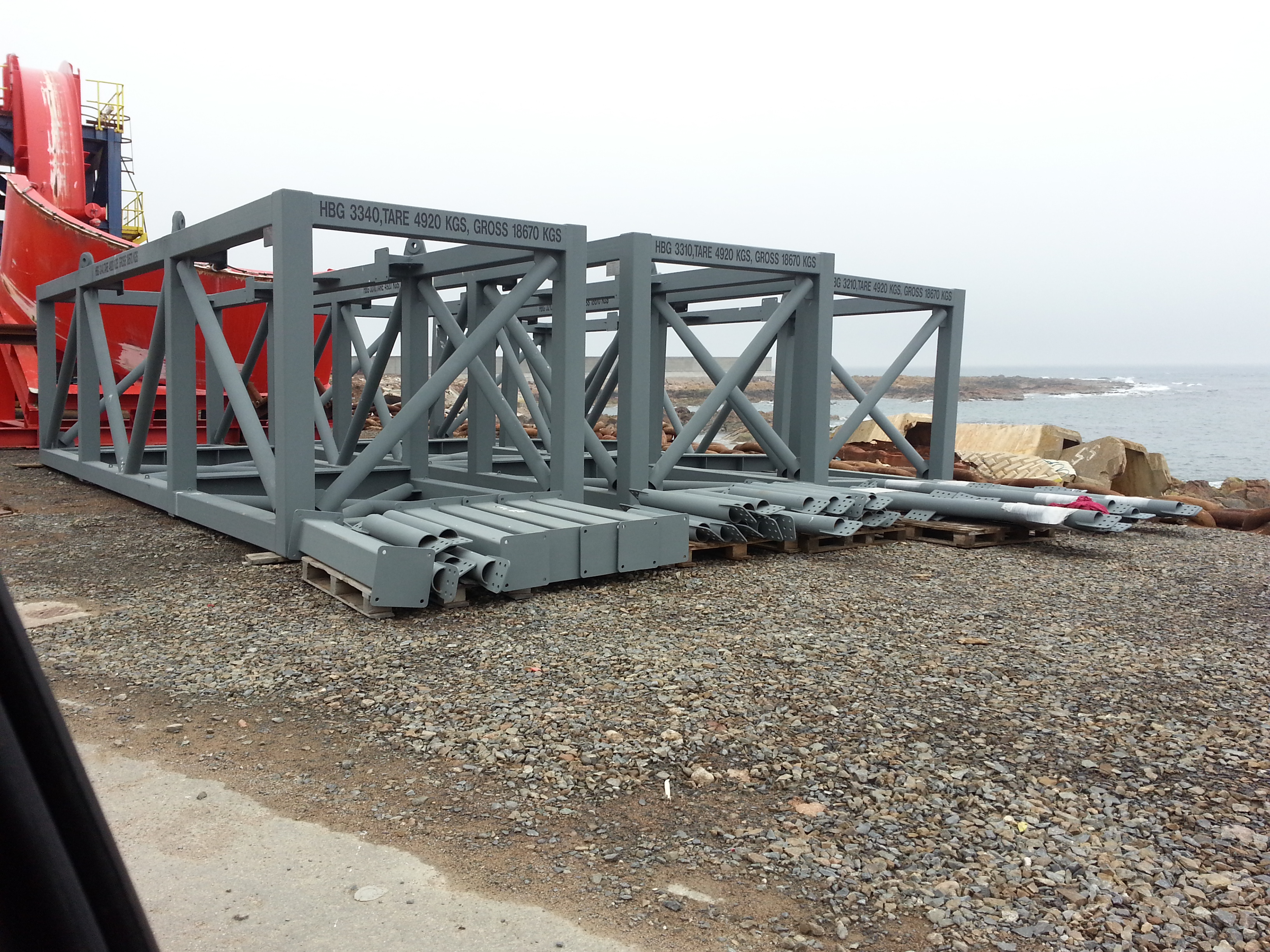
Cooler transport frames to get them off-shore safely.
This job has really developed my understanding of how BP do business. More importantly it has increased my understanding of how critical risk appreciation and management are to successfully executing a project. Ideal considering the up-coming HAZID for the Bruce bridge inspection platforms. There is a plan afoot to get off-shore over the next month or so to actually see the coolers getting fitted, but I am not raising my hopes to high as there is unlikely to be a lot of space off shore during the TAR.
In Other News
Hugo had his first birthday party last weekend and it was a great success. Next week he starts nursery as Corines parent will be heading home and she will be working half the week for Grampian housing association. I and Chris attended Kingswells Primary school yesterday for the third leg of our involvement in the Primary Engineer Scheme. This saw the children racing the shoebox cars that they had made over the previous two sessions. The vehicles were rolled down a ramp and measured for distance traveled and deviation from a center-line, with the children doing the launching, measuring and scoring. Chris’ teams put in a valiant effort but at the end of the day were resoundingly defeated, he might be the fastest man in all of Nairnshire but I am the king of the classroom!
Army chief visits Crossrail
A few photos of me chilling with an ex Squadron airborne brother under London.

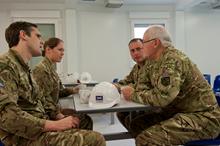
It was ‘Uniform to Work Day’ yesterday and as a result I was instructed to show the CGS around some of the tunnels under London. I managed to get some good ‘facetime’ under my belt and even mentioned in the CRL news letter ‘working at Crossrail is full time Army officer Capt Mike Burton, currently on a nine month secondment to Bam Nuttall as part of his Professional Engineer Training and based at Fisher Street.’ Well done me!!!!
Thats right SQUADRON!!!!!!!!!
The Ring Beam Trilogy
Ok, so the last post took us to the point of trials taking place, in order to ascertain the correct construction method. As a result the number of reinforcement bars, from the piles into the ringbeam reinforcement, was reduced. THe designers conceded that there was only a requirement for 3 x bars/male pile to protrude into the ringbeam. These 3 bars would provide sufficient shear reinforcement and bond length (in order for the next phase of excavation, where the ring beam will be temporarily suspended). The designers did specify that 2 of the bars had to be on the near face and the other on the far face of the shaft.
With the reduced amount of bars requiring coupling, the 200mm SCL profile was easily achieved and the time required to couple the bars greatly reduced (from 8 per pile to 3 per pile). The ring beam reinforcement cage was put in place and the shuttering positioned ready for the concrete pour.
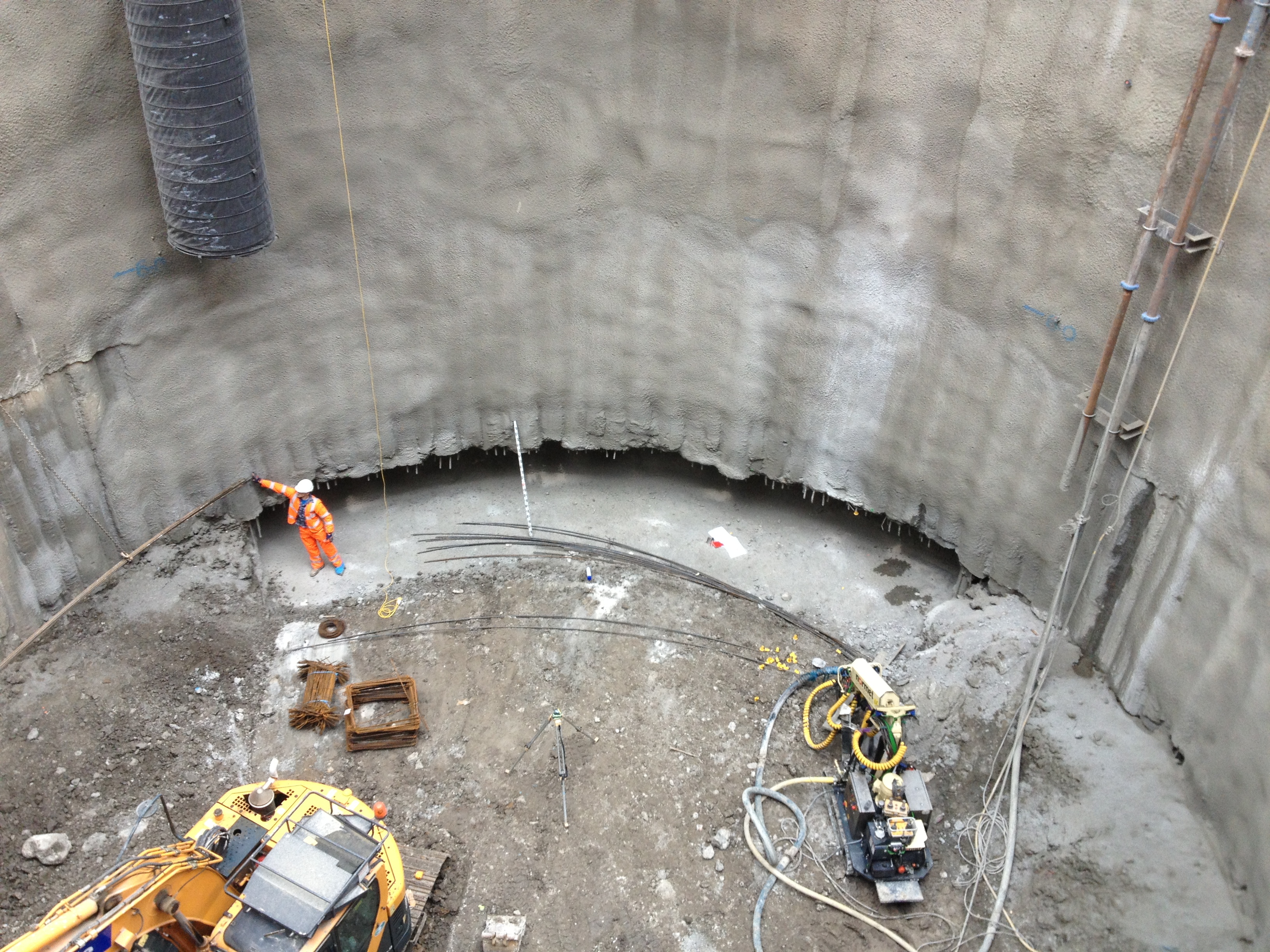
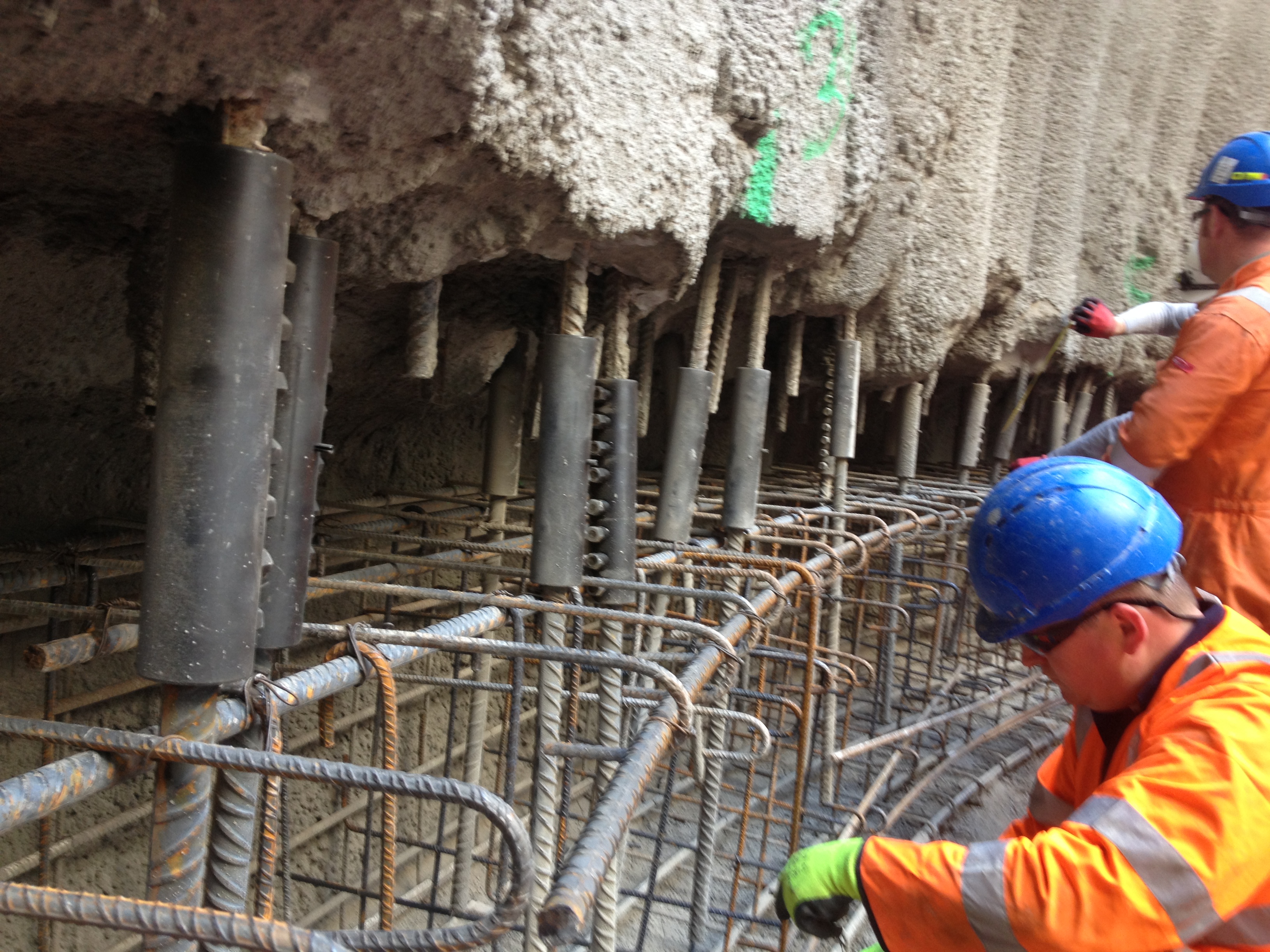

However, before the concrete pour can be started I had to do a pre pour check. This includes checking the reinforcement of the ring beam, ensuring the connections between the piles and ringbeam, checking the shuttering is as per the shuttering design etc. After reading Rich Farmers comment about the couplers on my last post, I had done some investigation and found that the Lenton Lock couplers ‘bolt heads will shear off when proper installation tightness has been reached, which allows for completely visual inspection’. AS you can see from the photo below, they had not!!!
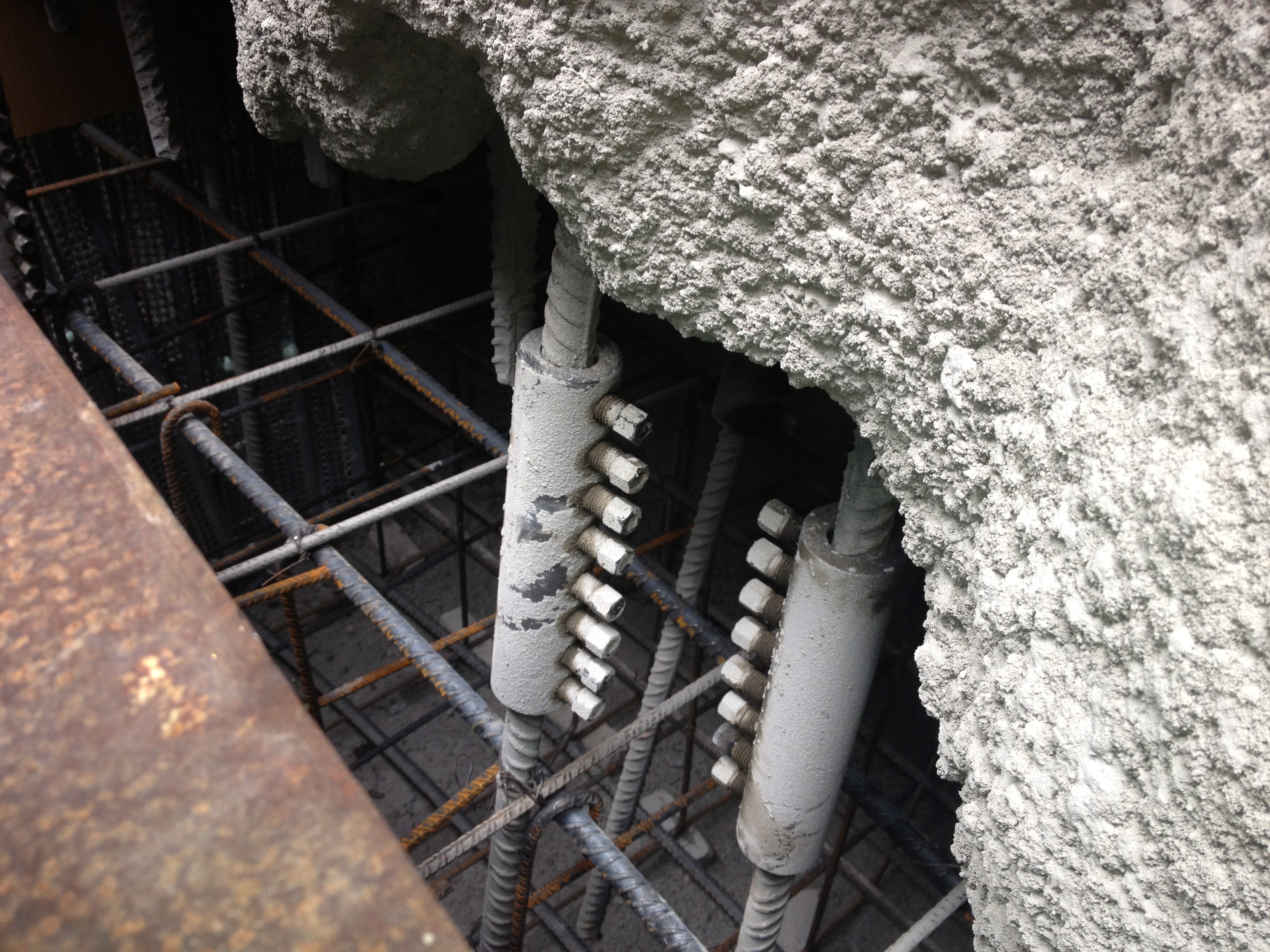
In fact the sub contractors, nor the CRL supervisors had realised the huge oversight. I then checked the bolts and not only had they not been tightened sufficiently to shear off the bolt heads, they weren’t even finger tight. The result was the concrete pour was cancelled, the shuttering taken down and the couplers all tightened untill the bolt heads sheared off. I was as popular as a pork chop in a synagogue. However the cancelled concrete pour was a fraction of the price it would have been to rip out the concrete ring beam and start again, as there was no way of proving to CRL that the couplers would have held.
You would like to think the fun stopped there but it didn’t. The next saga was the concrete mix. The idea was to spray the concrete (C32/40) in behind the shuttering using the SCL machinery all ready in place. This apparatus had already sprayed the shaft piles with a regulating layer of 75mm and would be used later to do the 400mm layer once we got below the ring beam. However SCL concrete mix is very much different to the C32/40 mix that the ring beam is constructed from. THe first batch arrived, loaded into the pump and sent down the steel tube and then into the flexible rubber hose. However within 30 sec the dryer C32/40 mix had blocked the hose and steel tubes. THey then tried dropping the mix in behind the shuttering with the skip, it didn’t work. Because the concrete had by now been on site for so long we took another slump test and it failed so the entire load had to be dumped. THis then lead onto the next issue, because Barhale had cancelled two concrete deliveries and then dumped the third the concrete supplier couldn’t deliver another batch till the morning. THis meant that the small amount of concrete that had got in behind the shuttering would have been curing to long before the next batch arrived. This would have led to a cold joint forming, as a result bthe shuttering had to come down for a second time. The small amount of concrete removed and the ring beam reinforcement cleaned.
We are now in the position to pour the concrete again. The spraying of the C32/40 mix has been scrapped and they are using a skip with a tremi on it. This should result in the first quarter of the ring beam being poured within the next few hours. In reality it is about an 8th because either end of the ring beam reinforcement cage can not have concrete poured onto it., as it must be left open in order to tie in the next quater of the ring beam reinforcement cage.
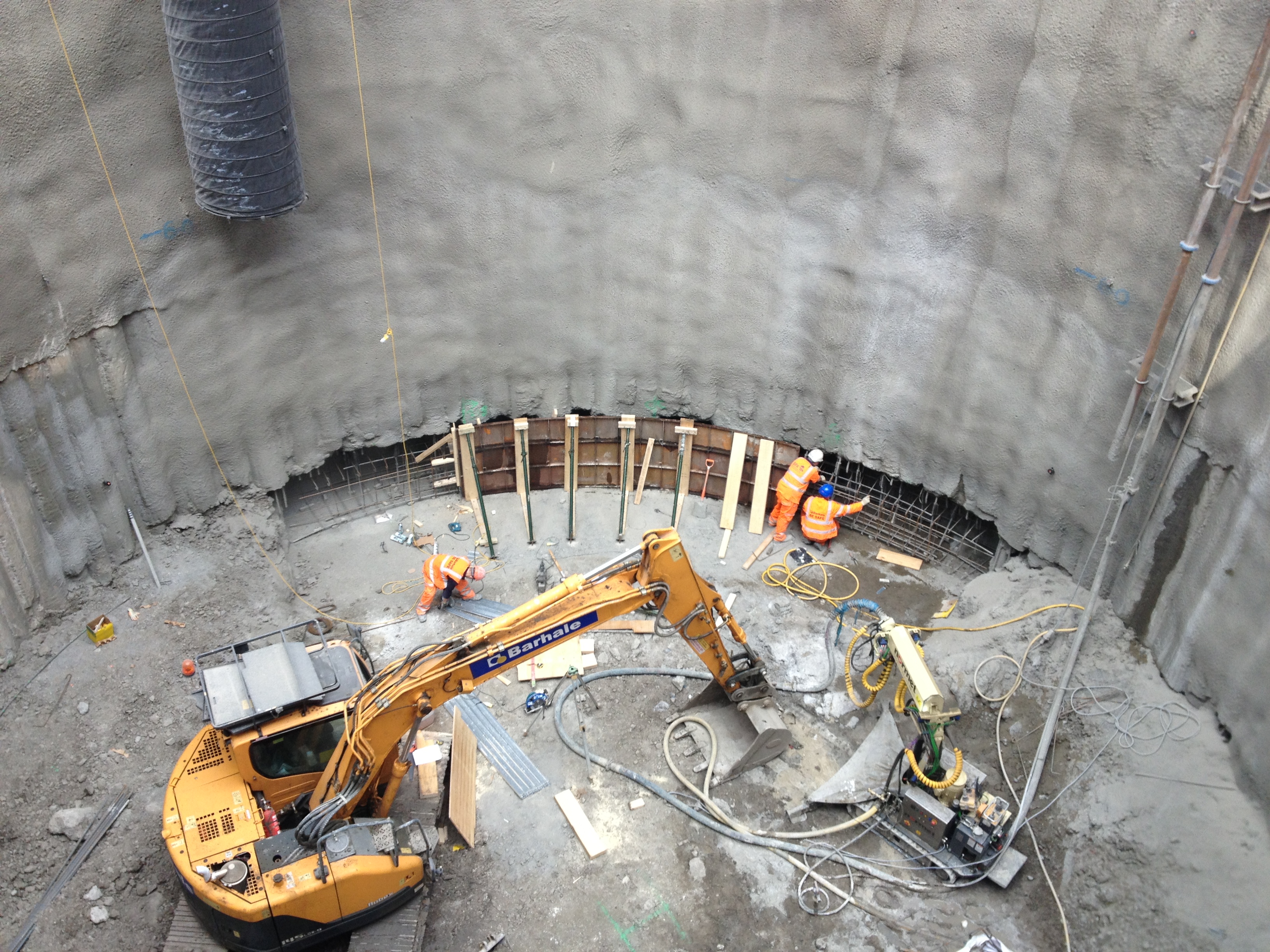
Witnessed: Civilian Equivalent of Cowardice!
Wait all this time then 2 posts come along at the same time.
We are going to be installing a large transfer beam at the beginning of next week, this thing is going to be a 20 tonne beast, with next to no tolerance for line and level. In order to try and give us the best chance of success we are using lengths of steel angle to act as a template for the holding down bolts (don’t ask me why, this was a decision that was reached between the fabricator and the consultant) the steel erecting team from the fabricators arrived on site today. The project manager decided that his total involvement consisted of introducing the foreman to the steel erectors and then quietly slipping away so that once the general name exchanging and such had finished everyone just turned around and looked at me. The setting out engineer had no idea what was going on and so apparently I became the one in charge, not a single person more senior that me visited that part of site for the rest of the day, after the fabricators had left. However in my one trip back to the office to get some lunch I was asked an irrelevant question about brickwork, where do these people come from?
It’s Been A Long Time
TMR 1, some leave, Lizzie not well, the CI’s visit and healthy dose of laziness have all conspired to prevent me from completing a blog for sometime.
Update Artesian Water – The 2 dodgy men that turned up with big drills and a few bags of cement did manage to stem the flow of the water. It took a while and wet feet (not mine) but eventually a chemical grout managed to stop the water. I have to admit I was skeptical right up to the point where the water stopped, it seemed like a very amateurish outfit but it made me laugh to see a Celtic supporting Glaswegian and Rangers supporting N Irishman step out of the same van. The death of water problems combined with a couple of other long awaited solutions have finally opened up the last part of Block B for construction and by the middle of next week I expect to have a water tight plant room.
The project continues to be plagued with design issues a constant stream of RFIs come in from the concrete contractor, I’m trying my best to get ahead and stay there of the construction process but with more trades on site now I can’t dedicate all my time to structural stuff. The M&E types are slowly dribbling on to site and dangling a few things from the soffit in my plant room.
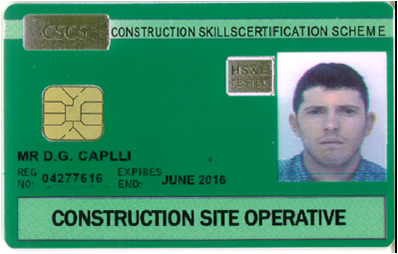
I have been conducting all the inductions on site at the moment and because of that handle a lot of CSCS cards and one didn’t look quite right this morning, apparently the line in fake cards didn’t extend to a fake phone number on the back and eventually it was confirmed that it was a fake card. Free breakfast care of the contracts manager for Rich!
Ring Beam update
My last post got us to the point of reaching the excavation depth of the Ring Beam. THis post will go into a little more detail.
Due to the amount of reinforcement of the piles, the construction sequence of the Ring Beam had to be modified. As you can see from the sequence below, the reinforcement in the piles needed to be cut.
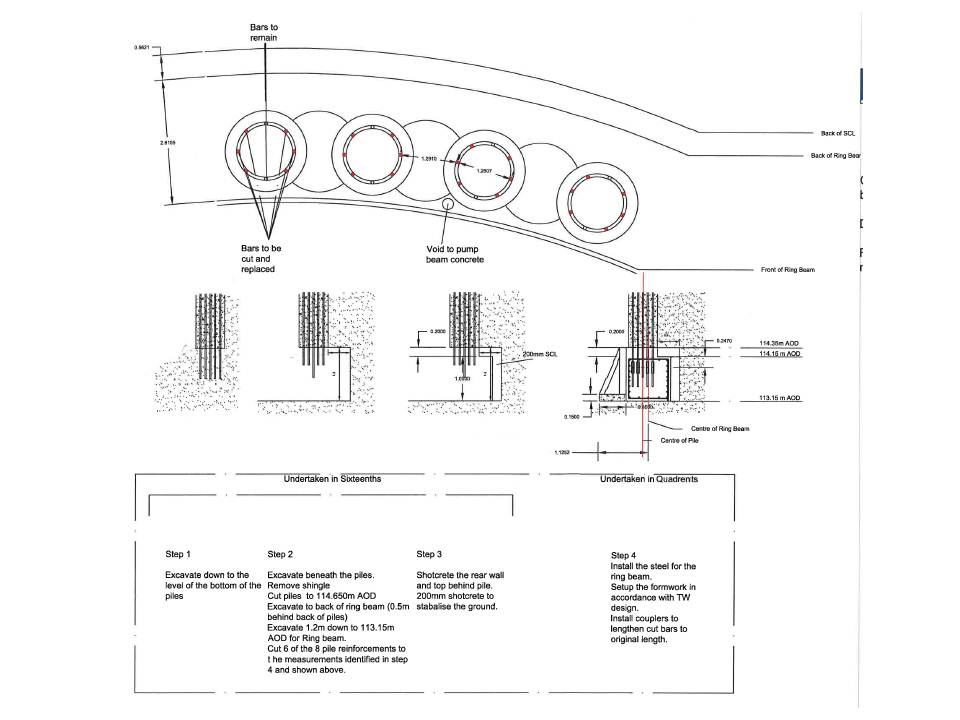
However in order to decide how much-needed to be cut a quick calculation was required to see what bond length was required in order to hold the Ring Beam up.
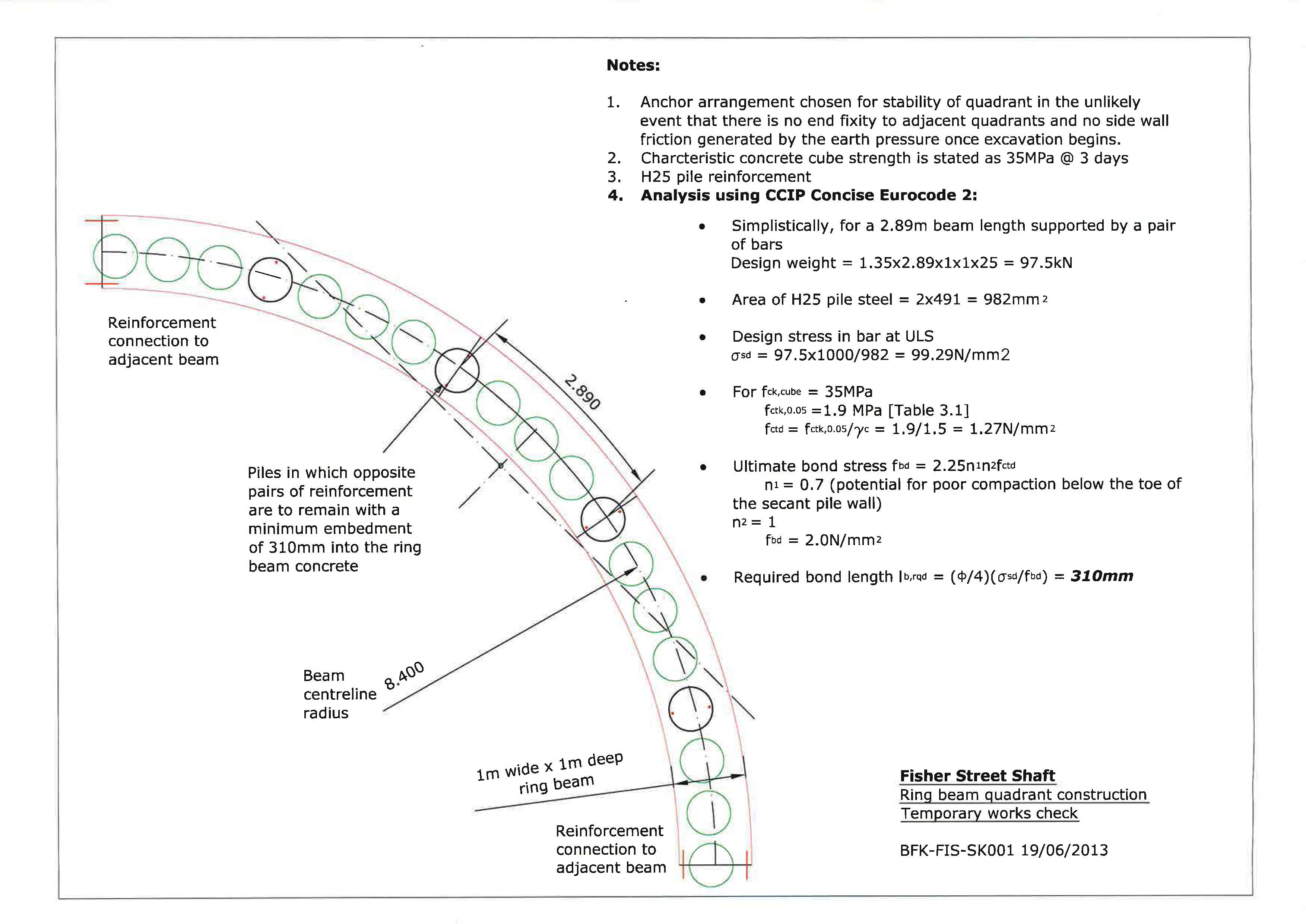
Once the reinforcement requirements for the Ring Beam were calculated, the decision to cut the reinforcement could be made. However although the calculations demonstrated that all the reinforcement was not necessary, the decision was still made that all the reinforcement bars had to be coupled back together, once the SCL had been completed. I am in the process of trying to find out why this decision was made.
The next issue is trying to obtain the 200mm SCL required in the cavity below the piles, where the Ring Beam will sit. There has been several modifications, but it now seems that with design #4 (as seen below) we are managing to get the correct SCL profile.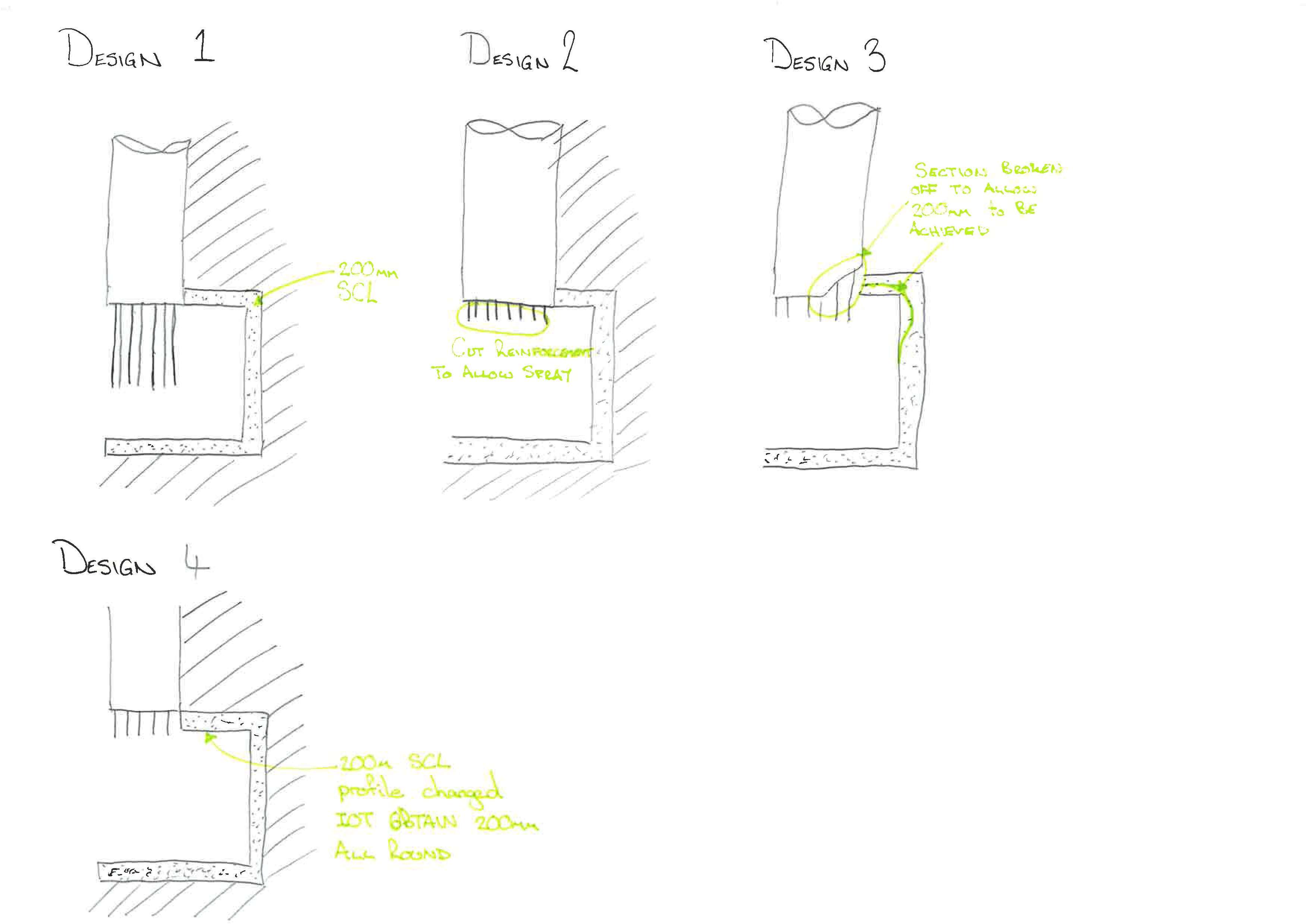
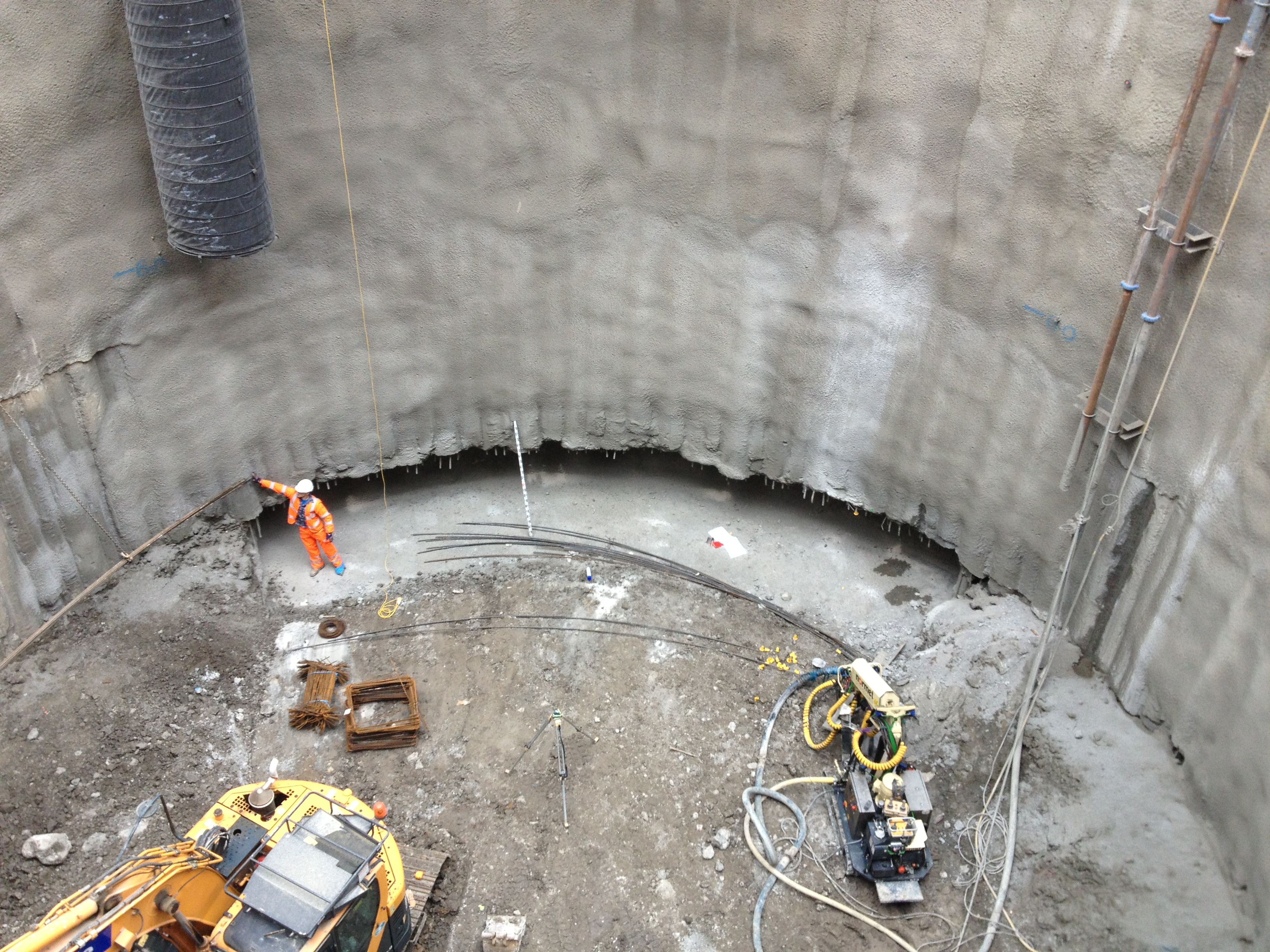
Trials are taking place as I write, we will see if this construction method works
 Holdfast Training Services Trial Blog