And now for something…. vaguely useful?
For those of you that are reading this in the back of the classroom room whilst pretending to listen to a lecturer you won’t have had the joy of concrete yet. For those of you that are out in the real world but aren’t playing with concrete in the same way that I am I thought it would be useful to see a few things that might make design in the future a little easier. These are the concrete accessories that have appeared on site that didn’t fall into the category of either steel bar or concrete.
Shear Rails
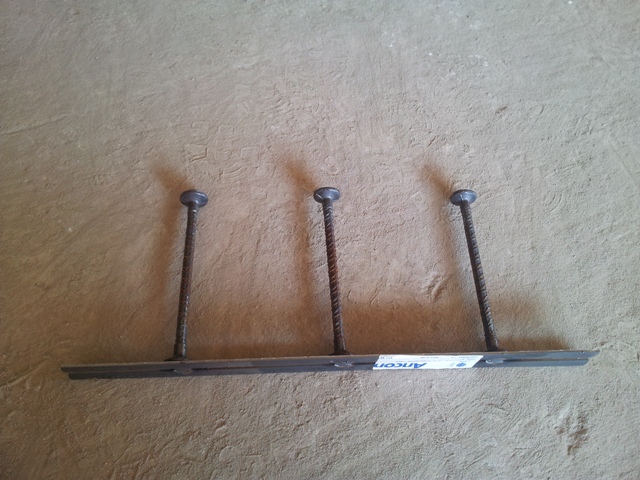
Funnily enough I didn’t have to ask what these did, however I have to admit that I don’t fully understand how you would design for them. These rails are placed in the slab with the ‘mushroom’ end down and the flat bar uppermost. They are placed in a radial pattern around the base of some columns, I can only assume that it is to deal with punching shear in the flat slab (if John Moran answers this first I’ll be berated about my lack of an engineering model and if Richard Farmer gets this first he’ll enjoy dispensing his knowledge). The rails appear to be shorter now we’re starting to get into the post-tensioned slab.
‘Conny/connor bar’ or Anchor Strip depending on who you talk to
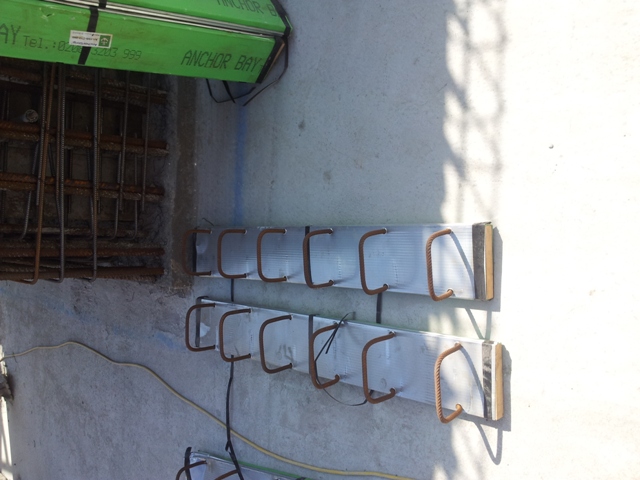
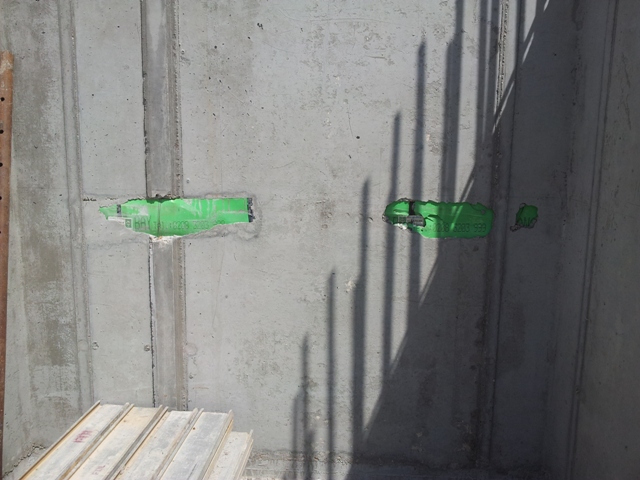
This off the shelf product is used in to provide starters without the need to make timber formwork. The steel loops that you can see are tied into the reinforcement cage with the green side flat against the shutter, the wall is cast and when the formwork is struck the green plastic is peeled away to reveal starter bars that can be pulled into position, these are perfect for casting the landings for stair cases. Be careful if you get asked whether you can use these instead of the scheduled starter bars, they ask to make life easier for them but don’t appreciate that slab starters are designed to be 32mm bars for a reason and can’t see why they can’t use the conny bar with 16mm starters.

Baseball Bat
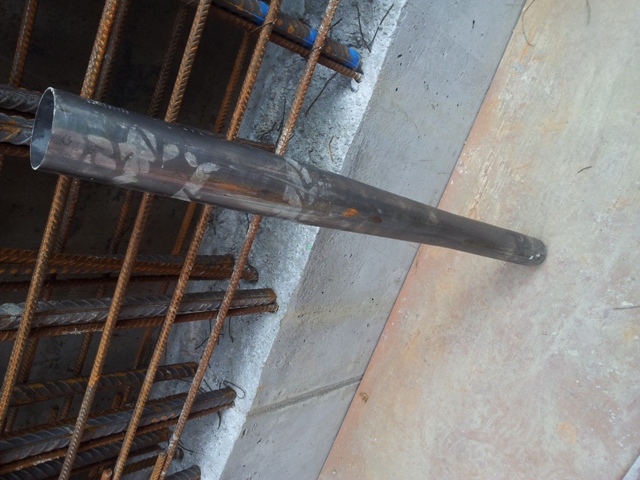
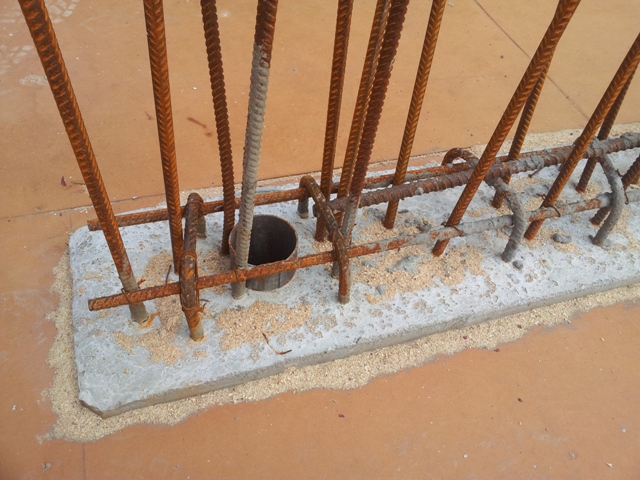
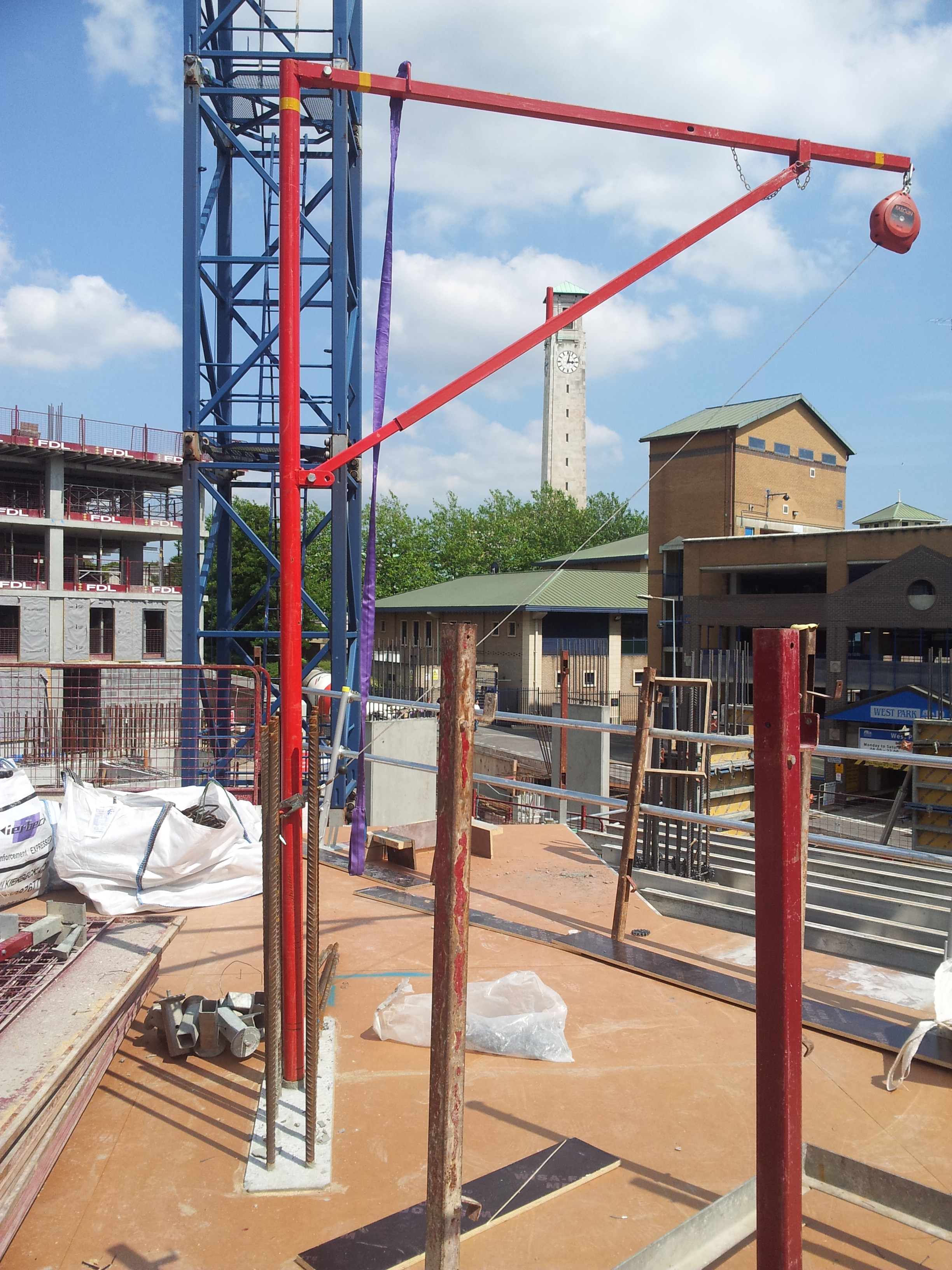
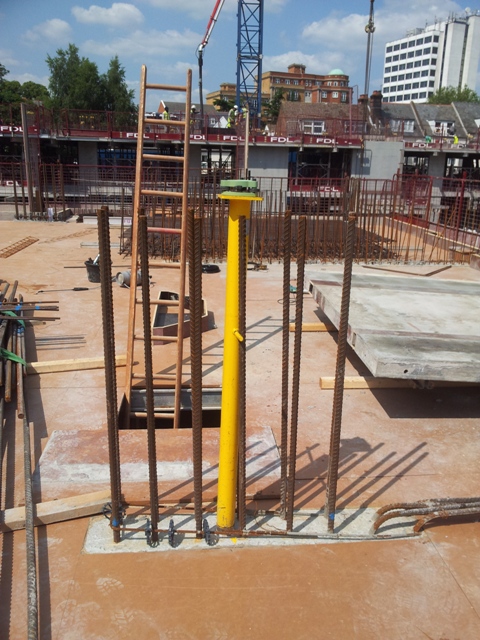
This socket gets cast into the top of columns and serves 2 purposes. Firstly it is used for placing a fall arrest system inside, the red post sits firmly in place and then has an arrester wheel dangled from the end, this allows safe working at height for individual building the decking for the slabs. The second use allows the yellow post to be placed in the socket and provides a firm base to attach an instrument to for setting out, setting out from a tripod on the decking isn’t used because there is too much movement and vibration.
 Holdfast Training Services Trial Blog
Rich
Great stuff; really interesting.
Rich,
I’ll perform both duties, John being on leave. First off, the name Ancon Shearfix is a bit of a give away. See: http://www.ancon.co.uk/projects/westpac-place-sydney-australia for thier blurb and offer to calculate for you how much of your cash they would like to extract from your project. They are a simple means of dealing with punching shear as you quite rightly say: See lecture notes for flat slabs and punching shear with reference to EC clause 6.4.5 and figure 6.22 all a haze of symbols and equations I fear which suggests I should do better this time around. You might recall the photograph of a car park with columns protruding through the tatters of the slab which was stacked on the floor below? The solution of course is to demand an understanding of what is going on – an engineering model! If I suggest that design to resist shear could use a truss model where a notional diagonal compression element is set up and tensile reinforcement is then provided vertically and horizontally that should chime with the past. Add to that the concept of a shesar perimeter… Have a look at EC2 on IHS – it’s not that hard to follow….. By the way – thanks for the blog, compliments Niks very nicely 🙂
I agree partially with that ANCON do tend to extract the budget from a project, judging by the exorbitant prices they charge for shear connectors, but when it comes to shear stud rails, I was actually quite surprised how cheap they were. $65 for a custom made rail of 4 studs, whereas to buy kits, (2 mushrooms and threaded bar) approx $60 (+ the associated manufacture and fixing costs charged by the steelies) makes it more like $160 but balanced by flexibility during a D&B project.
I did actually look at your notes, but my scanned copy was partially blurred and I couldn’t make it out so went back to good old Mosely and Bungey – oldie but a goodie. Internet was strangely dry of punching shear information.
Nik
Jim,
I can only assume that was sarcasm.
Rich
Yeah got there just now…. I noticed the shear rails on the drawings you sent….you’d expect to see them radially splaying form the column positions…..particulalry on edge and particulalry corner edge columns.
IF I’m not wrong there also seemed to be nlgles links laid on the beam lines close to columns – much for the same reason