Proposals, Presentations and Thongs
Over the past week I have been working mainly on the proposal for Ballinyoo Bridge referred to in my last post. The issue with the site is that it is just so far away from anything and all quotes for geo, survey, road safety audits, and visits all include the cost of substantial amount of travel and accommodation. I evaluated the 3 Geo quotes and found them all to be fairly similar in content, which made my job easier, but 1 was significantly higher in price. I assumed that they just didn’t want to go up North but was surprised when they called to express their interest and ask if there was anything else that they could do to assist their quote. It was really a 2 horse race between the others who were coming in over $30,000 cheaper for the same service. I had to get the quotes amended to allow for pavement design and a different drilling methodology. This drilling issue that arose whilst talking to the clients Works manager, who stated that the river was in flood due to unexpected rains in North WA and would probably be so for the following 5 months. This meant that the geotechs would not be able to drill a BH at every future pier (as dictated by the Aussie code), and would therefore have to drill from the deck of the existing bridge. It turns out that this would only be a couple of $k so not a huge issue. The bigger issue is that the drilling would effectively close the single lane bridge and hence the road for about 10 days. The shortest detour would be about 600km, so it looks like the geotech investigation will have to wait until the low level (ford/culvert) crossing was trafficable. This will be about 3 months if the rain holds, so even if we progress with design without firm Geo, the construction is not likely to be completed in their dry season unless BG&E pull out all the stops and complete it in a couple of weeks. I was able to reduce all the quotes by a couple of $k by organising with the Shire works manager to provide a water source to cut off the water-boring costs.
My initial experience of the BG&E flat organisation structure was good. The idea being that it allowed everybody to interact with each other and had direct access to senior engineers and directors for building effective project teams. Though this obviously shook my being to the core as I found it impossible to understand how anybody could work without a organisation wire-diagram, it appears on the surface to work. Recently though, the cracks are showing somewhat. Directors employing junior engineers direct and not involving their ‘line managers’ means that the junior engineers are not being managed effectively and often have too much work to deliver at the same time. This could be eliminated by involving line managers to manage workloads, but this is an additional cost to a project. This situation came to head when an error on a project meant that a junior engineer was accused by a director of negligence and the line manager had no ability to protect him because he knew nothing of the situation. I think this may be something Rich Phillips is looking at but it made me appreciate the military management structure somewhat, and thought it would be a good thing for industry to take on.
I have been to 2 presentation over the past 2 weeks. The initial conference was about the new products that Hilti were bringing out. A recap on the use of chemical anchors in design brought back memories of the hospital project where Chemical anchors were seldom designed, but were the “get out of jail free” card that contractors were constantly abusing to save time. The second part was an introduction to a hollow drill bit that is used as part of the system to suck dust out of a hammer-drilled hole in order that it is immediately ready for chemical anchoring. The presentation concerned me so much that the practice at the hospital was so poor, I immediately emailed the engineers to make sure they were in the loop, and even emailed to presentation to the main culprit subcontractor with a summary of why the particular drill bits would save him money.
The second presentation was organised by Engineers Australia (ICE equivalent) and was by a civvy who worked with the Defence Science and Technology Organisation (DSTO), so I decided to go to support the military. Turns out that all that is Science and Technology in defence is not that interesting. 1.5hours on radar waves pretty much killed me, though I did rouse briefly when he spoke about the large civil structures designed for the systems. There was pizza though. For my CPD log I will state in the “What did you learn from this activity” box, “Always read the presentation summary before you attend.”
In other news, Nicky and I went down to Cottesloe beach and joined the world record attempt for the ‘largest number of people connected on the sea on inflatable thongs.’ Before you get too excited, a thong is actually a flip-flop over here; but when paddling out to the line-up, there were plenty of thongs on thongs so I am not complaining.
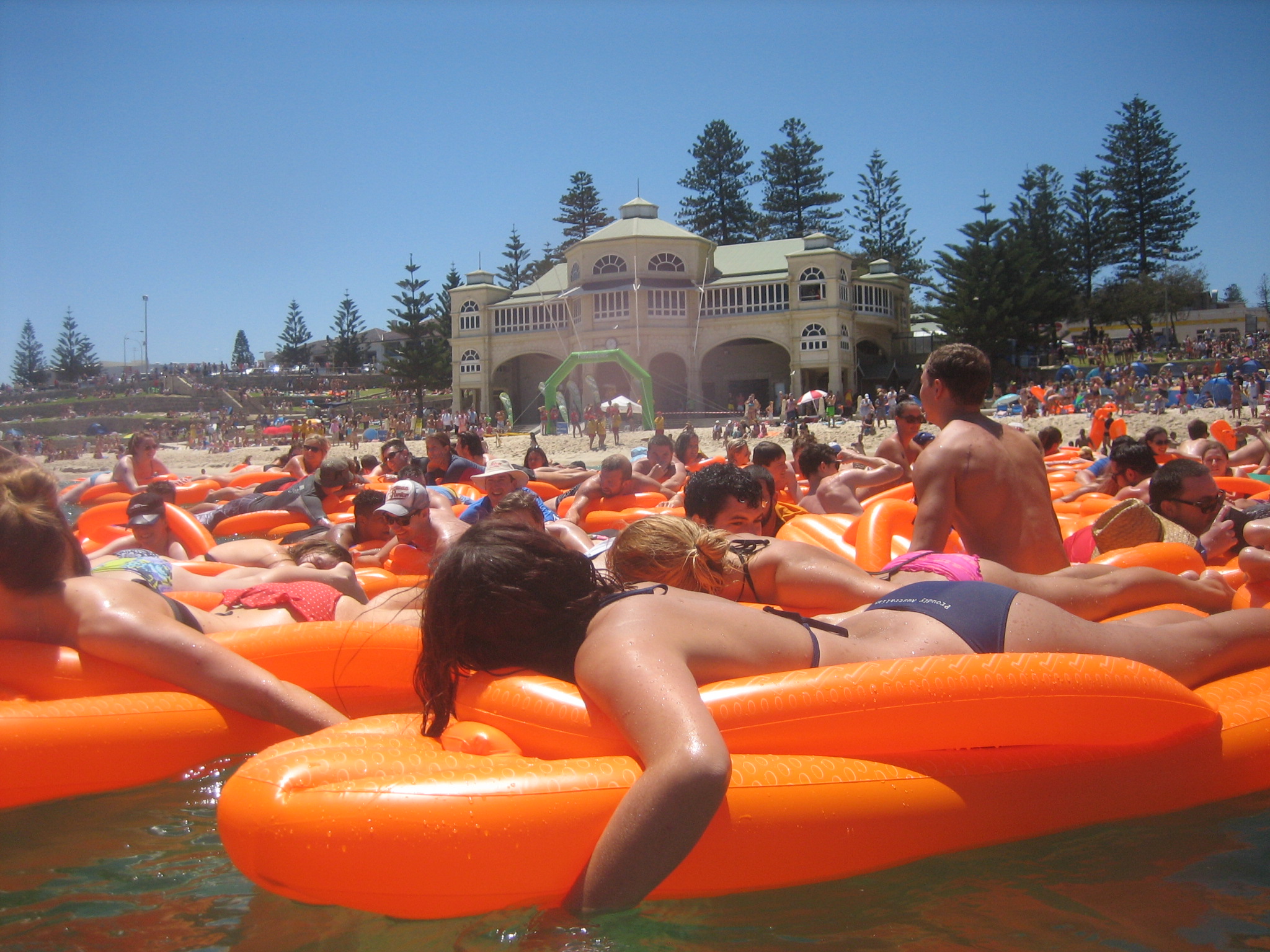
She is going to have some terrible tan-lines!
 Holdfast Training Services Trial Blog
Nik,
The flat organisation of a design team is not something I’m looking at the thesis is far more site orientated. I have witnessed here but in general haven’t seen any problems, there are a relatively small number of graduate or design engineers (read ‘red arses’ and ‘experienced but non-chartered’) here and only the principal engineers or the associate task them directly, the team is only 16 strong and so everyone has a reasonable idea of what’s going on.
The structure is flat the design office has the same affliction as site in that they all like their titles, whilst they don’t talk about money from what I can deduce a ‘senior’ engineer earns less than me.
IT would be interesting to know at what stage the accusation of negligence arose, I quite regularly feel that my work isn’t being checked (the bridge I’ve previously talked about is one example) particularly thoroughly. If it’s wrong is it my fault or the checker’s?
The responsibility for design lies with the designer. A checker is merely part of an internal QA/QM process. Slightly different if the work is completion of code bashing i.e. delegated number crunching by an assistant on behalf of a senior, in which instance the senior is the designer the junior is part of the internal design team. Frequently comes down to who signed the construction issue drawings!
Nik,
ICE exist in Aus. I believe Engineers Australia are mutualy recognidsed andI’m sure Neil can confirm/correct. Now you know why there are large factors on construction in design… Not many thongs in your photo….
Nik,
Why was the third quote so much higher if the contractor really was interested in the work? You need to establish this as often the additional sum represents work that will manifest itself, for which this contractor has declared upfront costs and others either plan to claim for, or have missed.
Remember that many an infrastructure problem can be managed away. With a 600 km diversion as an alternative I’m sure traffic would wait for an hour to enable a BH to be completed and for the rig to move before resuming with the next hole (as an alternative to closing the road completely for 10 days). May not suit the ground (traffic levels ay be too high) but could be an alternative for you.
Thanks for all the comments.
David, The quote prices were assessed against content, and I could see no clear distinction of future costs between the cheaper 2 and more expensive third. In fact the omission stated by the 3rd were clearly included in 1&2. This potential ‘overpricing’ was confirmed on request of additional task quotes when estimates were about 40% greater for the 3rd over 1&2.
My thoughts are that the company are not wanting to drop their prices to suit the current climate. Quote 1 was from a large global company and 2, a local but well established firm. 3 was from a relatively new company (2years) but started by ex-directors of the 1st.
That said, my recommendation was for the first based on price, but assisted by a good history of working relationships with BG&E. It is in the hands of the client now to make the choice.
If you’ve made a professional recommendation to the client to accept the lowest priced tender based on previous experience the implication is that you have assessed their perfomance i.e. time and quality component so he is looking at the moon on a stick! – He wouldn’t go against your recommendation unless he had very good reason.