It is a good idea to hit steel to steel connection bolts with a (small) hammer
So here is a picture of Tower Crane Two (TC2). It is a WOLFF tower crane with a 45m tower and a 40m jib.
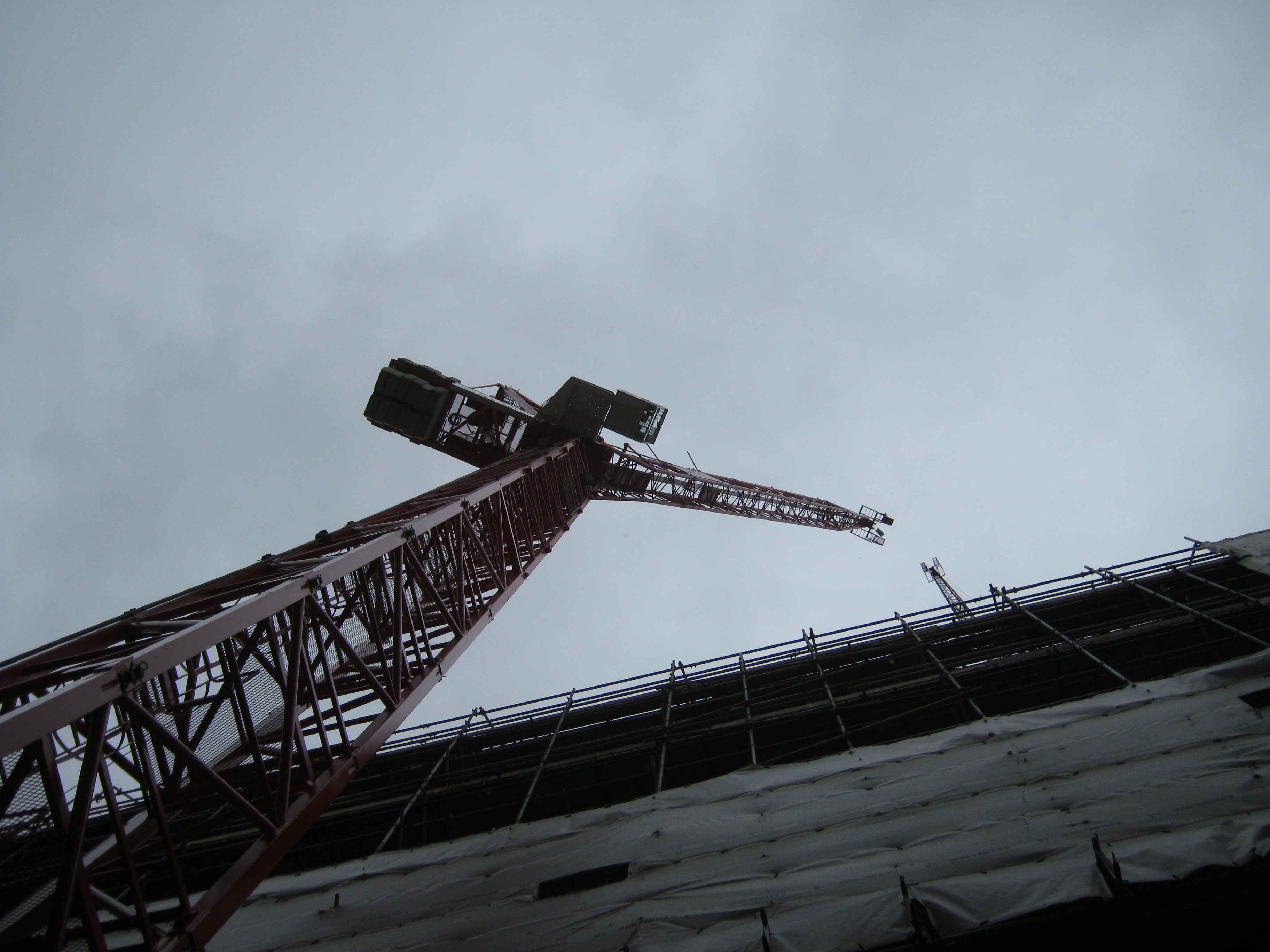 Tall Red Crane
It was installed on Thursday and Friday last week by HTC. On Thursday morning prior to the installation I went on site with Roy (the Mace Construction Engineer) and the designer (from a consulting engineers) to sign off the grillage.
The steel grillage connects the tower crane to the piled foundations beneath. Simple right? That is what I thought. So we went on site, had a look at it and signed the paperwork after some discussion.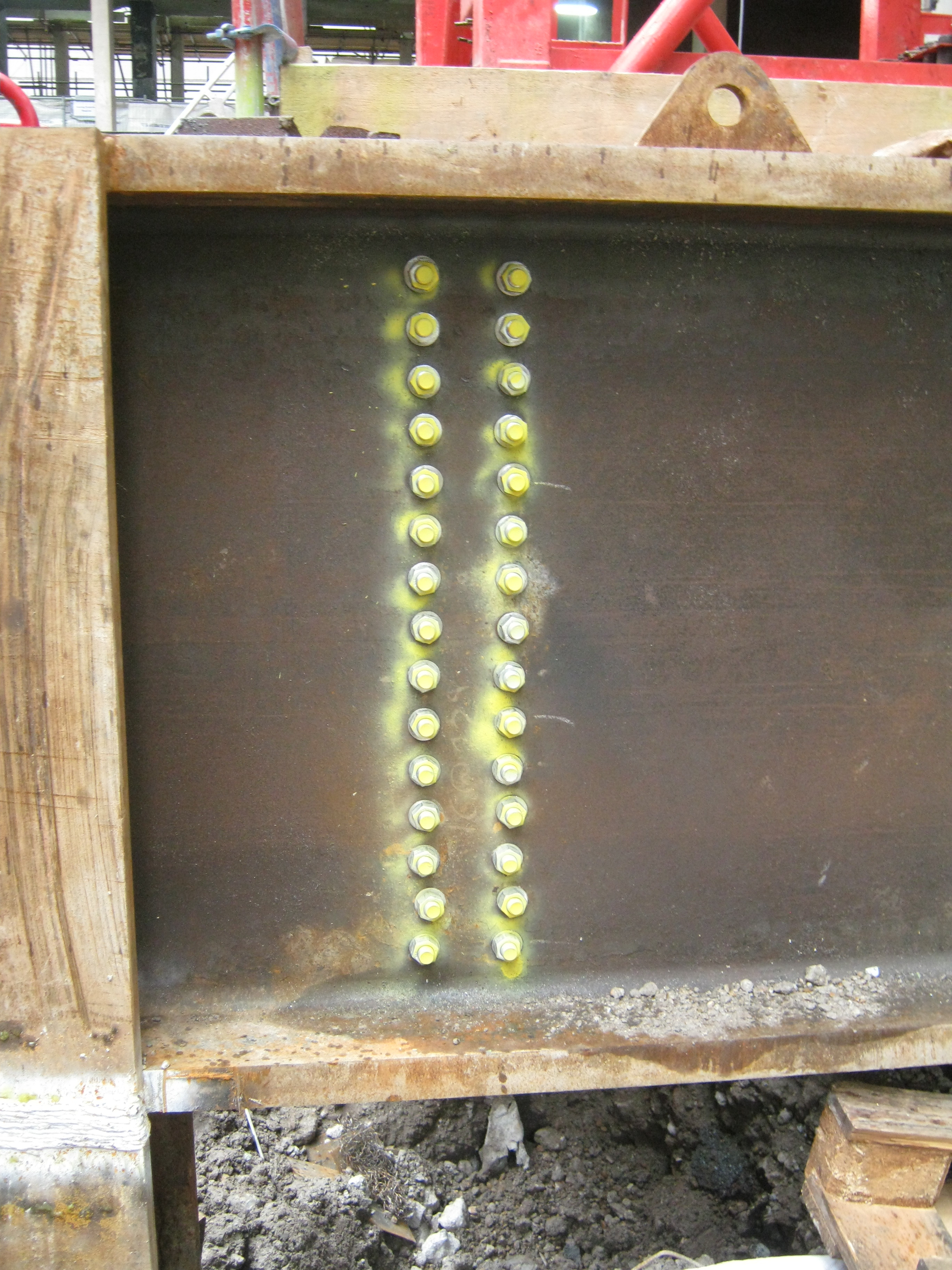
The Grillage
Well on Friday afternoon with the crane built and the load test about to start, the HTC inspector just thought he would check the bolts on the grillage (sprayed yellow in the picture above). Technically doing this was not in his remit, but he thought it wise to give them a tap with a hammer to see if they’d ‘ring’ (tight) or see whether they were loose (and don’t ring).
Well, many didn’t ‘ring’! In fact maybe 5-10 (of 240) were positively loose and perhaps 50% could be tightened further with a long spanner! Queue phone calls to the Construction Manager, Sub Contractors and me! The questions being:
1 Why are the bolts loose?
2. Who tightened the bolts?
3. What torque should they be?
4. Who signed off the grillage?
Since Roy was not in the office I found myself answering these questions. It turns out the answers were:
1. They were not checked, or re-checked.
2. The sub contractor PC Harrington responsible for the grillage sub-contracted the fabrication to DAM Fabricators. DAM didn’t check the bolts.
3. There is no torque. They had to be tight (manufacturers guidelines)! I think this means a man/woman hanging off of a spanner. As I understand it only friction bolts usually need a torque.
4. PC Harrington, Mace Construction Engineer, the Lifting Operation Manager for Mace.
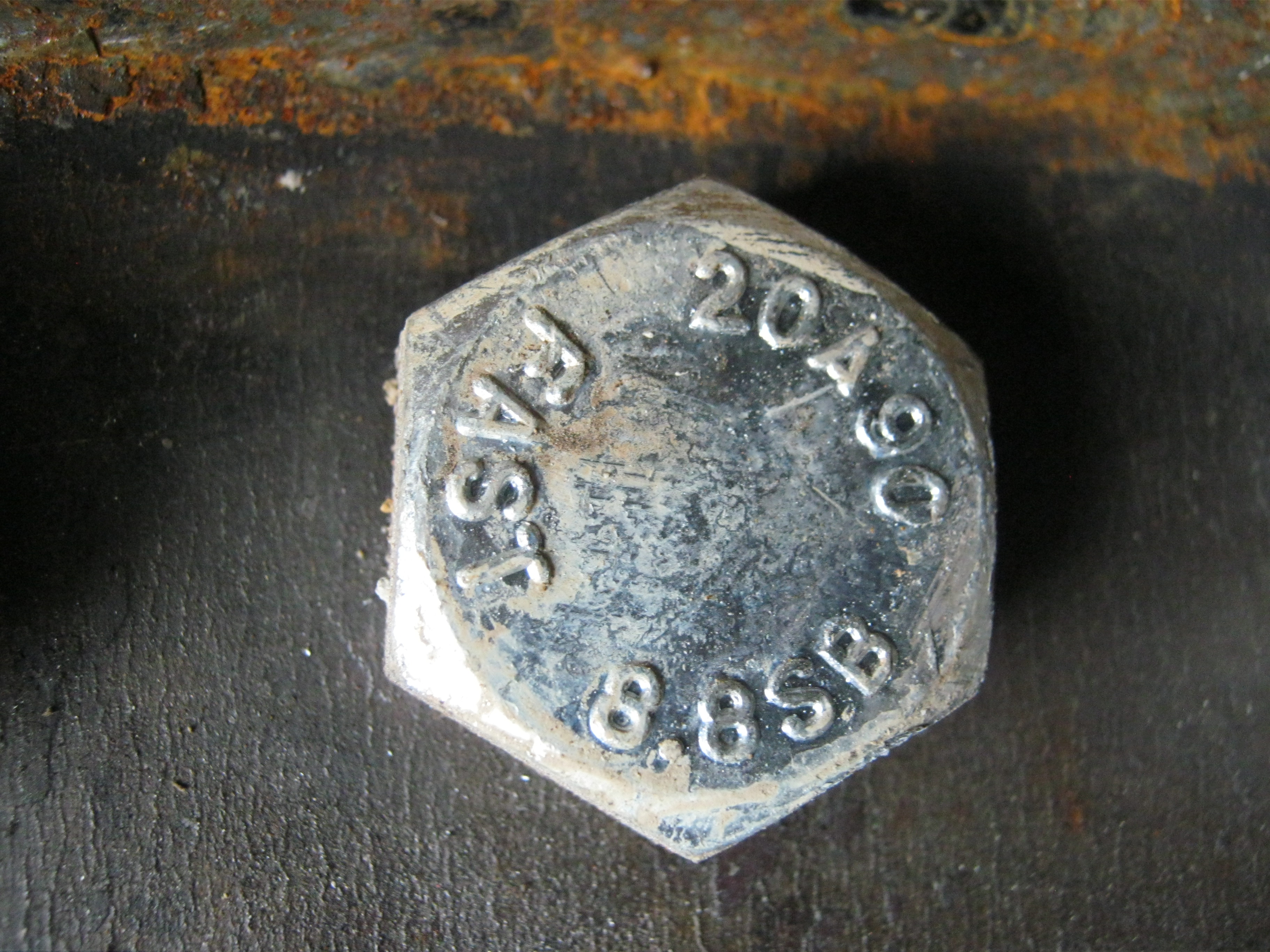
The bolts in question
So what is there to learn? All sub-contractors need to sign off their work (DAM were responsible for the bolts and they had no sign off directly to Mace); Sub-contractors need close supervision (no surprise there); Hit bolts with a hammer to get an idea of how tight they are; And finally understand what checking procedure has been used prior to you checking something.
Have I missed anything???
The key question I haven’t answered to myself is whether we (Mace) should have done a random check of bolt tightness? You chould say yes, but then we’d have a lot of other bolts to check too. I guess it’s all about the risk associated with that particular bolted connection!!!


For the life of me I can’t read the bolt head data..other than (I think) it’s and M20 Grade 8.8
So it’s not a friction grip bolt so there wouldn’t be specific tightening instructions.
IF the bolt were asked to work in tension ( as in a moment joint , then there is a requirement for the nut to be so many threads on and tightened to limit the rotation required to develop the strength.
The image with all the yellow paint on is a bit alarming for another reason… and here’s why
If this is part of a grillage then the bolts are transmitting shear ( and possibly a moment)
For shear the mimimum bolt pitch is sbout 3 times the nominal bolt diameter ( M20’s at 60 mmm) I don’t see the pitch
If theses are M20’s at 60mm centres then in single shear they are worth about 50kN
So the joint is worth 1500kN. If the crane is operating at full radius at full load you can quaickly determine what you need….I am assuming the limit is the bolt in single shear because the grillage steel looks BIG.
If the bolts were being asked to work as shear connectors….the nuts not being tightened would only worry me if there was some chance of them vibrating loose
John,
The bolt pitch is 56mm (vertical centre to centre spacing of the bolts). You are right that the bolts are M20 and grade 8.8. Looking at the Blue Book the shear capacity of a single bolt is 91.9kN. Therefore the capacity of the group is near 2757kN.
The connections are shear only, so there will be no tension. (This is how the designer modelled it). The greatest shear force at a connection is 2346kN (ULS).
Rich
What are the bolts bolting to what? What is the load path? Does it only attract shear? A good example for Steel this year
Regards
Neil
The bolts connect a secondary 1016 x 305 UB 487 to primary 1016 x 305 UB 487. They are shear only. No moment.
I’ve been tasked to design a grillage for a TC at a Met Police Station. The TC will be located on the roof of the existing building. Its rather interesting! I’ve done some prelim sizing and need to do the detailed design.
http://wp.me/a24Cc0-1J6 – Grillage Plan is here