My tunnel is too tight….
One thing that has struck me since joining CrossRail is that the opportunities for innuendo bingo are legion. I will not recount the most memerable examples here, but I encourage you through the medium of my blog to play along at home.
So after almost two weeks held in reserve, up in the main office at Hanover Square, I was unleashed on an unsuspecting site at Tottenham Court Road. Now I would like to think that coach put me in due to my obvious concrete competancy, but I fear it was much to do with a calender clash that distracted almost everyone else on the team. Turns out Friday, was the annual Concrete Society Dinner…a social event only just overshadowed by the Oscars this weekend….
The running tunnels, cross passages and concourses have all received their initial and primary sprayed concrete layers. Initial lining is utilised to protect and prime the excavated surface and is sprayed to thickness of approx 75mm. The primary layer contains steel fibre reinforcement and provides the main structural integrity of the tunnel, and runs to a thickness of 450mm. Following that, the surface requires regulation and preparation in order to cover rogure steel fibres that are likely to damage the subsequent waterproofing layer. This is acheived by spraying a finer aggregate layer. Or so we thought…..
I stepped in to take over the workss which had been programmed and planned…allegedly. Predictably I arrived at site to find that nobody down there had been briefed and the concrete hadnt been ordered! Difficult to spray concrete, I find, without, er, concrete…
After many an hour listening to a load of Irishmen shouting at each other we finally began to spray. The Potenza spray machine…essentially a large hose mounted on a pickup truck, which allows regulation of flow rate. This brings about a quality management point. The nozzlemen…Spr Bloggs as we would know him…want to spray at the max rate of 20-22m3/hr. He gets a bonus per advance/chainage completed in his shift. Understandable. However, this flow rate increases the chances of rebound. Exactly as it sounds, the concrete does not adhere readily to the substrate causing dimished strength.
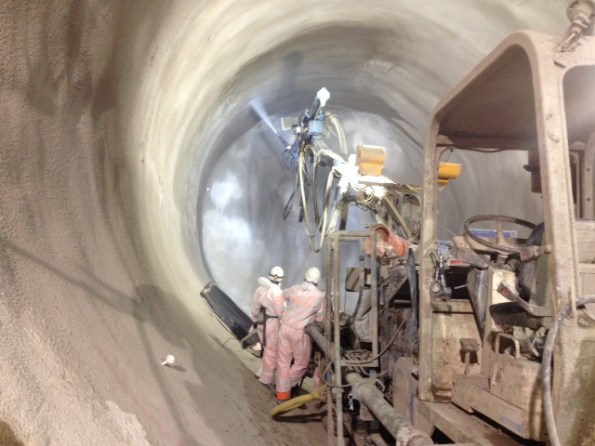
This brings about a quality management point. The nozzlemen…Spr Bloggs as we would know him…want to spray at the max rate of 20-22m3/hr. He gets a bonus per advance/chainage completed in his shift. Understandable. However, this flow rate increases the chances of rebound. Exactly as it sounds, the concrete does not adhere readily to the substrate causing dimished strength. Test panels that are sprayed, then cut into beams, highlight band layers which reduce the flexural strength by creating failure plains
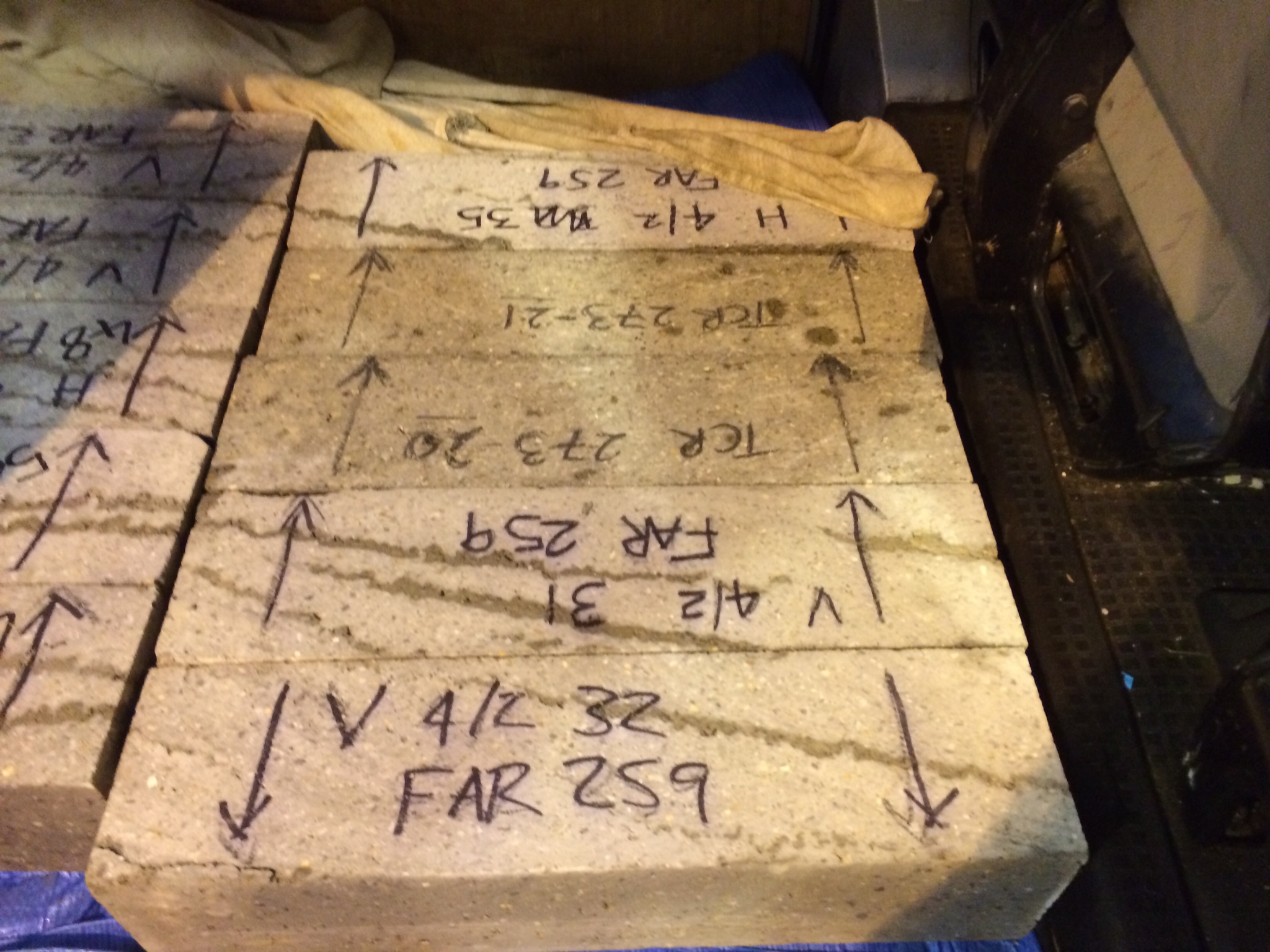
Note: TCR=Tottenham Court Road, no band layers. Far = Farringdon, band layers. Inconsistent quality assurance across sites is future blog fodder…look forward to that!
On completion of the regulating layer spraying, I returned to inspect. It was immediately clear that things hadnt gone well. The surface was particularly poor, and contained craters caused by large aggregate. The reg layer is supposed to be a finer aggregate so it was immediately clear that there was an issue with the batch
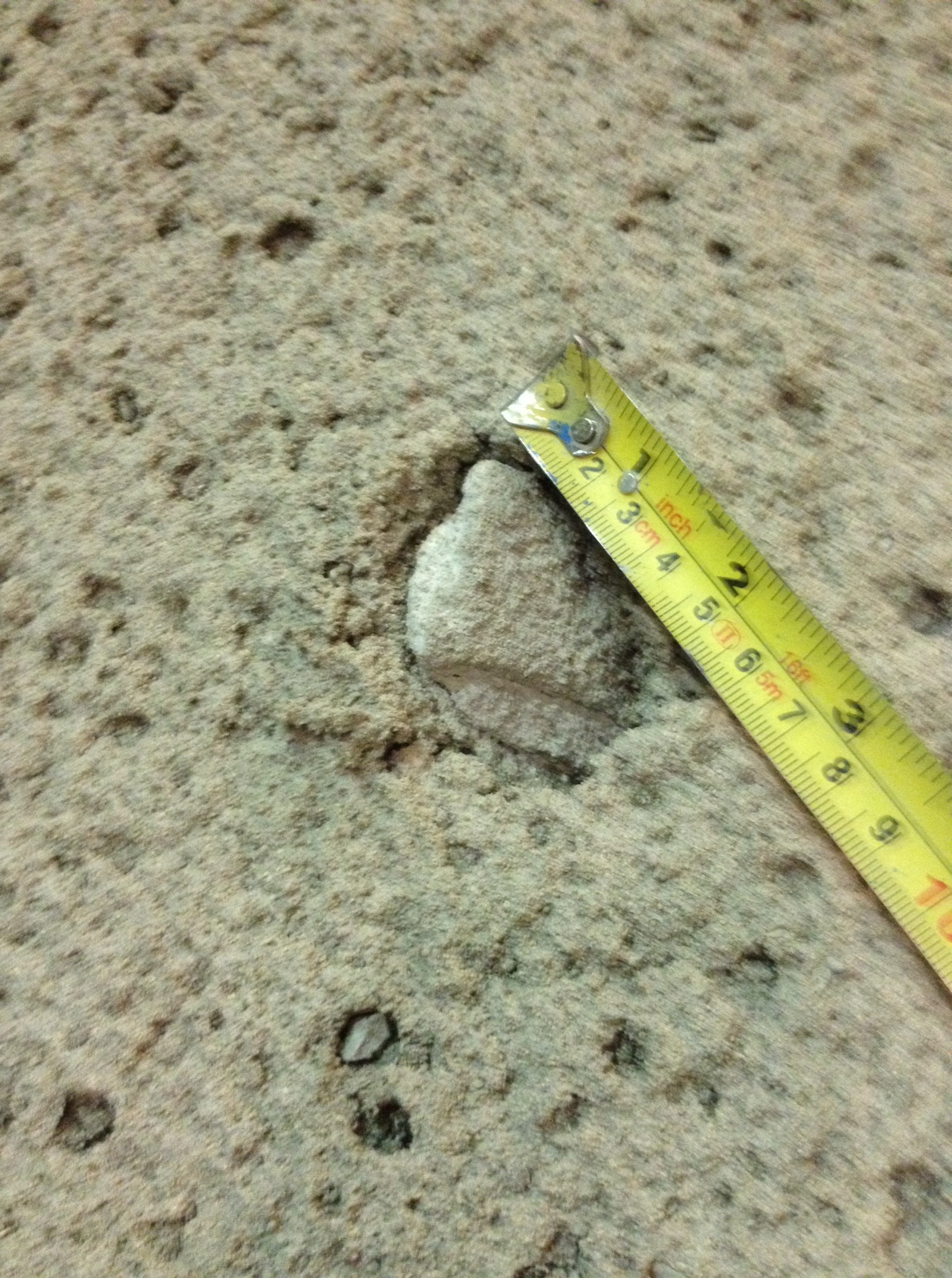

After some digging, a number of issues came to light surrounding the concrete contractor, Hanson.
1. The core contractual terms dictate that when concrete is ordered from site, it must be batched within 50mins and sent immediately to site, where the lorry is tracked. However, this does not apply to concrete used for trial which is outwith of the core contract meaning the contractor can effectively send it when he’s ready. Over six hours later in this case. When our first batch arrived at site, it was flow tested and failed arguably due to too long in the wagon.
2. Quality control. It seems that the batches were contaminated at the plant with a larger aggregate, whihc presently is unexplained. From our perspective this is frustrating. The mistake has managed to creep past the initial batcher, aswell as our liason guy at the plant (whose job is precisilt designed to prevent this!). Additionally, when it was receipted on site and tested (temp and flow) it was again not picked up.
As a lessons learnt, we will now have an SCL rep on the surface to oversee receipt of the batch. When a sample is taken, it will be poured into a bucket through a sieve as an additional check to confirm aggregate size.
Next up are the trials of the waterproofing layer, which is entirely my baby. I wrote and admin instruction and distributed it yesterday with a number of taskers. Its raised a number of eyebrows, as it doesnt seem to be the done thing to communicate with each other around here. Granted, due to my poor understanding of the hierarchy, I did effectively task CrossRails Chief of Staff! How to win friends etc….
 Holdfast Training Services Trial Blog
This is good stuff to know Ryan, I’m about to go pour some test cubes for thermal monitoring with….Hanson. I hope that the Aussie chaps at Hanson are better than their UK brethren.
We’ve had issues with Tarmac supplying Lytag. It is a lightweight concrete that is used in floors to reduce the dead load. The main issue we had is that the light weight aggregate in the concrete floats to the top! This gives a poor finish and can affect the strength!
I’ve learned that they are pretty ruthless over the contract, which means that the late delivery on trial concrete being outwith of what was initially agreed effectively leaves us powerless to act. That said we didn’t accept it on site so the only cost is in time and program.
Being bolt action on the contract works both ways though…Hanson are dumping 3 silos of aggregate at Victoria Deep 1 batching plant as we speak to this large aggregate issue is resolved with no further effect. The fit QS over here is all over it for a compensation event later on down the line!
I’m curious… if doing masonry it is common to have ‘sample panels’ if it’s not like the trial panel then it comes down again.Your job sounds a little like road construction …(sub-base, basecourse, binder and so on) the differeing layers look different and are subject to different quality regimes but you get used to the fdifferences. If I were to see different gunite layers I wouldn’t know one from another …I certainly wouldn’t be able to identify the pitted surface you show and good bad or indifferent …who decides?
The test beams are evidently cut some time after application and so form part of a QA process but not QM. Active QM requires a number of sampling points/gateways/checks or whatever label is used in the terminolgy system you’re in. You need to know the spec but also the contractual comliance criteria and how these are practically applied. Then you need just enough knowledge to give you the confidence to challenge a bluffer and have the balls to reject material or work at an appropriate control point (No small amount of moral courage required when you’re facing down a large physical and unhappy contractor in a dimly lit hole!).
You will recall learning about longitudinal and transverse shear resulting from bending. Your sprayed layers have exactly this going on when you cut them into beams and flexurally test them. Bond strength between layers will matter but… 1) colour is not necessarliy an indicator of anything other than pigmentation in concrete so be more scientific than that. and 2 if you cut your beam carefully you can put a weakness on the nuetral access and it disappeears, cu it another way and you can expose a significant problem of your own making!
And finally; Your oversized aggregate image looks suspisciously like cured spray concrete that has gone off in the hopper, pump, delivery equipment piepline and has now broken loose and been deliverd at the far end (possibly because the whole assembly was not run down and cleaned thoroughly between batches – standing time?). I’d have a little look at your team closer to home before slinging mud elsewhere then might just be tugging your todger.
The test panels are arranged as part of the trials and are sprayed in a manner to simulate sprayed concrete application to both tunnel side wall and tunnel crown – in effect the panel rests against the wall at minimum 45degrees. Panels are not moved for 18hrs and are covered with polythene sheeting. Along with other testing, which involves cores being taken, beams are then cut to test for flexural strength. Interestingly, it is not defined in the Inspection and Test Plan whether you are to cut beams vertically or horizontally. Under testing , horizontally cut beams are failing much more frequently than the vertically cut beams, and it seems to be the beam cut from the bottom of the panel that most prone to failing. A notch is pre cut at the mid point to induce the crack under lateral stress.
Observing the failures, those beams without strata crack as you would expect perpedicular to the neutral axis and along the line of mid span. Observations of those beams with strata indicate that the crack tracks longitudinally along the strata, in effect leading to unbalanced loading over the effective length and failure at some other point.
From what I can see, there potentially two key issues here. Material and workmanship. As you point out, the specification is enforced through BFK liason at the batching plant and testing when it arrives on site. Given the concrete mix has undergone materials testing and been endorsed for use, and that the strata layers are only really occuring with any prevalence at one site (Farringdon), I think the issue is unlikely to be concrete related.
That leaves workmanship. Think of the panel leaning against the wall. The nozzlemen spray the panel in layers from the bottom. This leads to a greater prevalence band layers/strata in the bottom beams when cut horizontally. Vertical cutting gives the same average band layer number…..I think.
Anyway there is a proposal to relate the nozzlemens bonus to quality in future rather than quantity so we will see if that makes a difference.
The large agg issue may well be as you suspect. I took photos of some of the rebound with measurements and there was a LOT of 20mm agg in there. Given that the regulating layer is a much finer aggregate than the well graded primary layer, the large agg scattered in there at that pressure would be like firing it into custard, relsuting in the large ‘splash’type craters?
John
I had the same issue. I tried to establish what the criteria wa for judging the layer as shown in the photos. There is some concern from the designers, but it seems to be restricted soley to the aesthetic. Essentially, the reguating layer is doing its job by covering the steel fibres and providing a surface for the waterproofing layer, and the representatives from BASF who are supplying the waterproofing are happy to spray onto it. It meets the manufacturers specification, so I cant see what we can do about it to cheer them up!