Grand Designs Part 1
Although it has been a relatively sedate pace at BP it has certainly not been slow at home. Having moved into the new house 3 weeks ago I have already stripped 3 rooms back to plaster and floor boards ready for windows, plastering, electrics and plumbing.
Being a 1930s semi built with solid walls and suspended flooring, it doesn’t lend its self to being thermally efficient, so with my new found knowledge (thanks Mark) I aim to change that.
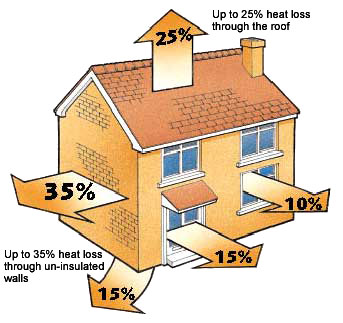
Approximate heat losses through building fabric
A quick lesson
For those not in the know, the U value, or thermal transmittance, represents the amount of heat lost (in watts) through a square metre of the considered fabric per degree of temperature difference between the inside and outside temperatures. So if the temperature difference is 20OC, U value is 1.4 and the surface area covers 2m2 then heat loss would be U x A x (Ti-To) = 1.4 x 2 x 20 = 56 watts.
When there is a combination of materials through which heat is lost, i.e. insulation, air gap and brick, then the overall U value can be determined by calculating the reciprocal of the sum of the thermal resistance, R values. In the case of 25mm insulation, 10mm air gap and 225mm brick the relative R values are 1.19, 0.15 and 0.3 m2K/W respectively and additional thermal resistance of 0.04 and 0.13m2K/W are also considered for the outside and inside surface resistances. Therefore giving a total U value of 1/(1.19+0.15+0.3+0.04+0.13) = 0.55W/m2K. Simples!
Windows
Current windows are approx. 15 years old and in some places, much older. Solution: Upgrade with new uPVC double glazing filled with argon with a U Value of 1.4 w/m2K. The value of 1.4 is below building regs part L1a value of 2.0 for new dwellings.
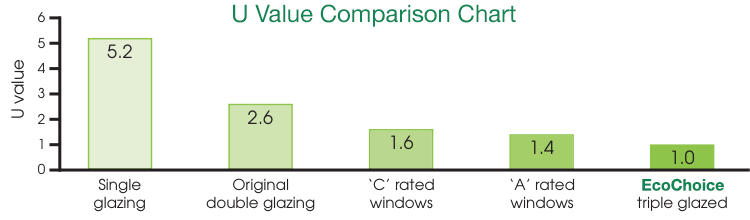
General window U values
Walls
Current walls are 225mm solid brick with a U value typically of between 2 and 3 W/m2K. Ouch. Solution: apply 25mm rigid polyisocyanurate (PIR) insulation to the inside of external walls to reduce overall U value to 0.55. This does not reach the part L1a value of 0.3W/m2K but in order to reach that value then an insulation thickness of approx. 60mm would be required and a compromise had to be made.
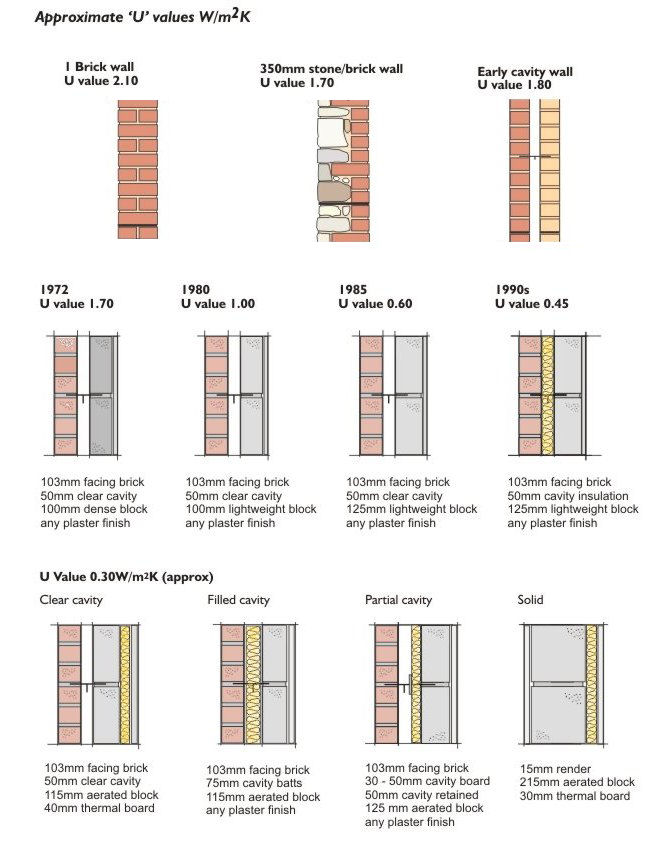
General wall U Values
Ground floor
Currently the flooring consists of 18mm floor boards and carpet giving a U value of approx. 2W/m2K. Solution: addition of 50mm PIR insulation will reduce the U value to 0.35W/m2K which is higher than 0.25 required in new buildings but a compromise had to be made with the increased cost and depth of floor joists.
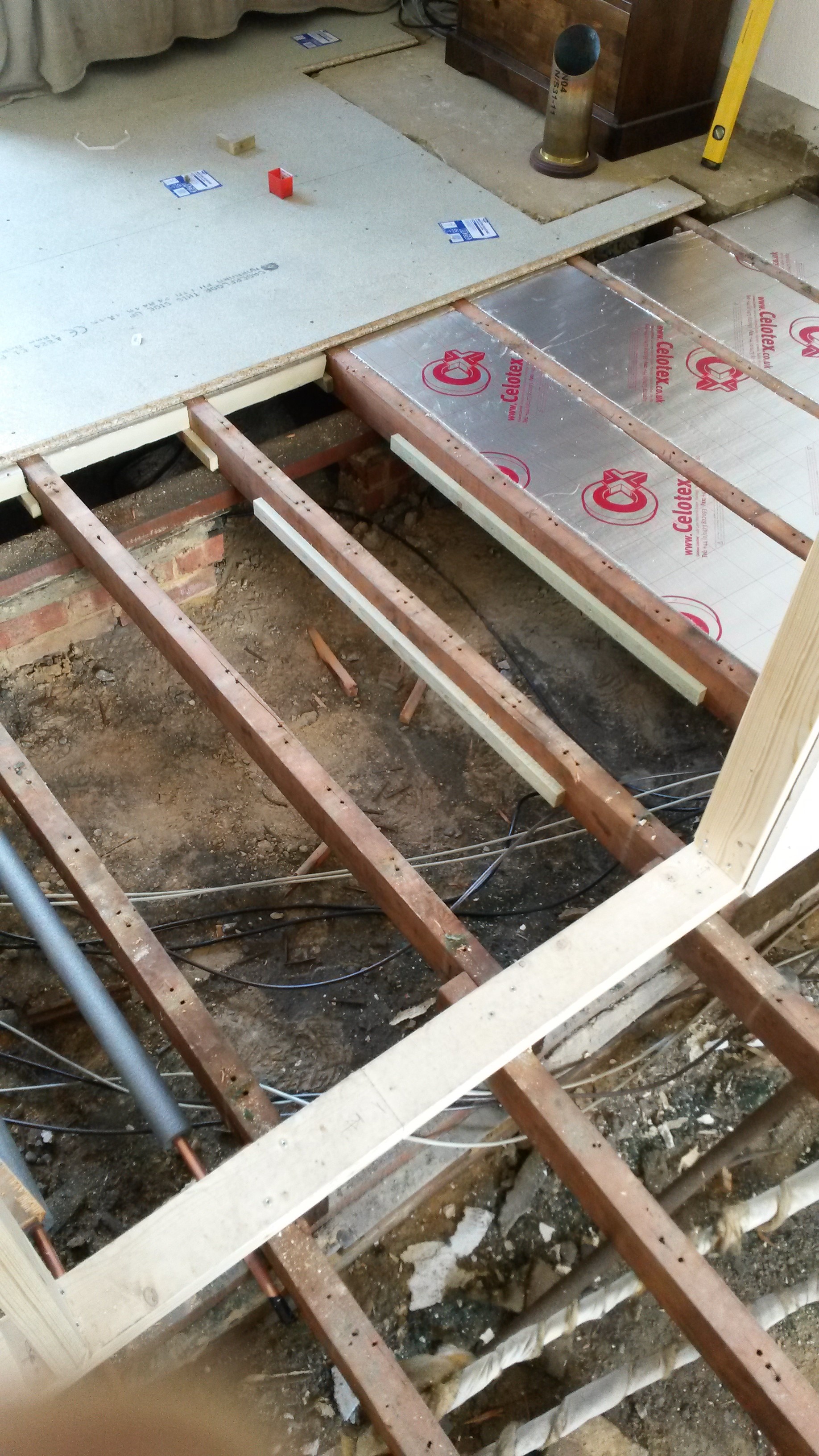
Progress as at 6 Jun 15
(current state above. You will notice a whole host of cat6, coax and HDMI cables running under the floor)
So what?
Reducing the U value of windows from 2.8 to 1.4, reducing the walls from 2 to 0.6 and reducing the floor u value from 2 to 0.37 will ultimately reduce the heat loss by approx. 75% and therefore reduce gas bills. I forecast the total cost of these upgrades across the house will be approx. 16k with windows taking up 12k of that. Average current gas bill, say £100/month, therefore savings £900 a year, therefore a payback period of nearly 18 years!! But at least I have that warm (excuse the pun) fuzzy feeling of doing my bit for the environment.
Next step
Size emitters (radiators) to each room given the surface areas, U values above and internal and external temperatures of 21 and -1OC respectively and size boiler given the emitter sizes and hot water demand calculated.
Final thought.
During a conversation with a sales man from Everest Windows (other window suppliers are available), he said that it is not worth getting triple glazing as the additional money you would save on the gas bill due to the higher U value would be countered by the need for additional lighting due to a reduced level of light because of the additional pane of glass.
 Holdfast Training Services Trial Blog
Mike,
Chasing the final 25% what is the insulation in the roof space like?
Busy at BP then?!
I take it all back! I have just been calculating U values for blockwork. Best blog ever!
Henry – Not had a chance to get into the loft to conduct a thorough assessment but I am assuming fairly poor. Bld regs state a U Value of 0.2 for a roof, and as space is not limited, will upgrade to meet that requirement; off the top of my head, 200mm should do it.
Guz – Always busy!!!, this was just a bit of work on the side whilst commuting between London and Aberdeen. Good to see you getting involved!
Mike,
Looking great and makes me very jealous of your very hands-on grand design – but no mention of the mitre saw!
Additionally, having recently fitted uPVC windows to my rented property and starting to think about re-designing the bathroom (using Google Sketch-Up) maybe I should turn my attention to the fact that I can see daylight between the roof tiles when inside the loft! That’s a potential 25% saving right there. I’ll be interested to see you work in your loft and be asking for ideas. In fact, if you have a spare wk end next year and fancy a few post build beers in Leamington Spa fancy giving me a hand?
Fran, I was going to leave the COMPOUND mitre saw to a blog of its own!!
I wouldn’t worry about heat loss through the tiles as the loft floor/top floor ceiling is where the majority of the heat loss reduction should occur and 200mm of a good quality blanket insulation should be enough. 100mm between the rafters, 100mm placed across rafters perpendicular to bottom layer. Otherwise you would just be paying to heat the loft space below the pitched roof; unless of course you were going to convert loft. I would only ‘fix’ the tiles if there was either potential for water ingress or enough play in the tile that it would fall off eventually and therefore allow water ingress. That would all depend on the angle of dangle of the tile/gap.
As an aside, I charge £200/day for manual labour and £50ph for design consultancy work!!