Site Two Fifty One – Concrete strength and Waterproofing
Site Two Fifty One – Concrete strength and Waterproofing
A set of cubes for each capping beam pour is taken. BS EN 206 states that any individual 28 day result should be no less than characteristic strength- 4N/mm² and a rolling set of 3 should have a mean less than characteristic strength+ 4N/mm². This means 46N/mm² or 54N/mm². Recent results put it near to the 54 N/mm² limit.
However, after some discussion, the aim now is to use the 56 day results to confirm compliance.
The capping beam cube results have also come back with the piling concrete results. Their mix uses a 50:50 proportion of Portland cement to Ground Granulated Blastfurnace Slag which brings a faster strength gain up to 28 days compared to my mix of a higher (70%) GGBS quantity.
Between 28 days and 56 days there should be more strength gain of the higher GGBS proportion concrete. Although the 56 day strength of the 70% GGBS will be lower overall, there is more gain of strength later on, than that of the Portland cement: GGBS 50:50 mix.
More eloquently:
“Typically a CEM I concrete will achieve about 75% of its 28-day strength at seven days, with a small increase of 5–10% between 28 and 90 days.
At 70% GGBS, the seven-day strength would be typically around 40–50% of the 28-day strength, with a continued strength gain of 15–30% from 28 to 90 days.”
Reference: Cementitious Materials – The effect of GGBS, fly ash, silica fume and limestone fines on the properties of concrete.
So what and who cares?
Faster strength gains (found with higher Portland cement content) = higher heat of hydration = more likelihood of cracking in deeper members. Therefore reducing cement to GGBS content, as long as the eventual strength is of that required (50N/mm² in my case), helps reduce cracking. Who cares? – People who construct below the watertable – me and my project!
Waterproofing
Reflecting on Guz’s comments on the cost of injection grouting cracks to improve the waterproofness of concrete, I am at the pre-pour stage.
We are using a hydrophilic (absorbs water over time) material to form a watertight joint between the top of the piles and the base of the capping beam.
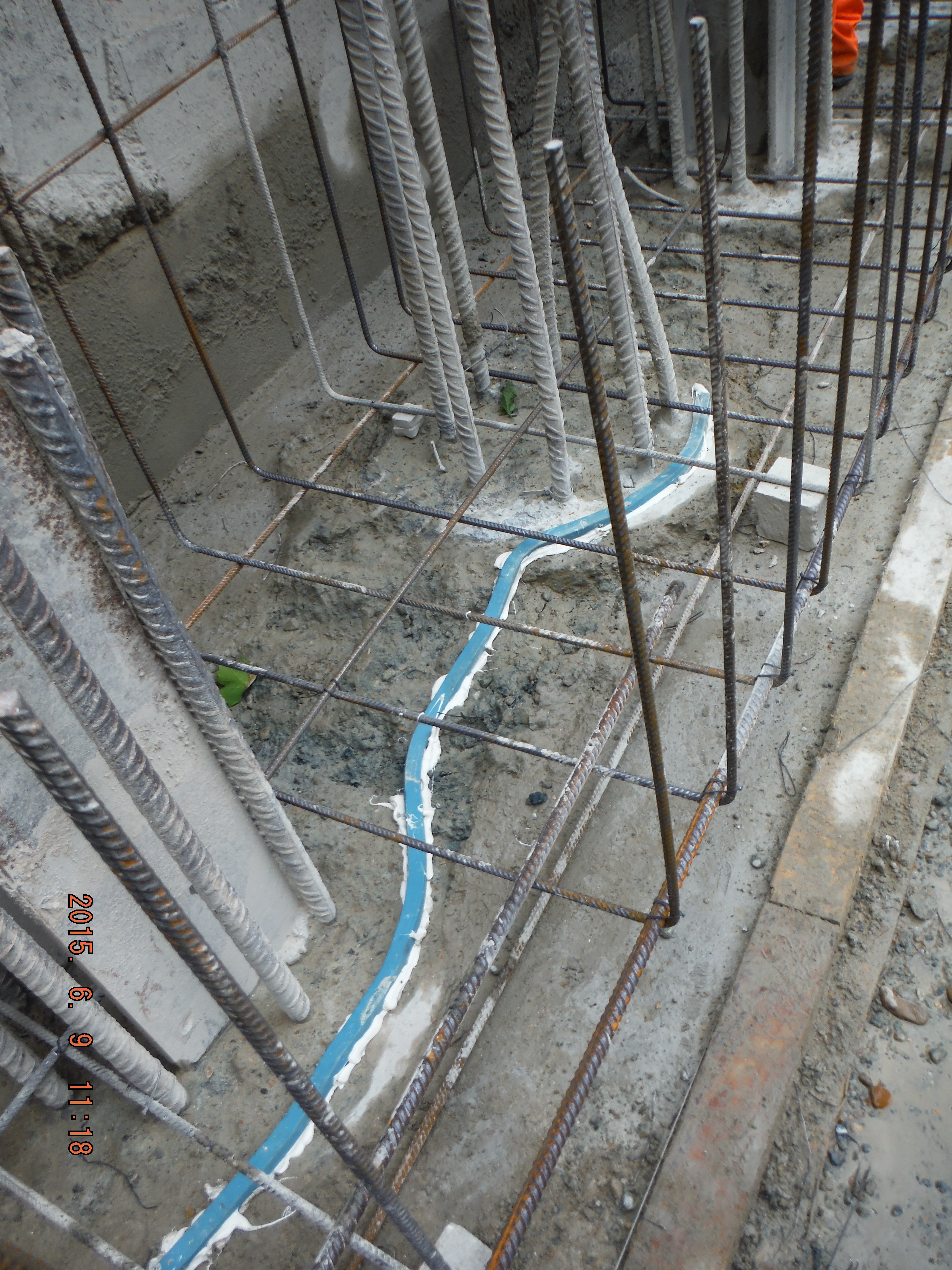
Hydrophilic strip laid along length of secant piles within “waterproof” section.
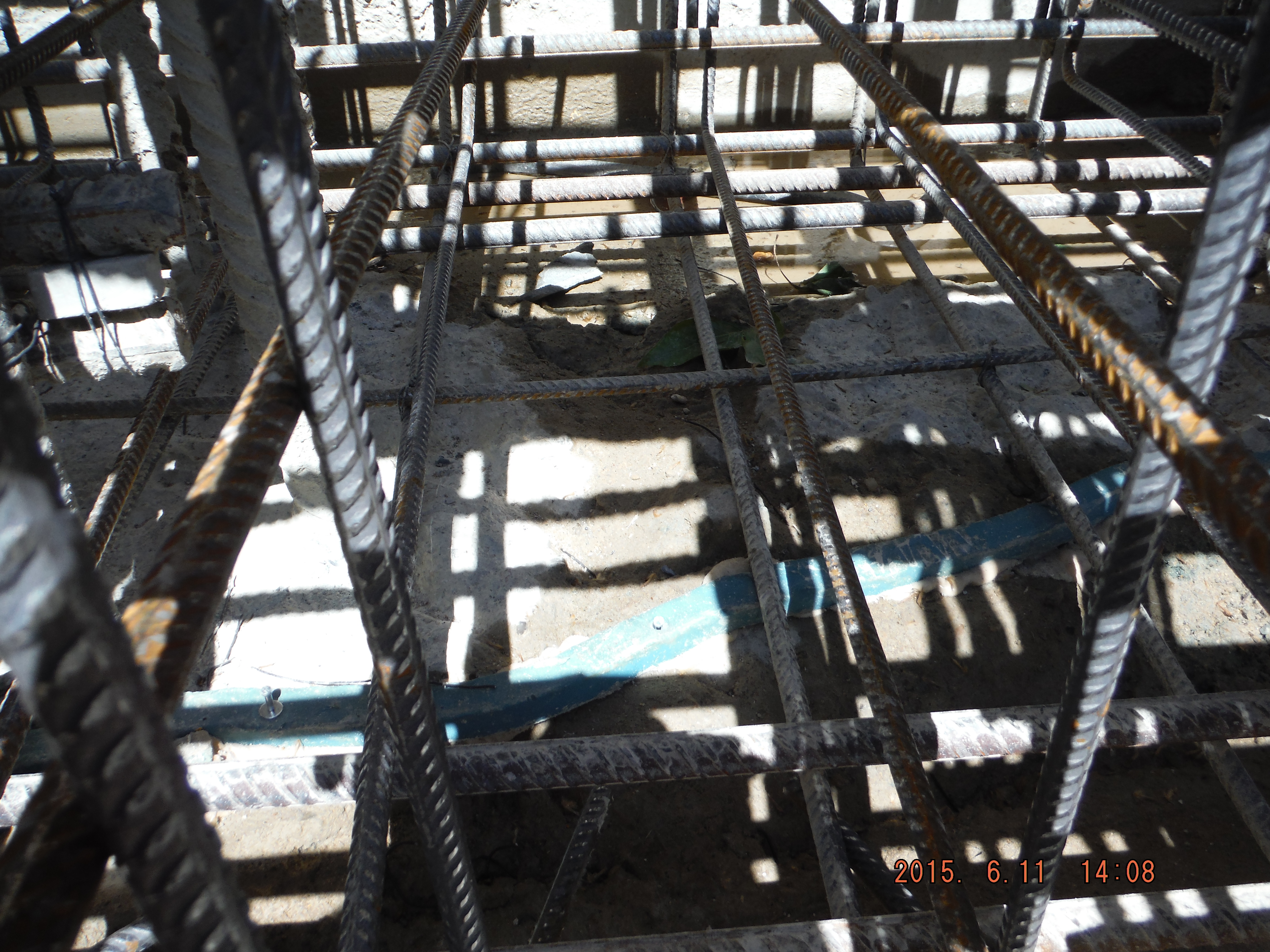
Line of hydrophilic strip.
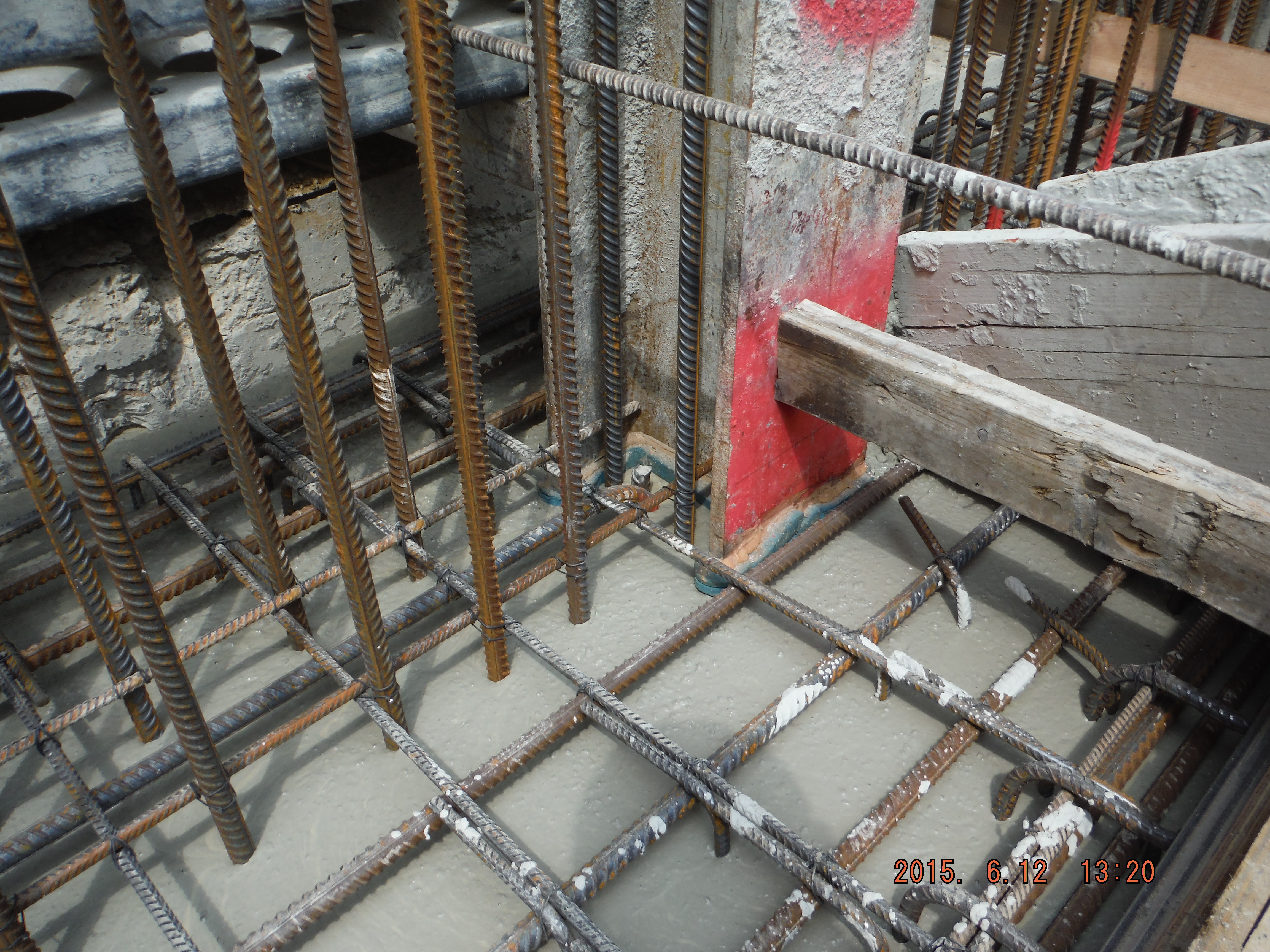
Hydrophilic strip fastened around king posts.
Thoughts.
The advantage of this system is that the joint between the surface of the piles and the bottom of the capping beam will not provide a path for water to pass along.
However, there are fairly significant reality issues with this.
- The piles have been broken to cut off level using breakers – therefore the surface is overly rough and uneven (beyond the mechanical interlock required for a structural joint).
- In the instance of an uneven surface a mastic beading is to be used to sit the hydrophilic strip onto. This is then supposed to be nailed to the piles. Issues here are using masonry nails has safety issues – they fly out and hit people, the nails also provide a water path.
- The reinforcement cage needs to be installed after the hydrophilic strip has been laid. Therefore during the installation of the cage great care has to be taken to avoid standing on the strip.
Waterproof concrete
Finally, and I will only touch on this, we are using waterproof concrete to ensure water does not pass through the capping beam in certain areas. The Grace (company supplying waterproof admixture) datasheet provides a comparison of permeability of the control concrete compared to the waterproof concrete as follows:
Control: 6.90 x 10⁻¹⁴ ms–1
Waterproof: 1.28 x 10⁻¹⁴ ms–1
This translates that in 10,000 years the waterproof concrete might have water penetration of 4mm compared to control concrete of 21mm. Last time I checked, design life of buildings was somewhat less. When identifying risks – this (concrete permeability) is not one of them.
Conclusion
More important are the joint preparation, crack control – through mix design and curing methods and vibration to reduce porosity.

Capping Beam concrete pour with waterproof concrete.
 Holdfast Training Services Trial Blog
Damo,
All of our cubes to date have been well over the required strength, and by well over I am talking about results in the region of 70N for 50N mix design (excessive I agree but there is a reason). It seems risky to be using concrete that is only just within tolerance as you have nowhere to go if your loads are delayed arriving or your pump/crane fails and you have to modify the mix on site.
I’m guessing you did some mix trials, what sort of results did they produce? Has the concrete reduced in strength (Batching QA) since those trials or was this spec accepted then? Have you had any batches fail on the cube tests yet and what is your Conplan if/when that happens, break out or design change?
Olly,
The concept of using a mix delivering excesively high early strength suggests greater expense and is rather like just bodging in twice as much material as is needed at the clients expense under the “if we use plenty it’ll be alright” banner. Not what engineers get paid for! Specify to requirement, manage through good QM, reject as necessary.
If, after providing a good design, delivered competently, it transpires that the mean concrete strength is below that specified the question is not what do we change but where does this imply increased risk? Who has to carry that risk and what are the implications? Usually it will be a durability risk which the client might reasonably want to be compensated for but probably at a lower cost that excessive strength concrete throughout (although if that seems unlikely, there is justification for getting him to pay over the odds up front!). Where you are dealing with a structure that will need full DMRB process design and check certification stages 1-3 there will be little if any flexibility from the acccepting organisation so the impact of a materialising risk of understrength concrete would probably be more onerous than over specification.
Richard,
I’ve spent the day with Damo and discussed this with him so this is for you and anyone else suffering from insomnia. Buckle in, it’s a long on.
The “if we use plenty…” comment has nothing to do with this nor is it lazy engineering!
As mentioned originally the mix design is for 50N concrete. That’s what is specified and what we’re paying for. Any increase in strength over and above the 50N sits with the supplier. The only direct impact for us is ensuring Freyssinet, our PT Subbie has all the concrete cube results to design the jacking loads.
All of our concrete is supplied by Hanson’s, they have a batching plant in Rochester and one in Aylesford. Neither plant has a large capacity and we have to draw on both of them to supply concrete for >140cube pours. This will sound bonkers to most people who will be used to getting mass concrete with ease but that’s what we’re having to deal with.
Additionally our concrete is mostly visible and forms the aesthetic form of the bridge. As such we can not change the concrete from start to finish. This means we have the abutment and pile cap pours to perfect things prior to fixing the mix. It also means that anyone taking delivery from those plants in the next five months is getting a variation of our design as the plants are only going to stock our aggregates, delivered from the same source in order to ensure colour match.
The mix contains limestone aggregate which produces a high strength quickly. It achieves this by drawing the moisture out of the wet mix which speeds up the curing process without generating excess heat (no increased cracking issues).
The bridge structure will take five months to complete starting in July which means we need one mix to cover the hottest part of the summer and wet cold winter.
Initially we were aiming for an S3 130mm but it was simply unworkable. We then tried an S4 180mm (+/- 20mm) and found that it was just workable and was used for the first two abutment pours.
The big problem we are having is maintaining the moisture content until we have finished the pour. We poured last week and a combination of the heat, the wind, pumping (increases stiffness) and the limestone were causing the concrete to set with a crust in little over 20mins. The guys were struggling to float it.
My comment on mix modification refers to adding water…calm down before you trigger a bout of angina 🙂
Each mixer that arrives has a delivery notes as usual, however our notes contain a permissible water addition quantity. The nature of the limestone mix allows a degree of water to be added on site in order to achieve the required slump and subsequently accept. These have ranged between 20ish to 70ish litres. The first run on the first day (four trucks) I turned away due to slump failures. As frustrating as this was it demonstrated to the supplier what sort of standards we expected but also allowed us to play with the mix and add water to see the results. Since then we have not had to modify any deliveries as they have provided better consistence however the option is available.
We think we have now found the final mix that works ard don’t expect to have to alter it again.
Your final point is spot on! the high strength concrete does not cost us any extra nor does it affect us with regards to concerns over cracking, etc. KCC who will adopt the bridge are more than happy with a higher than specified product so why spend more money and time to reduce it.
AAAANNNNNDDDDD….relax….sorry for the long and rambling email. It turned in to an inarticulate brain dump!
I hope it all made sense, Damo please chip in if I missed anything or failed to explain myself.
Thanks Olly. Very happy wih the addition of permissible water as long as your tests and cubes are all taken after not before as was happenning on Joe Wood’s site under other engineers. Limestone generally reduces shirinkage and modulus of elasticity, the later being useful in prestres post tension work. Have a think about the concept of reduced curing time due to re moval of water ( cure versus dry…) before proferring that advantage. I’m intrigued that you are finding that pumping is changing the concrete properties and, finally, well done on being firm with acceptance of the first few loads. It will pay dividends but you’ll need to be vigilant again once the large pours start.
Olly – My eagerness to see high strength gains early is too hasty. The idea with a high GGBS proportion in the mix is that strength is gained over a longer time (28 days and beyond). Therefore the snapshot at 28 days does not immediately suggest there is a problem.
I like your use of the word “risky”. To put it back at you, using 70N/mm2 concrete must have a high cement content(?) – this is probably more expensive than using a mix which produces a 50N/mm2 result. So perhaps your risk is more on the economic side…
If I said the mix design was a smooth process, it would be a lie. I would argue it was not as well planned as it could have been and resulted in some last minute changes. However, to date we have had no failure of cubes at 28 days, and strengths are predicted to rise as time goes on, so perhaps it is actually a pretty economic design.
Not sure I follow the points on modifying the mix on site because of equipment failure. If a pump breaks and we cannot pour the concrete, I would either cancel the pour or reject the concrete. I doubt changing a mix on site ever happens – The risk is with the supplier, not contractor, so altering it would be a dangerous move.
Regarding trials – this has been done but only from “live” batches. The results prove fine (above 50N/mm2) and the results from the supplier also appear fine (unsurprisingly!).
Why are you content with achieving a 40% strength above what is required?
Damo, will discuss when we catch up today.
After you have conferred, could you post your reflections on the blog so that we can all benefit please.
See above
Damo -we’ve hijacked your blog.
Richard – We slump the concrete when it arrives and only once we have accepted the load do we cube it. This is reflected in the ITP and is over seen by one of us and the RE from KCC.
We have not personally seen any stiffening of the concrete due to pumping. The GF and Section Foreman have highlighted this issue based on previous experience. When I discussed this with Guz and Damo yesterday they were both aware of the issue from their own sites so many one of them has first hand experience.
The shutters from the last pore were struck yesterday and the results are not great. A carefully worded email has just been sent to the batcher from our site agent to imply he is providing an unworkable mix and has suggested the use of a mixed in retarder. We are aware this is our problem but from a commercial point of view we are hoping he covers the increased cost…we will see.
Finally, none of our pores are that big. The pile caps are c.250cube but then we only have a couple of 100cube pores and the rest are 30-50cube. The problem is our pores are complex shapes with multiple fixings, falls and tight details. All of the concrete is exposed but more crutial they contain curved PT ducts that have 2mm tolerances.
Complexity, not size is our concern!
If you’re having issues with consistence and forming shape you want a plasticiser not a retarder and possibly a water reducing agent but with same water content. You also need to ensure good placing and compacting i.e. vibration. do upload a couple of photos of the struck concrete on a blog that will take us off Damians! P.S. I think that any hope of 2mm tolerance on a PT Duct is dreamwork.
We lose about 1/2 inch of slump after pumping
Has anyone been in a position to take a cube before and after pumping and compare? My suspiscion is that pumping reduces the entrapped air, which would reduce consistence. In a properly comapcted pour this should not make any difference to finished article properties. Any thoughts?
Brad, do you routinely slump pre and post pumping as part of your QA or was it done as a test only?
Richard – we are direct discharging at present, but the piling team are pumping. I will attempt to do as you suggest and see what differences there are. A different view is that for the first pour of a day, the priming of the pipe lining will remove some fines from the mix as the inside of the pipe is coated/lubricated in concrete (having been washed/cleaned out the night before). I can see this reducing the consistence of the slump and therefore making it less fluid. Once coated, I suspect there will be some fines losses throughout the day albeit minimal. Also a suitable mix design (well graded aggregate and sufficient quantity/balance of fines) for pumping should avoid a significant loss of slump.
We use an F5 mix (flow test, not slump) which is extremely fluid – it has produced some good results which I will include on my next blog.