A Novated Contract
My project was originally run to tender in 2007 but our bid fell short. When the economy did a summersault the project was shelved. In 2014 it was revived however our new bid was also declined and most of the tender work was thrown away. Within a matter of weeks BamNuttall were asked to resubmit it’s tender as T&Cs had not been agreed with the 2014 contract winner and the they had pulled out…cue alarm bells!
The revised 2014 quote was c.£400k lower than the initial 2014 quote. It was accepted pending two key conditions:
- A team would be mobilised with immediate effect and begin work (this took a week). This was necessary to comply with planning conditions outlined by the local authorities.
- The original designer who designed most (not the river bridge) of the 2007 scheme would be novated to us under a D&B contract but they would now become the sole designer for the whole scheme and adopt the original river bridge design from Halcrow.
Novated – I had to look it up but in effect it means that you take on the asset under the original T&Cs.
The Problems…
- The original river bridge was designed by Halcrow. The designs were handed to WSP but none of the supporting calcs, therefore WSP had to pretty much redesign the whole bridge prior to an external CAT3 check. This was not costed in the tender. It also lead to lengthy discussion as to whether WSP accepted the risk when agreeing to adopt the bridge design or whether they were explicit in outlining the cost associated with a redesign.
- TrentPort (Client) use JCT contract for all of their other project. This was already in place with WSP when our bid was finally accepted. We have entered into a D&B NEC3 contract with the client however; we have taken over the JCT contract with the designer. This means that when we all sit around the table we are not contractually talking the same language.
- Value Engineering benefits the designer. Within the NEC3 contact we have detailed that any value engineering change will benefit us 75% and the client 25%. If this is a method change then no VI is required however if a VI is required then the designer will be paid and the profit reduce prior to the split. However, because the designer is in a different contract he has tied our hands on numerous issues and we have been forced to pay hand over fist to move the most simply checks and tweaks through.
The Sticking Point…
The relationship with WSP is frosty to say the least. The designer working on our project is a nice guy who appear rather uncomfortable at meetings when he’s asked to comment or make quick amendment. He simply speaks on behalf of his master and repeats ‘please formally request the RFI or design change, we’ll quote you for the work and then you must instruct us to carry it out’. As you can imagine this is a long, slow and frustrating process which often takes weeks for tweaks!
The Solution…
We continue to press on often building at risk or making quick changes to the programme to re-order the construction sequence whilst we wait for answers.
A meeting has taken place between our commercial team, our design co-ord and WSP. Some form of payment (details are unknown) has been agreed in order to speed up VIs, RFIs, TQs. Over the last couple of weeks there has been a marked improvement however the it feels like a triangular mine field where no one is willing to step in to the middle but would rather tiptoe around the edge and waste time and money.
SWOT
Guz hit the nail on the head when he mentioned the use of a SWOT analysis or lack thereof. The speed that this project was established was rapid, I spoke to Steve Payne a couple of weeks ago and he was shocked at how quickly things had moved. It appear that the focus was very much on the ‘O’ with a little ‘S’ thrown in for good measure but I’m not sure a great deal of time and effort was invested in to the ‘W and T’.
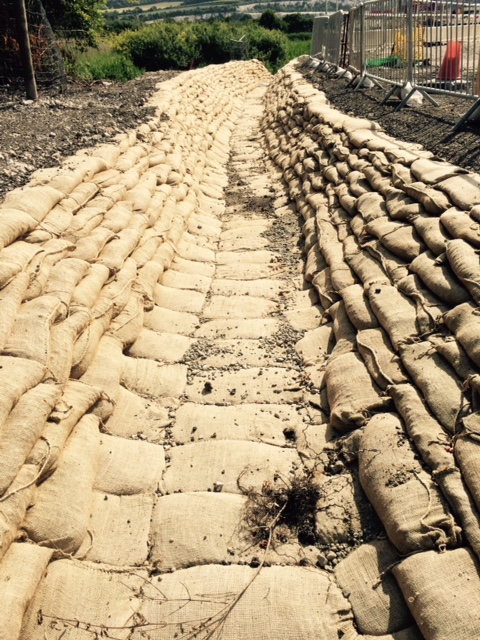
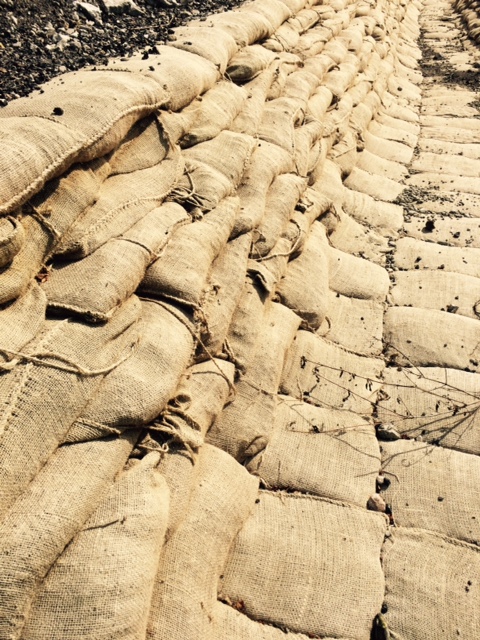
On a Lighter Note…Check out this sandbagging!
 Holdfast Training Services Trial Blog
Nice! The first question you raise is what constitutes a design; a much over used and under defined term! Did WSP ever receive the design or just the output of the design process. Bam might well have had recourse to the client to request supply of the full design or additional fiunding to re-develop the design. As it stands WSP might well be seen to have failed to obtain on behalf of BAMM sufficient information to constitute a design and unles that short fall was notifed (they being the experts in this field) why would BAM have asked the client for more (assumption being that the novated designer was content) so why, now that WSP realise that tey lack enough information should BAm be liable to fuind their attempt to make up the shortfall?
The differrent contracts and use of this glitch by the designer to his advantage against a contracter is so rare that I’m wondering which award to nominate them for. Usually the MC runs rings around the design team!
What are the sandbags filled with?
Richard, This topic is one I have tried to Blog about before but every time I think I understand the complexity I learn a little more from someone else. The full picture is sadly hidden behind a cloud of excuses whilst people blame each other in quest for self preservation. My PM is very honest and frank about things which is helpful. AER2 will explore how we managed to save the c.£400k in our second tender and try to work out how the change from balanced cantilever (initial design) to in-situ (current design) will in fact cost more!
What I think I know…
WSP received the bridge design output and final calcs to substantiate it but not the full design documentation, therefore they did not know why decisions had been made. This made it very hard to reverse the design process to gain understanding and made it easier to start fresh.
The client is sticking with ‘This design was acceptable in 2007 and we’ve handed it over in full so it’s not our problem, any problems you had with it should have been expressed to our Rep (Waterman) prior to accepting’. We are using the line ‘WSP accepted the design without concern and now they’re changing the goal posts’ and WSP are saying ‘we have change the design brief (by changing construction method) so we should pay’. Sadly we all know this is going to end up in court in a couple of years and be thrashed out then!
I have my view but I’ll express that after the first week of Dec!
Gregg Tripp – Are you able to add any further detail to this? (he spent some time with our QS and commercial team making the tea, doing the photocopying and bringing himself up to date with the industry)
The sandbags are filled with a dry mix. They form the two ends of a drainage ditch. One end has a concrete pipe discharging into it (from an interceptor) and the other end spills out in to the medway.
Sorry about the delay in replying, my computer was having some issues with the PET bloggersphere last week. Anyway I have had sight of the contract signed by BAM Nuttall and Trenport and it is a work to behold. Basically Trenport employed their usual developer QS consultants to prepare the contract documentation and it appears they have never used a NEC contract before. So, they have attempted to convert NEC into a JCT D&B contract (which they are familar with) with the biggest number of Z Clause add-ons I have ever seen; pages of them literally. Re-writing standard form contracts is an extremely foolhardy activity and it is little wonder contract clause interpretation is disputed on site. This may end in (expensive) tears for everyone.
With regard to your novation problem I think Bam Nuttall are on the hook for the design as it stands. I would refer you to Blyth & Blyth V Carillion 2011 (Give it a google). In which a simiar dispute over design liabilities was decided against Carillion who had accepted the design novation before identifying the potential problems.
I understand that the client didnot novate over utility management and statutory licensing to Bam Nuttall so I would imagine that Bam’s commercial team will be looking at any delays and changes in these areas very closely for cost recovery opportunities.
Regards Greg