Paradise Circus, Birmingham
Welcome to Paradise
On the 22 February I started work with Carillion PLC on the Paradise Circus Demolition/Construction in Birmingham.
The development scheme involves the transformation of 17 acres at Paradise Circus in the heart of the city centre. The £500m development is being brought forward through the joint venture company, Paradise Circus Limited Partnership (PCLP), a partnership between Birmingham City Council (BCC) and BT Pension Scheme, managed by Hermes Real Estate with Argent as development manager. In addition to the developer other interested parties include Amey who maintain the A38 Queensway Tunnel on behalf of BCC.
The project is currently in the Phase 1; primarily demolition of the RC concrete structure of Library and office buildings. Phase 1 also includes some large bore piling, up to 1200mm and the construction of a podium deck car park. This will be the platform for future development (contracts that Carillion are highly competitive for at the moment, but have not been awarded). The future development aims to bring over 300,000 sq ft of grade “A” office space to Birmingham City Centre.
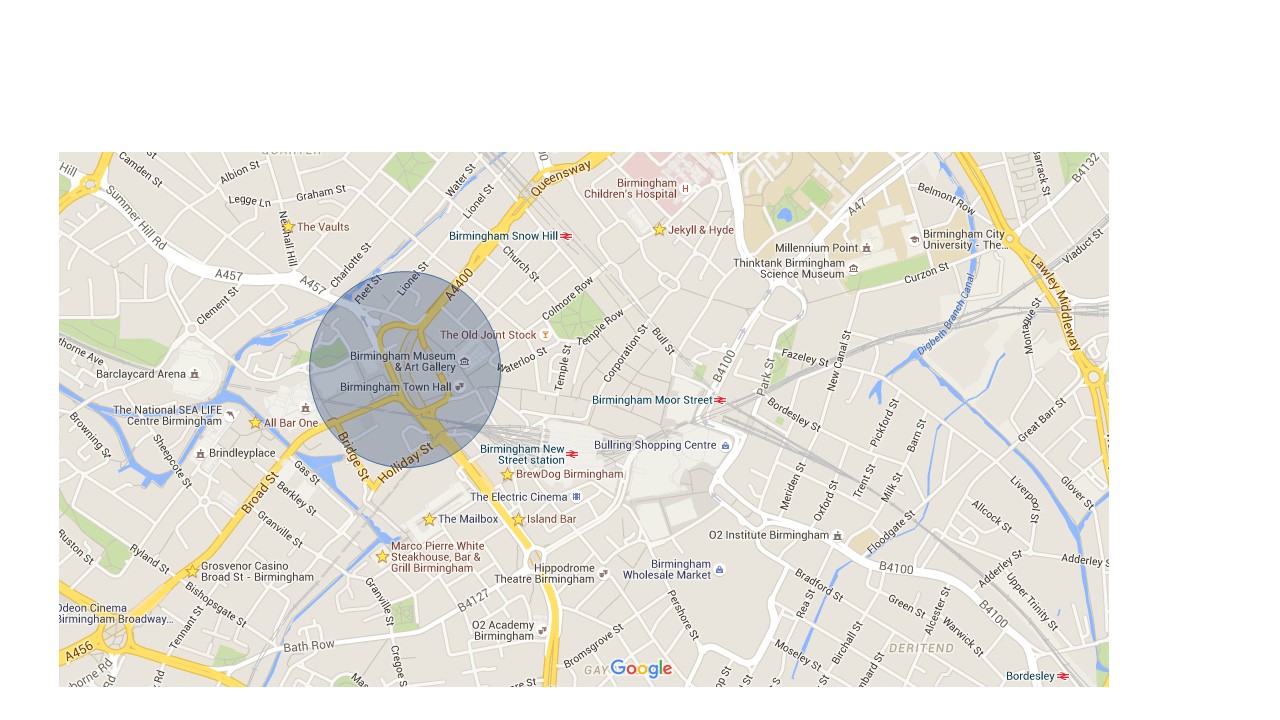
Area in blue includes the 17 acre redevolpment and road improvement scheme
Demolition of the main building, the reference library, is primarily being completed through use of a high-reach excavator. This plant weighs in excess of 1600kN with the potential to put a very large point load on the ground beneath.
I have been tasked with the monitoring of the A38 (Queensway bypass) that passes under the site through a combination “cut and cover” and bored tunnel. The majority of the tunnel has a precast pre-stressed inverted T-beam roof. These are infilled with concrete and laid edge to edge.
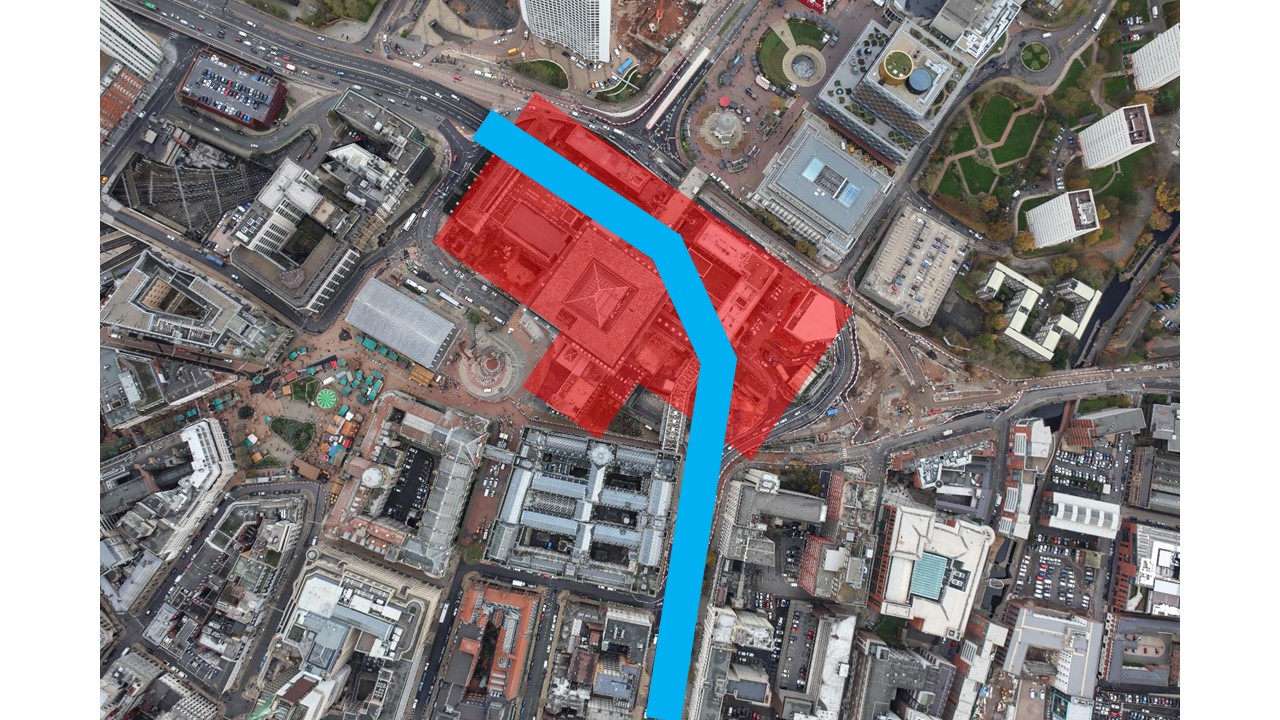
Demoliton zone – Red; A38 Queensway tunnel – Blue
There is a concern that the high-reach excavator is too heavy to use in proximity to the tunnel. To mitigate the risk of the plant load, the site has been divided in to zones 1-4. Zone 4 not requiring a specific RA for the tunnel, down to Zone 1 which needs a full RAMS and approval from the BCC Engineers. Zone 1 is above the tunnel or within a 45 degree angle from the base of the tunnel.
Trigger levels have been set by theoretical modelling of the tunnel. Remaining capacity of the T-beams is calculated and the Red trigger level is set around 80% of the ULS (evidence of this is assessment is elusive). Monitoring has been installed in the tunnel and the normal deflection pattern established (this is over a 2 week period, but I cannot seem to find any evidence or analysis of this). Interestingly – or not – the normal pattern of life seems to move the tunnel through twice the deflection that has been set as the Red trigger level. This has resulted in the Section manager and project director receiving upwards of 300 alerts last week alone (I haven’t received my work phone yet so I’m dodging that bullet at the moment). The tunnel hasn’t collapsed…yet.
A load test is being conducted on the inverted T-beams to test the theoretical model. Type 1 Aggregate is compacted in layers over the course of 4 days. The first three days, 2 layers are compacted with two layers of 150mm compacted on day 4. Each morning a materials technician from Environmental Services Group (ESG) carries out a Nuclear Density Test on the aggregate to ensure the sub-contractor has reached 90% compaction density.
The final layer of aggregate is currently being placed by the sub-contractor. The senior engineer and I are responsible for checking the levels of the beam – currently we have 0.5mm deflection throughout. This is done through a series of 3m rebar pins that have been set in concrete on the roof of the tunnel (as well as the automatic monitoring inside the tunnel).

I am still trying to get my head around the expected outcomes and controls that have been applied to this test. It seems to me that the trigger levels have been set too low and the equipment monitoring the deflection in the tunnels are not that accurate (influences such as temperature, traffic flow and pollution can impact the results).
I will add an update when the test is complete and we have the results interrogated.
 Holdfast Training Services Trial Blog
Hi Chris, nice start. What depth is the tunnel soffit below ground level – is it as per your diagram it is that just the test? What compactive effort are you placing on top of the inverted T beams in kpa – I assume much less than what you would create with long reach excavator.
What is the net building load versus plant load – would off setting the plant to the side of the tunnel work. Have you allowed for dynamic loads (bits of building falling onto ground from height)?
What is the test trying to achieve – are you trying to replicate existing ground conditions above the tunnel?
If you have good data for vibration and deflections at steady state then this might allow sensible trigger values to be adopted with the local authorities.
I assume this issue was known at tender so what had the contractor proposed? Were there conditions imposed at contract award plant/deflections?
Hi Damo,
The tunnel soffit is as shown in the diagram above – it does vary throughout, but this is the area of interest as per the demolition plan drawn up by the demolition sub-contractr (DSM).
What do you mean by compactive effort? The type 1 is being compacted with a remote control sheeps foot roller and a whacker. Or do you mean what force is being applied by the aggregate – this is in the region of 13kN/m due to the normal overburden up to 27kN/m due to the load test. The excavator puts a force of 165kN/m through it’s tracks (I have the specific data in the office).
This is where the plan all gets a bit fuzzy – I have come in as the load test is beginning and I’ve been trying to pull together all of the information relating to it. The building loads have only been assessed to see what the effect of unloading will be on the tunnel transfer beams – generally where the building loads come down on the tunnel, there is a transfer beam that takes this to the tunnel walls. No mention has been made of dynamic loads, but is this nugatory with the groun cover and maybe a operating mattress too?
The test is trying to authenticate the theoretical model that has been used to set the trigger alerts.
There is data of vibration and deflections (longitudinal and transverse) but these are currently being coveted by TPS, Carillion’s surveying and investigation department.
This was not included in the contract – knowlingly or not – so the client is currently paying for all investigatory works and future design changes.
Thanks for your questions, when I get more information or results from the 2 days settlement I’ll post them up.
Hi Chris,
Thanks for the reply. That is what I meant by compactive effort and comparison of loading against long reach excavator. I can’t quite get my head around the actual situation though – are you able to add a site photo or two to the blog.
It sounds like you have already got some good contractual/commercial considerations to include in AER 1 especially what might appear to be an oversight the understanding of how the demolition works were to take place. I assume going forward the building of the new works avoid loading the tunnel area.
Hi Chris,
Interesting to see someone up in Brum, although the ‘Paradise’ tag might be a bit of a stretch…
What is grade “A” office space? Does this have any impact on the specifications (for example for finishes, flatness, deflections)? I know some of the exposed structural concrete columns on my job, particularly in the reception and foyer areas, had higher finish requirements which was a bit of a pain.
Its interesting that you say that the red trigger is set at 80% of the ULS, and that this is being exceeded on a daily basis. Did you mean SLS? If not are people worried?! What is the plan with respect to this? Clearly its not acceptable to have 300 alerts a week otherwise they will just become background noise and get ignored, defeating the object of the alert in the first place. Are you going to raise the threshold (not really sure that this can be viable given the proximity to the ULS) or try to limit the deflections?
Who is responsible, contractually, if there is a requirement to close the tunnel? There would be a lot of local business impacted. How is the financial cost potential quantified?
Paradise is a stretch,but I’ve heard a few people say it looks better as a construction site than it ever did.
The grade refers to the location, finish, systems installed – not sure if there is a governing body or if it is self proclaimed – I think it also refers to the rent!
Well, the red trigger seems to be the only trigger set, again by TPS (a Carillion company). I got the 80% figure from a diagram I caught sight of – the amber trigger should be at SLS and red at 80% ULS. As I said, evidence of this is elusive and I get very little back when I ask questions on this.
I think the theoretical modelling has been done incorrectly or interpreted incorrectly. I think the triggers need to be changed to match what the pattern of life is. I think the alert needs to be time based as well as magnitude based. i.e an increase in 2mm deflection over a few minutes – not a few hours.
As per the Emergency Preparedness Plan – I, as the Duty Operations Engineer, am responsible for closing the tunnel. This is done through contacting the contractor (Amey) who maintains the tunnel. They have an emergency procedure for shutting the tunnel. Firstly I or a TPS engineer have to confirm the readings are correct and not software or hardware errors.
I haven’t yet seen a Risk Register with this quantified, but as I said it seems to be laid at the clients feet currently – although no work can progress n Zones 1-3 until Birmingham City Council Engineers agree.
It really is this haphazard – although I am not professing to have sight of all the information available. There may be method to this madness.
Nice one Chris. I’d keep chasing the origins of the trigger levels. It looks similar to the effect achieved when consideration of the moment required to deflect a single element is used to set a movement threshold but the movement of the rest of the structure and ground associated with the load applied to generate the moment has been ignored/forgotten. I’d also worry a little bit more about the tunnel closure process – I wouldn’t want to be the person that delayed closure whilst software errors were checked and a tunnel gracefully fell in… First requirement must be to close and stay safe and then look for reasons to reopen ASAP otherwise you make a mockery of the monitoring installed and put public safety after unnecessary cost and delay which would not sit well if an issue were to arise. IF that means someone takes a greater interest in getting monitoring right then that is what needs to happen.