Playing the blame game
My old site BCT – just seems to be the baddie in a 1980s B movie – it just won’t die. Every week brings a new issue that needs rectification. Multiplex are expecting to make a $20 Million loss on the project.
I am spending a lot of time conducting what I call ‘Post Mortems’ on projects. Each one could be a TMR by itself and can be depressing/interesting depending on how morbid your curiosity is. There are a lot of firings going on and these Post Mortems are make or break for some people. My boss described it thus – we don’t fire them ourselves we just put the ammunition in the gun. Monday saw an interview without coffee for the main players in the BCT project team. Why is your project already $1.5 M over budget in reo and you have only just come out of the ground? Below is an email of my assessment of the reo overrun sent to my oss :
The facts of the situation are these:
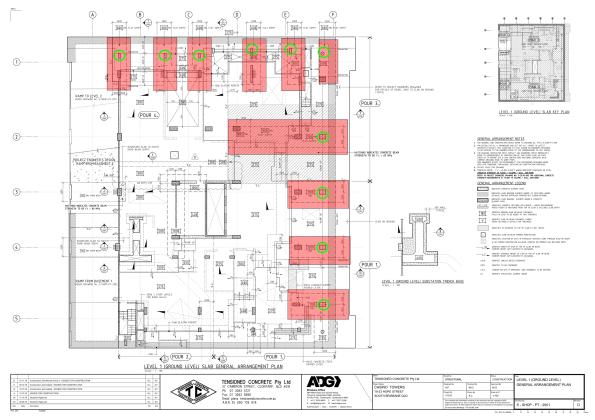
- Projected versus Actual. The greatest increase in reinforcement has occurred at Level One with approximately 6.5 times the reinforcement projected( 107 T against projected 16.2 T). The majority of this reinforcement is in the transfer beams on Level One (84 T). This leaves approximately 23 T of reinforcement in the remainder of the Level One slab (not including mezzanine).
- The transfer beams were added due to issues with the basement retention system. The original design called for pad footings close to the secant pile wall. However, because the secant pile wall was not deep enough in the North and East of the site, there was concern that the footings close to the wall would undermine the bottom of the wall. The decision was made early to remove the pad footings rather than issue the piling contractor with a variation. Subsequent consequence analysis seems to have been focussed on the geometrics and car park spaces. There appears to have been no formal consideration of the cost impact of the additional transfer beams. As a rule of thumb, one transfer beam costs approximately $35,000. The decision to remove the columns in the basement and use transfer beams resulted in an extra 10 transfer beams (approximately $350,000).
- Contract Award. There are no transfer beams included on the Level One sketch in the Post Tension tender documentation. While the transfer beams are shown in the capping beam documentation in S-CD-09-001 Retention Wall and Capping beam Plan, this information was not transferred to the Level One drawings. There appears to have been no tracking of the transfer beams on a design register and it does not appear to have been communicated to the sub-contractor effectively during the tender process.
Assessment. The existence of the capping beam drawings muddies the water somewhat. On one hand the sub-contractor should have been aware of the need for transfer beams from the capping beam drawings but, could argue that it was not covered by his scope because it was not on the drawings of Level One. There were several failure of process within the Multiplex team.
- Failure to communicate the addition of the transfer beams with up to date drawings prior to contract award.
- Failure to understand the second order consequences of removing the columns in the basement (Cost).
Regards,
Doug
Having thought that the PT designers had got the message about putting too much conventional reinforcement in the slabs, I received the new drawings for Podium Level 2. The previous iteration had approximately 60 T ($120,000 over budget for level 4) of reinforcement over what had been agreed in the contract. Having worked late into the night to get an answer to the project team on the savings and ground truth of their design I was disappointed to discover this iteration had shaved a meagre 15 T off that figure ($30,000 saving). Not good enough Mr Consultant show again!
In other news I have been playing around with STRAND (finite element analysis software) trying to assess the natural frequency of a 20 m span conventional reinforced concrete beam. The beam is supporting a swimming pool above the ballroom at the Jewel Hotel on the Gold Coast and there is concern that the chandeliers could swing around because of the vibrations from the pool. It’s not urgent but its fun to play with when BCT gets depressing.


Doug,
I think Bond said something aling the lines of, once is happenstance, twice is coincidence, the third time is enemy action.
Seems like the lack of engineers on BM projects is proving to be the enemy within. With so many projects needing post mortems does that not suggest the root cause is higher than individual project level. Still, should continue to provide good evidence for CPR.
May not be the case here but I was chatting to a guy from Tata the other day who was making the point that early “efficient” design can cost more in detailing later. He was talking specifically about the cost of beefed up connections and extra fabrication costs for lean beams and columns but the concrete society had a similar cost breakdown on one of their presentations (can’t remember which i’m afraid. Might be worth looking up.
Tony,
Definitely worth looking up. I would say this wasn’t efficient design rather people who are less experienced than me with less technical know how going off piste and screwing it up royally.
Also we have lost 2 directors in as many months and there is a degree of cleaning house going on. The previous managing director had a naive view of giving the client what they wanted and not seeking variations coupled with a lack of geotechnical know how leads to the mess that we are in.
On the upside I saved $60,000 in steel this week. Every little helps.
Doug, It sounds like Multiplex are in clip state! How is it that they are in such a mess with regards to lack of people with technical knowledge? It seems to me that they are leaning on you quite heavily to get them out of trouble which is not ideal considering you are leaving them in a couple of months.
Fred, it’s nice that you have faith in me but, I’m really out of my depth I was asked to design a slab to tie in a concrete slab in tension and my result didn’t impress my boss.
My boss is the real Jedi knight here but there are only two of us and we have to cover 3 states and new business is really heating up.
It all comes down to over extension. Like so many businesses before Queensland multiplex grew too quickly and over extended. They hired in new people who weren’t fully trained and promoted people to soon. A very quick way to burn $35 million (BCT is not the only failing project.
Thanks for this one Doug.
I’m following the re-bar at BCT saga with interest. It does look like there is a theme in the need to have a technical understanding of what its going on in order to understand the impact of decisions i.e. employ and engineer to project mange construction.
Strangely I’m with Tony on the efficient design front: put a little something in for others to pare back and they’ll adopt the ‘save and gain’ mentality over ‘run costs up as far and fast as possible and take the pain because there’s still profit on the over-run’.
I often wonder at the shortsightedness of ‘losing’ a member of staff in the midst of things going wrong. Frequently they are best placed to know why and actually do something about it, after all they have something to gain from doing so. A replacement can simply deliver at current projected loss and point out how much of a poor position they were handed and how they stopped the rot. How often have we seen the incumbent MCF pointing out how well they are recovering the disastrous situation left by their predecessor, who strangely was saying much the same thing when they were in the driving seat!
Do update on your success or trials and tribulations with STRAND. Useful thing about a swimming pool is the live load is actually pretty constant because displacement means you can add all you like to the water and it just keeps on delivering the same UDL! But you do have to wonder at the concept wisdom of high density loading directly over your desired open space with minimal columns.
Rich,
I will be calling you for a chat next week. Firstly the issue of going bold early. There is certainly an argument for being conservative and then rationalising as you go. However, in a commercial environment when you are looking to win work the lowest bid often wins, you need to be a lean possible. A realistic approach is probably some way in the middle but, crucially to have the variations on hand if the client starts to creep the scope.
Regarding management of staff. My belief is this train in not select out but, how much rope do you give a person? These directors had this long coming and if an organisation is not functioning you should look at the top. No new work has been won in the last year and projects that have been won before this (less Jewel), are losing money. Sadly the ship has sailed on these projects it is about minimising our exposure.
Technical knowledge in projects. You are really preaching to the choir here but, where in the course were we told rules of thumb like a transfer beam costs X doing this cost Y. How do you have an efficient, that is not technically efficient but commercially so? It is something you gain from experience. We are trying to do more detailed design on our D&B bids before we go to tender and try strike that balance.
Multiplex’ business model is to transfer risk to consultants and subbies – they don’t build anything they manage. How do you incentivise others to be efficient?
Swimming pool- stupid place to put a pool but that’s architects for you.