Innovation. The conclusion of the trilogy.
The long awaited concluding part to the innovation trilogy. Spoiler alert – RF was right. It’s about risk appetite and opportunity. Feel free to stop reading now if you can shout that at the reviewers with enough confidence to convince them you know what you’re talking about. If you want a bit more information up your sleeve then see below. Alternatively wait until Disney buy the rights to make the Innovation Trilogy and then watch the film.
Most of this is based on discussions with the authors of “Innovation in Structural Engineering – the art of the possible” published in The Structural Engineer Jan 2017. I won’t cover the report in detail as i’m sure you’re all keen to read it. I also sit on the Expedition Sustainability Group (SG) with two of the authors, and we’ve discussed some of the wider issues in our meetings.
To quote the US Administration and Tom Clancy….”there is a clear and present danger [from innovation*]”. (*also drug cartels but that’s for another day). Therefore Clients are wary of it and there must be a demonstrable benefit (potentially T, Q or C). The sustainability group believe that to implement innovative solutions they need to contribute to both innovation (pushing the boundaries) and sustainability. I think they missed out the key requirement and that it also needs to be functional. If the proposal falls within all 3 of the circles below and has monetary saving it will be difficult to argue against.
![20170211_132843[830].jpg](https://pewpetblog.com/wp-content/uploads/2017/02/20170211_1328438301.jpg?w=595)
One of the authors (Jones) presented his research to the SG. He thinks whether innovation can be realised or not can be expressed as below:
Initiator + Enablers = adoption
Requirement, constraints, Resources, skills
aspirations
The article cites earlier research suggesting that likelihoood of adoption primarily depends on five factors:
- Compatibility – how well does the innovation work with what already exists.
- Complexity – how easy is it to understand the innovation.
- Observability – can the success of the innovation be visually demonstrated. (In the case of SNFCC literally jumping up and down on one of the prototypes was one of the most effective demonstrations – despite being completely unscientific)
- Trialability – Can you safely test it or is it just a punt
- Relative advantage – How much T,Q,C is improved
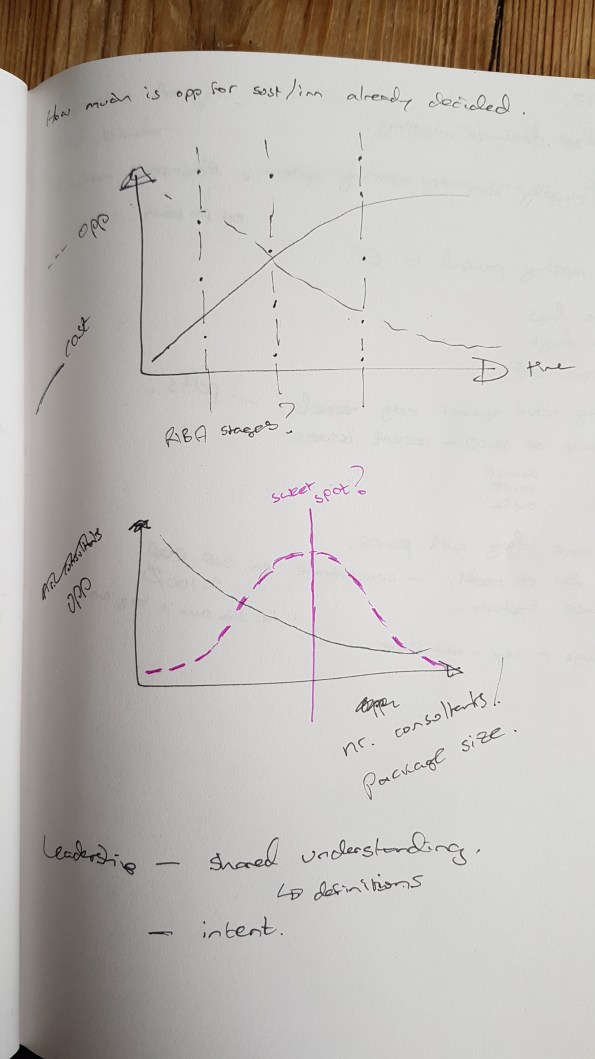
In addition, as I mentioned before, there are unintended contractual barriers. Many innovations may not be realised due to the Client/QS and the way they have tendered the works. We will all be familiar with the opportunity for change versus cost of change graph (top graph below). I think this can be applied to innovation and that right of where the two lines cross, you’re unlikely to see an innovation unless the saving is enormous. Depending on the nature of the contract, the amount of D&B, the size of the packages and when they are tendered, the position of this crossing point, in conjunction with the RIBA stages, will change. The lower graph shows my thoughts on the number of consultants/number of packages. Initially I thought that the more consultants or specialists you have, the smaller their packages of work will be, and the less opportunity there is for innovation. On reading the innovation article, I then revised this to suggest that there might be a sweet spot with enough specialists for a broad range of experience and knowledge, but still maintaining a large enough brief to be able to make savings within each tendered package of work. Put bluntly, why would one designer make a change that would benefit another consultant or contractor’s work package.
Of the 5 factors listed earlier, trialability is the most interesting to me because I had no idea how this would be approached in a military engineering context. It was also one of the biggest challenges on the Stavros Niarchos Foundation Cultural Centre (SNFCC) project., when they wanted to use ferrocement to provide a thin canopy on top of the building.
The team highlighted 3 methods of trialling. The cheapest is to look at other industries or projects that have implemented something similar, proving the material in a different context (or perhaps even the context with a different material? but this is trickier and less likely). This leaves a gap which needs to be bridged with supporting calculations, and is therefore relatively risky. (I think Concrete Canvas have found it difficult to progress from this option to the next option)
The next option is to combine physical models, computer analysis, and prove the innovation from first principles. The level of proof and risk with this option varies massively. Generally the more physical and less conceptual the analysis, the more you can tick off complexity and observability. Providing, that your modelling assumptions are correct.
The final option is to gain certification of compliance through formal testing against specific performance requirements. This is expensive and often outside the scope of an individual project, but can deliver a good level of confidence and consequently a low risk of failure.
The successful SNFCC project used all 3 of these approaches. With the above in mind does anyone know if we used any of these techniques on operations or on PDT?
The SNFCC canopy innovation was ultimately successful because it had the right project team, but this was not an accident. The Client was actively seeking out innovations and had a budget to support this. Expedition understood the intent and set about to secure a team of academic and industry experts to support them in their quest. The project was tendered competitively with the project team demonstrating a viable construction solution to potential contractors. This meant that there were less unknowns, and therefore risk for the contractors to have to price.
The so what for me is that I don’t think i’ll come across many clients actively seeking innovation in the next few years. However, I might be forced to implement innovations to overcome other barriers. If this is the case then i’ll need to decide upon and implement a testing/proving process to demonstrate management of the risk, and a real benefit. I’ll also need to have access to the right team to support me, which means understanding the reachback to 170, academic staff, the wider Corps and the invaluable Engineer Staff Corps.
Expedition is considering forming a technical working group to investigate the potential for reducing the partial safety factor for reinforcement, and safety and material factors in general, following a recent academic paper by Beeby and Jackson. I’m hoping this will allow me to develop a methodology for evaluating some of the safety factors used in military engineering.
 Holdfast Training Services Trial Blog
Thanks Tony,
Your comment on the opportunity and cost vs time for change graph and relating it to innovation is interesting and intuitively feels right but I do wonder if there is opportunity created in the materialization of risk, which means that it doesn’t fit the project stages. My suggestion is that the time line is actually part of the lower level design processes around consideration of practical delivery i.e. use of innovative materials or methods is a low cost high opportunity option as soon as the need to do something is being thought about. This might well originate late in the construction process if a risk materializes that prevents the original intent from being executed. The opportunity window however is then very short.
I would observe that part of the issue here is that the answer is 42. What is innovation? Can it be progressive or does it have to be a step change from whatever you think of as normal? Does it need to be remarkable or is a development, refinement or variation in application of another existing idea innovative? Is it materials, methods or the situation or combination of these? So many questions and I would suggest an answer in several parts but that’s for you to play with.
Have the military ever applied any of your trialing methodologies… transfer from other industries: Mining techniques demonstrated in the Welsh pits used to place explosives beneath the lines in France; Design from first principles: Mulberry Harbours; Physical trials and testing: Hobarts funnies and the assault tanks of the Armoured Engineers. But there are numerous less dramatic examples and it is in the smaller scale that I think most innovation originates.
I think you a very wrong in the assumption that you won’t come across clients seeking innovation, it’s just that it might not be as apparent or overtly expressed. All clients want to take advantage of the experience gained by others (free ride) so secondary adoption is high. Few want the risk of being first. When a problem arises on site teams are often willing to take the risk of ‘a really good idea’ that might get them out of a hole, particularly if the alternatives are unpalatable (do it all again) and the impact of failure is small compared to the project overall (if it works we’re OK, if not it cost very little and we’ll have to do it all again). i.e. innovation at the low level of a single task on site within the control of a project engineer is more likely as a first use. This is why I ask about scalability of innovation. Building the cheese grater at Leadenhall St was unique in it’s use of prefabrication… no it wasn’t!! but it’s never been done on this scale and in quite this way before… The same site space constraint has been overcome using off site prefabrication by the same engineers on smaller parts of other projects loads of times before.
Safety factors in military engineering, hmm, if only there was a common philosophy for military engineering and perhaps a publication that provided for purpose guidance. ME Vol2 Pam 10? Lets see if a re-write happens and of sop what it can deliver…..
P.S. Do I get a share in the prize for eliciting the longest response now?
Tony, really interesting blog. You should have written my CIs paper last year as I think you expressed the sentiment better than I managed to – the appetite for innovation being linked to a need and appetite for risk (leading onto managing that risk appropriately in order to reduce it). Multiplex have a group called the Engineering Innovations Group (EIG). They function completely independently from the main construction company and the EIG director works directly to the CEO. When Multiplex are on a D&B contract, EIG are often used to complete a design review to see whether the design can be changed to realise any benefits to cost primarily. With A108 they influenced a redesign on the outriggers to reduce the level of damping that would be required at the top of the building. They also tender for jobs independent of Multiplex Constructions and submit their own designs to clients. They have won substantial jobs doing this by putting forward innovative designs. I attended a brief from EIG just before Christmas and their director claimed they would always have a job so long as they saved Multiplex money. The cost to fund the team was close to $2m and they saved Multiplex over $30 last year. A worthwhile investiment.
Jo,
Thanks for the reply – although not as long as Richard’s. I forgot you’d done your paper on that – I guess innovation isn’t as sexy and memorable as Kukie heroically saving Bambi (potentially worthy of a medal to go with his Tosca one?) and Doug singlehandedly rebuilding Warrior (did other people know he worked on that or is it just me?).
I assume $30m not 30 bucks. If the former then that’s a clear benefit, if the latter then I assume his job will be up for grabs soon?
I think my blog undersold the opportunity for innovation at contractor level, I saw some of this on site but my mind was quite blinkered to design when I was writing the blog. The intent for innovation from my site was driven partly by the contract (almost as blunt as “you will innovate”) and like Multiplex a normally financially driven benefit. I would suppose that being a D&B contractor potentially (dependant on how it is subcontracted) breaks down some of the constraints relating savings that can be realised across work packages/contracts. Hopefully the initial designer has done his job well, not focussed on being too efficient, too early and left the D&B contractor some belt tightening space.
Maybe i’ll doodle an alternative graph showing contractor innovation to the right of the opp/cost crossing point.
Sounds like your EIG works with the same intent as our SG but it’s applied differently. Whereas your group is completely independant, the Expedition one is almost entirely integrated. Our sustainability design reviews (called sustainability opportunity sessions) are conducted by the rest of the office, the only element the SG separately focuses on is setting policy and marketing the sustainable credentials of the company.
You’ve made me realise that I don’t actually know any “savings figures” so i’ll try and find this out, but instinctively I feel that it won’t be as clear cut as with a D&B contractor. Design consultancies will not have control over how an innovation is applied so I would imagine the figure they throw around would be potential saving (?) so arguably not worth the paper it’s written on as it may be diluted by some of the risk being realised, or market changes.
I think the challenge with figures for savings from a consultancy are exactly as you intimate: It’s not cash handed back but a belief that you have a product that was produced more efficiently or will preform ‘better’ over it’s life cycle. All quality perception issues even if you measure actual parameters unless you have a control for comparison. Hence the concentration on marketing sustainable credentials and promoting ethos. It’s about emotion and not logic (the elephant not the mahout).
I can forgive you for that mate, ha ha. And yes you did spot my typo. It was an estimated saving of $30m not $30 based around their estimate cost for build pre EIG involvment, and estimated cost for build after EIG involvement.