Your thoughts on blast vibrations.
I know I said I wouldn’t blog again but this is pretty interesting. I am looking at bidding for a contract for an 8 level basement in argillite rock in the centre of Brisbane. This will be the deepest basement ever built in Brisbane is quite ambitious.
I have two problems:
- The site is surrounded by heritage structures and the Riverside Expressway which have vibration limits of 5 mm/s.
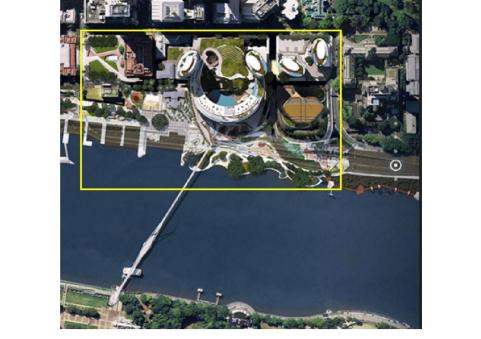
Aerial View of Queens Wharf Development
 The shiny structure is Queen’s Wharf – you can see why blasting rock may be an issue.
2. I did an excavatability assessment and nearly the whole thing needs blasting.
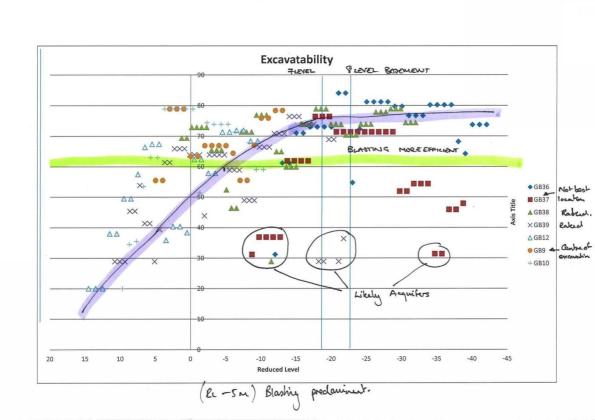
Excavatability Assessement (GSI vertical axis and Reduced Level horizontal axis)

Site map and boreholes GB27-GB35 are missing!
The less permissable vibration the greater the cost (see below). The arguments for the 5mm/s limit come from a german code (the most stringent). I need to produce a paper to argue with ARUP that this vibration limit can be increased. There is about $3 M AUD in savings if I can increase or mitigate the vibrations. Any thoughts?

Some useful background reading.
200281_ Selection of Blasting Limits for Quarries and Civil and Construction
 Holdfast Training Services Trial Blog
Doug,
Is excavatability really a word or did you just use make it up? Either way it works
I’ve not come across anyone who blast excavates in London as there is no need (no rock) and it has obvious problems attached.
That said, we do design buildings against blast so all I know is that as soon as you add ‘blast’ into a project it becomes a very specialised, secretive discipline and therefore additional consultancy fees spiral quickly.
Tom – interestingly the blast waves are not the problem but vibrations through the ground are (allegedly). I’ve been doing some digging (groan). It comes down to amplitude and frequency. Big wavelengths are more damaging than short wavelengths.
This really is a complex problem. The senior management have just twigged from the graph that they are going to have to blast half of the rock. The riverside expressway people are being a real pain. 5 m/s is unreasonable for a reinforced concrete structure (even if it was built in the 70s).
Oh and excavatability is a word.
Doug,
I know you said you weren’t going to write another TMR but this is pretty interesting…
If there is one thing I know you have learnt/honed on placement it is writing a technical paper to investigate an aspect, draw conclusions and make recommendations. Your title would appear to be “An evaluation of vibration limits for heritage structures and highways associated with explosive excavation” I think you just drafted the introduction and are half way towards a sensible aim. Your question was possibly ‘what methodology should I apply to this?’ but I’m suspicious that, with very little additional thought, you already know. I look forward to reading TMR 5, unless of course you can convince Al Bartlet he wants an easy early TMR 2 with active assistance and real industry application.
Sadly, I will have to write something. I don’t think I can bluff my way through next week playing solitaire. I am not looking forward to trawling through the Australian, American, British, German and European codes on this one.
If Al is up for this I am happy to give him all of my research so far. I think useful information would be:
1. Define vibration effects people and structures
2. Contrast piling and blast vibration.
3. Explain how it can transfer to the ground.
4. Recommend methodology for mitigation of vibration effects.
I have the geotech reports , spec and methodology of piling works if he is up for it.
Don’t know anything about blast…so this won’t take long
Firstly the damage that ground bourne vibration does to buildings depends upon:
a) The source being transient or continuous – the latter very much badder than the former
b) The sensitivity of the recipient structure – old structure much badder than properly framed new structure and humans 10 x more sensitive
c) The frequency of the source low badder than high
d) The limits are normally at the 90% – ie 10% are generating higher ppv
e) Even when the source is not oscillatory you have to limit the number of blasts per day
e) There is also an overpressure ( sound wave issue) but I don’t know much about this
SO where you are you are probably designing NOT for the sensitivity of what the Australians laughingly called heritage structures but for human response…..humans response levels are lowered outside working hours – ie the humans are more sensitive in the night than day
5mm/s is really quite low and even that would be taken at the 90%’ile
Look in BS 7358 and BS 6472 – last time I used them was in connection with vibration caused by piling
John, Thank you. I could have used your summary. I suspect the client has confused sensitive structures and sensitive place they have applied human thresholds to the heritage and REX piers. The heritage building is unoccupied and REX does not qualify as a sebnsitive place so higher limits should apply.
Everything I have read indicates that there is a more intelligent way of assessing this other than a blanket 5 mm/s. This low threshold is unhelpful and could even make the problem worse by prolonging the work.
The Australian Standards reference the BS 7358 and BS6472 so I have had alook at them again. I am bidding on Marine works (the new walkway structure in the river that needspiling) and the main excavation of the basement (piling, D wall and blasting).
The trick I believe is low frequency vibration from mechanical means (piling) is far worse than blast vibration which has a higher frequency. I think I have a good arguent to raise the blasting vibration limit to 25 mm/s.
Interestingly previous explosive excavation has used the Swedish Codes that better deal with these types of issues. Queensland codes are similar to BS codes but relate to human exposure and not structural damage. There is a common theme of 9/10 explosion having to be under limits but blasting is restricted to certain times of the day; not number of blast per day.
The links are to some work that was done on the airport link tunnel in Tuff and echo your summary.
Doug,
I might still have some of the vibration monitoring records from the demolition in Birmingham. We were worried about large concrete panels falling from height and landing on tunnels, the vibration was being monitored for the pile coring, but you could apply the concrete panel scenario to a blast vibration – maybe…
The limit of 5mm/s is really low – I wouldn’t be surprised if you got this from tracking heavy plant near the area of interest. We got some high ish readings around 70mm/s but caused no observable damage to an RC structure. I think the limit for cracking plaster is around 25mm/s but this is stated in the BS.
Let me know if you want more info on this.
Hi Chris,
The Demo is going on at the moment so I suspect that contractor is very much living the same nightmare.
The 5 mm/s vibration limit is ridiculous and shows and ignorance of the levels requied to cause structural and cosmetic damage. I am trying to convince Multiplex that in order to win this contract they need to accept this level of risk in the knowledge that the chances of damage are very low-non-existent. The client is totally risk averse so by accepting this risk and using technical knowledge we can manage this risk for them.
Alas, Multiplex are similarly risk TRANSFERers (if that is a word) and not managers. So the idea of them taking on board risk is alien to them. But with a competently managed excavation and a little bit of technical knowledge the risk can be TREATED so that it is TOLERABLE.
I look forward to hearing about your experience over a few beers when I get back. Best wishes to ever growing family. 😉