You sunk my barge……
I thought you may like the pictures. As many of you know, at the Northern Line Extension we use barges on the Thames in order to remove our muck, fed by a conveyor system from our site.
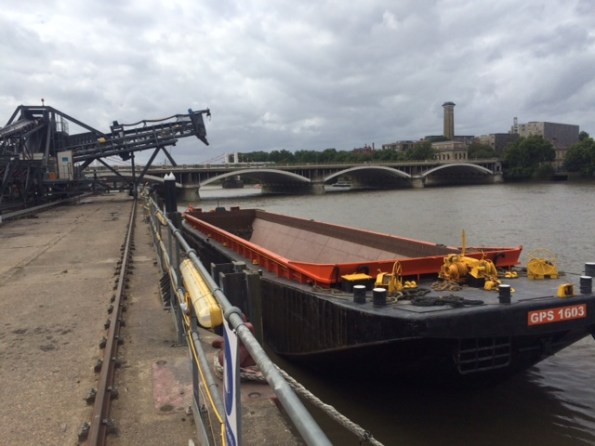
Fig 1. Empty Barge
The capacity is between 1200 and 1600t depending on which barge is being used, measured by the draught of the barge. The draught is measured prior to loading, using draught marks, and monitored during loading so that the weight in the barge is known; as a back up the weight of muck is measured as it goes over the conveyor belt.
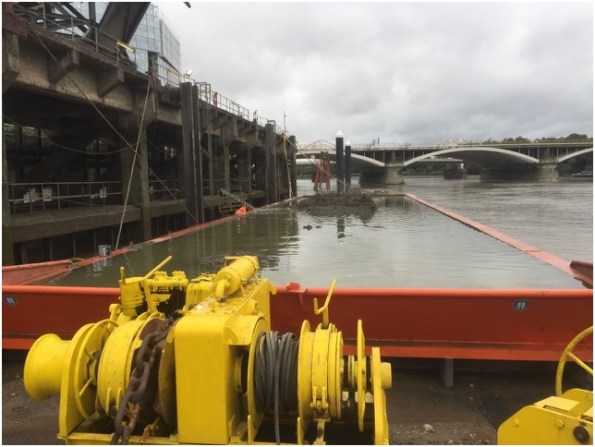
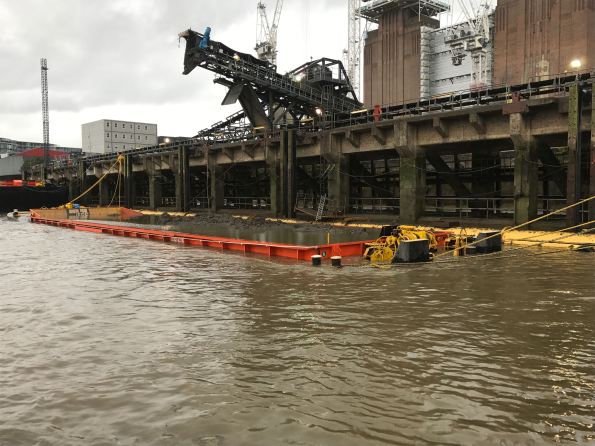
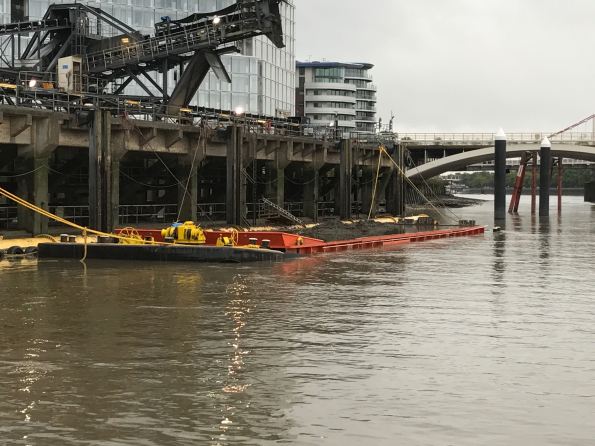
Fig 2 Sunk Barge
So what actually happened? The Lighterman who is responsible for loading the barges was carefully watching as the barge was being loaded, the draught was ok. Despite the ever increasing reading from the conveyor belt read out, the draught was still ok. Once the conveyor belt reading was in excess of 1900t the conveyor belt was stopped, but the draught was still ok……. Turns out the barge was just sat on the river bed so despite what the photos look like, technically the barge did not sink, it just failed to float once the tide came in.
 Holdfast Training Services Trial Blog
Henry, what does this get reported as in terms of H&S? Does it go to HSE? Are there any other repercussions to do with the unintentional scuttling of barges in the Thames?
Ed,
As far as I am aware its not a notifiable incident as no one was hurt and no one was at risk of being hurt. The area the barges is loaded is an exclusion zone as determined by the Port of London Authority, so therefore there should be no other boats in the vicinity either. Of course the Port Authority was notified as was the Environment Agency. I think the situation would have been considerable had it been sunk in the main channel.
That’s a fairly costly error, I’m guessing this has stopped the TBMs??
No, luckily our muck bin was pretty much empty at the time and it has the capacity for a couple of days excavation. This buffer coupled with the barge being re-floated two days later and the use of some lorries meant that the incident didn’t prevent tunnelling operations. If the much bin had been full it would have been a different story!
I understand that the material is all inert uncontaminated muck so no chemical contamination issues for unauthorized discharge? Presumably the pump out operation is easy enough as long as the water can go directly into the Thames but presumably it actually needed to go via settlement tanks. Then what? Digging out excess material looks to be more of a challenge but I guess could be simply cross decked to a second barge if you can get the equipment in to do it. All delays and EO costs paid by the barge operator? + on costs in terms of delay? DO please add the practical and contractual resolution when it leaks out or you can dig it out(pun intended).
Rich,
As you say the muck is inert, so I believed the water was just discharged straight into the river. The EA became involved as the barge had about 6L of diesel on it, which is used to drive a pump. However upon inspection this was not leaking and therefore no pollution was recorded.
To dig out the excess material; a raft with an excavator was moored adjacent to it, the raft having hydraulic piles at each corner which jack into the river bed, and the material was cross decked into another barge. The equipment was en-route the same day as the incident but if was the approval of the RAMS which took the time as they had to pass through us and London Underground.
With regards to the costs I am not sure; it wouldn’t surprise me if nothing was claimed in order to maintain a working relationship. We frequently request barges at very short notice, inside our contractual timelines and they generally provide them with no hassle, so I don’t believe it would be worth upsetting this balance. Secondly, although we had to remove muck by road this is no more expensive for us, so it didn’t cost us anything. If however our muck bin had been full and we had to stop tunnelling then I think you are right and we would have been looking for payment.
H