Rising Foul Main Connection Detail
I am trying to specify a connection detail for a 50mm rising foul into a 100mm dia gravity sewer. Peak flow is 0.05l/s, assuming 50l per person per day and 15 people. I have read about septicity causing illness in rising mains, Wessex Water describe it as:
- A common problem with foul pumping stations is a combination of low flows and long retention times. This results in bacteria multiplying in the anaerobic conditions. This is called ‘septicity’ and can occur in wet wells or rising mains.
I think that I need to provide a break chamber to slow the flow prior to it entering the gravity manhole. The design information does not specify how the connection is terminated, and as the design life is 10+ years septicity could cause a problem. Practically speaking, it will prevent the inside of the manhole becoming ‘splashed’ by high pressure flow.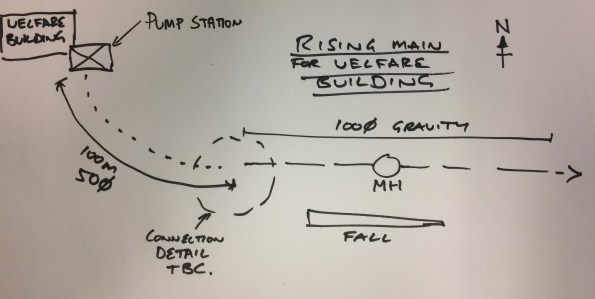
If anyone has any experience on such connections it would be appreciated.
Thought it would be a useful issue especially for providing such infrastructure overseas and the need to control disease/illness.
Cheers,
Dan
 Holdfast Training Services Trial Blog
Morning Dan,
Interesting question… is the gravity pipe private or public? If it is public the local water authority will have guidance on the design requirements.
I can’t seem to add images to a comment but I’ll send you through a typical connection detail I found for a standoff/discharge manhole that is usually installed to transition between rising foul and gravity outfall to connect to a public sewer.
The detail comes with the following comments:
“In all cases where a rising main is discharging into the public sewerage system, a
separate manhole (known as a discharge manhole – refer to Fig. 4) and a short
section of gravity foul sewer (not in concrete to avoid corrosion by hydrogen
sulphide) must be constructed.
This discharge manhole and section of gravity foul sewer will dissipate pumping
pressures and facilitate a transition from turbulent to steady flow of the pumped
sewage prior to it reaching the public foul sewer. A rising main shall not discharge
directly into the public sewer.
The discharge manhole shall be protected internally against corrosion by hydrogen
sulphide using a sulphate resistant mortar and plaster finish. The discharge manhole
must also be ventilated using a sewer vent stack which can be connected to the
discharge manhole and erected at the nearest adjacent footpath or verge. The exact
position of the vent stack shall be agreed with the Water Services Department. “
Hi James,
Thank’s very much for the information. It is a private rising main and gravity system . All waste on-site is removed by tanker and taken to be processed/
Cheers
Hi Dan,
I realise I am somewhat late here but thought I’d throw in my ha’pen’erth anyway. All the foregoing comments are fine and dandy but 50mm is not a significant rising main; you’re in domestic plumbing not foul drainage. If you’re draining site huts the risk of septicity exists in the wet well nearest to your welfare facility however changing the contents regularly mitigate this i.e. filling and draining means the risk is very low (you’d smell any problem pretty quickly and would simply need to change the trigger levels as a first action and add some additional flow in if that didn’t work). The rising main will run up to a 450mm diameter plastic chamber, pop in through the side and discharge via a 90 degree down turn. No risk to anything. The chamber will be vented by dint of a perforated cover unless it is in an area that cannot withstand free venting – beware of creating a rat entry point. If you need to vent than a 100 dia pipe on the upstream inlet connection via a rest bend and up a couple of metres above ground with a Dirgo on top for good measure. From this it’s then a simple gravity connection to the site system. Should be able to knock out a couple of system sketches in about 20 mins, job done. Any issues do give me a call but I expect this is now long gone.
Hi Rich,
Thanks for the reply. Yes it is only for one welfare cabin and as such slightly over designed. I have produced some sketches that I sent to Arup. They have to complete a check to approve my proposal to extend the main to avoid a clash with some multi-ducts that run through the area. The perils of a drainage/services job being passed through multiple hands both from an engineering and construction side.
Thanks
Dan