Design and implementation of seismic resistant schools in rural Nepal
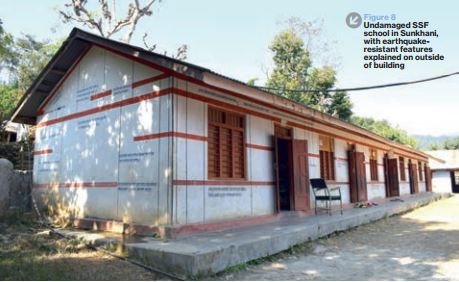
Interesting article in this months issue of ‘The Structural Engineer’ on how engineers can overcome the problems between design and implementation of seismic-resistant schools in rural Nepal. It covers issues such as skilled labour/quality control, availability of materials, local politics, bureaucracy/design approval, corruption, and perception of materials. It also proposes the following recommendations:
1) Engage with local politicians. Try to win the trust of individuals in the community who can help you understand the power dynamics. This is as important a preparation as a site survey.
2) Understand the limitations of the local workforce. Even working masons struggle to
understand written plans and new methods. Consider photos and 3D constructions. Expect a diff erent work ethic from labourers, and factor in delays.
3) Source materials carefully: you may need to compromise. Consider the problems of
transportation.
4) Consider innovative materials and methods. See what has been used successfully in
the area.
5) Adapt buildings for safety, but incorporate traditional features and appearance.
6) Anticipate corruption, and devise a strategy for its management from the planning stage.
7) Liaise with and learn from NGOs already working in the area: they will have solved many of the problems you face.
8) Remain optimistic that your efforts are worthwhile, and that children will lead better and safer lives as a result.
Given the environments we may find ourselves working in the future it’s worth a read – there’s also a link in the article to a webinar for the more visual learners!
Link to article: https://www.istructe.org/journal/volumes/volume-95-(2017)/issue-11-12/complete-issue-(november-december-2017)
Those on Phase 1, if you aren’t already aware, you can get a student membership with the IStructE for free that gives you access to a lot of useful resources.
Link to student membership: https://www.istructe.org/membership/types-of-membership/student-member
Ed (or anyone else who’s worked out there) – during your time in Nepal was there much consideration given to Earthquake design? Would be interested to hear your thoughts on the article.
 Holdfast Training Services Trial Blog
James,
Thanks for the blog, I love talking about Nepal! For wider awareness the Gurkha Welfare Trust’s (GWT) field branch is called The Gurkha Welfare Scheme (GWS) and has 20 Area Welfare Centres (AWC) across Nepal. The department I was in charge of was the Community Aid Cell, responsible for building local engineering projects such as bridges, micro-hydro electric stations, constructing water points in partnership with DFiD, residential homes and school buildings.
What is earthquake resistant design? I took it to be resistance against a catastrophic collapse in the event of an earthquake.
In terms of consideration to Earthquake design – it depends who is building it. Generally for local construction the answer is no and there’s no building regulations enforcing new homes. When I was out there I visited the offices of the National Society for Earthquake Technology-Nepal (NSET). GWS were using earthquake resistant designs for their buildings and I wanted to visit their headquarters to discuss further work. You would think that a country as earthquake prone as Nepal would have Government funding for a company like NSET. However, they don’t. Generally in built up areas the new constructions will be RC frame of a rather dubious hand mixed variety sat amongst old masonry brick buildings. They will try to build as high as possible and fit it into any space. This was reflected in the Streets of Kathmandu when the 2015 earthquake hit when lots of buildings collapsed into the roads making it impossible for emergency vehicles to pass. This wasn’t the big earthquake which Nepal is still overdue for and is likely to flatten many buildings when it does.
The point about corruption and the government should really the main one and the reason I never donated to any of the earthquake appeals in 2015. I cannot emphasise enough how any money provided through the government will simply disappear or be left so small that works can’t begin. Unfortunately some of the NGOs have to pay off local officials which also made me sceptical about most of them. On the other hand, if you donate to GWT they you can rest assured that no money is ever transferred through government departments due to the GWS’s AWC locations and ex-serviceman network. Essentially I’m saying if you want to donate money to Nepal and be assured the money is going to go where you intend it (and not into overheads as the MOD covers this) the GWT is who to donate to.
The point about locality for resources, manpower and knowledge is very true. It is very much a case of looking for the vernacular and something I think the Army could do when deploying in an expeditionary fashion. Outside of the built up areas you quickly move into wattle and cob type structure up to 2 storeys high with thatched roofs or timber. These are the most common type of buildings. Bricks are only used in the South where it is hot and flat, whereas stone walls are used higher up where bricks are not easily available. These were all considerations when I was managing a residential home build out there as UK architects only learnt all this after numerous trips, whereas a prior knowledge would have been useful for the initial designs. Some buildings would also be timber frame with the cattle downstairs and living areas upstairs. These were often in the low lying areas and are actually the best at mitigating the effects of an earthquake as their frame would move with the earth. However, it is always the ambition to move away from these resistant homes to more luxurious, bigger houses and so the cultural mentality gets in the way with effective earthquake design.
It is also possible to retro fit old buildings to assist in their earthquake resistance. I had plans drawn up by NSET for the retrofitting of AWC Taplejung with an earthquake resistant design. A previous recce report had told me that the AWC was one of the oldest within the GWS infrastructure and was constructed largely out of masonry. The designs for all GWS constructions relied on reinforced concrete frames to prevent a catastrophic collapse in the event of an earthquake. I used NSET to produce designs to use steel and concrete to internally reinforce and externally clad the existing structure in specific locations. I then tendered the work and employed a local contractor to complete it using GWS supervision.
I better stop writing now as I’ve probably gone too far.
Ed, wasn’t this also thought about the BGP/K? I seem to remember quite a lot of construction works while I was there which was reinforcing the current buildings? I’m also assuming these buildings were fine during the earthquake?
Chris, yes that was the same type of thing, applying steel mesh to the existing buildings essentially, although the BGP/K buildings were a much better standard of build in the first place. I’m not sure how the buildings coped with the 2015 earthquake but I’ll drop them an email now and try to find out just out of interest.