The most expensive cubic metre of grout?
The Plan
The casting of the column bases into the pile heads is one of the key early stages in my project. To (try to) ensure the quality of this operation a carefully staged process was developed with hold points and hand over inspections involving the concrete and steel sub-contractors, the principle contractor and the designer.
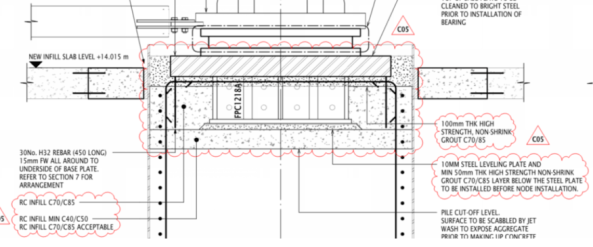
Design build up beneath the base plate within the pile casing
To leave space for the steel shear keys beneath the base plates the pile concrete cut-off level was left short of the top of the casing. The process for installing the base plates became a 6 stage operation as follows:
- Prepare the pile head as handed over by scabbling the surface and extending the rebar cage where required. Pour C70/85 concrete to achieve desired pile level, ~50mm below the bottom of the shear key.
- Install a 10mm steel levelling plate.
- Grout beneath the levelling plate using a high strength (100MPa) ‘non-shrink’ grout.
- Install the main baseplate with shear key and temporary works.
- Pour C70/85 concrete to within 100mm of the bottom of base plate.
- Pour high strength grout (100MPa) beneath the bearing surface of the base plate (max 100mm thickness) and up the sides to top of steel. Grout was specified to ensure full dispersal of the mix beneath the plate to ensure full contact with the bearing surface to satisfy the design bearing pressures from the column into the pile.
All stages had gone as planned until the final (and most important) stage.
The Execution
Unfortunately, our ‘specialist’ sub-sub-contractors clearly didn’t get the memo (or any training in mixing grout it seems). While mixing the bagged grout on site they ignored quality procedures and, following a mechanical failure with the volumetric doser, ended up adding water to the mix using the ever accurate bucket method.
The result is unlikely to surprise anyone. The grout was considerably over watered and separated in the pile casing. The cementitious content has fallen to the bottom topped by a layer of polymer additives, all submerged under 90 mm of bleed water.

Bleed water from the separated grout pour
There were immediate concerns over the strength of this grout layer and the 7-day cube result shows 39.1 MPa against a forecast compressive strength at this age of 75 MPa and a design target strength (28 day) of 85 MPa. This raises all the usual issues with failed quality tests but owing to the criticality of this bearing surface a remediation plan must be put in place within the month. Any longer than that and the designers cannot guarantee the structure for further steel erection – all of which is on the critical path.
With no float left in the programme following delays elsewhere (see my earlier blog on off-site programme) any critical delay to the programme will incur damages and costs totalling close to £1M per week.
So what are the options?
The Hope
Owing to the cause of this non-conformance (over-watering) there is no confidence that the cube result represents the in situ condition so additional testing is required. We will also take smaller core samples through the base plate’s vent holes to ascertain the profile of the grout across the bearing surface (see below).
I have uploaded an In Situ Testing Techniques guide from one of our sub-contractors for interest but for this problem we are taking simple core samples for compressive strength testing (BS EN 12504).
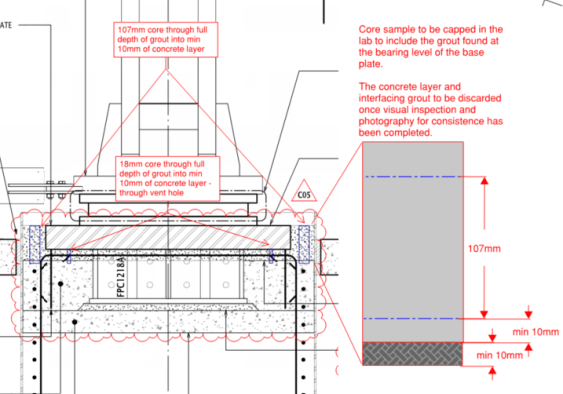
Core locations in failed grout layer
The hope is that a core can return a result approaching 50MPa and that the design engineer can justify this reduction in strength from the design. I suspect this is highly unlikely on both counts so what is the fall back?
The Contingency
The only fall back is to remove the grout but the access is extremely difficult. The current proposal is for hydro demolition with a curved lance to access the gap between the casing and the base plate. This is currently under review but adjusting the power of the lance should allow for the removal of the weak grout without damaging the concrete of steel beneath.
This requires considerable planning effort and time to execute. This will be followed by installing the grout again properly. And the clock is ticking before damages begin.
Lessons Identified
- A specialist is not necessarily any more competent than any one else in any given task.
- Adding water to concrete/grout, beyond mix design, is a bad idea.
- Paying to do the job right the first time is cheaper than rectifying mistakes if they happen.
- It doesn’t take long for a simple task to slip onto the critical path.
 Holdfast Training Services Trial Blog
🙂 5. Lessons identified are seldom passed from one event to another!
I suspect that the 39.1MPa 7 day result will yield a 50MPa 28 day return but I also doubt this is representative of the insitu material or its profile over the depth of the pour. Other lessons from previous versions of the same include: recognise as early as possible that there is an issue and get on with the necessary remediation as soon as possible instead of losing time to hope, rework and excuses. I shall enjoy learning how this plays out.
The current consensus amongst the structural engineers is that it is preferable to verify the current as-built condition as satisfactory, rather than to attempt remediation – the exact opposite of your proposal it seems. We have taken core samples for crushing and are hoping they return something closer to 50MPa that the engineer can then justify.
Interestingly, due to the complete encasement of the pile liner, the EC seems to allow what amounts to a 10% increase in design strength from the compressive test result due to confinement (11.3.7). Based on this, if the in situ is comparable to the cube, the sample need only gain a further 6 MPa by the 28 day point to be nudged up to ~50 MPa and we may stand a chance.
This doesn’t surprise me. I also suspect that it will be allowed to pass regardless because no-one will want the task of sorting it out and then trying to justify the inevitable issues that will be encountered in doing so. Having seen the core sample image you emailed I fully expect the cube to deliver 50 MPa. It would be interesting to compare the cube to the core sample in terms of visual appearance and segregation. I can accept the increase in situ due to confinement but I wonder what losses there were to site work over the lab cured condition… gamma M should allow 50 MPa actual to be equated to the design strength.
How do you vet specialists; particularly when they are specialists in something you have no expertise in? There is always a qualification, accreditation or some sort of peer reviewing I guess.
On a different part of my project we have a Horizontal Directional Drill subcontractor. They are always having issues, always causing delay and they seem to get away with pushing back on to us as they hadn’t allowed for x, y or z (usually something to do with ground conditions) in their price. It seems that our engineers don’t understand drilling well enough to argue the point or to have made sure that it was allowed for in the first place.
Gary, you’re quite right that of course all our sub-contractors undergo a PQQ process to ascertain their suitability for the job. In addition, where our sub-contractors plan to further sub out their work to ‘specialists’ they are to request our permission. Both the concrete sub-contractor and the grout ‘specialist’ are well established companies that would have no problem passing the PQQ.
Sadly, this is a site quality management issue with a root cause in operative familiarity. With concrete there are some site checks you can do to make sure the mix is not overwatered but with grout this is more difficult. You may be right that a true specialist should have spotted that the grout was too wet but the margins are so fine that none of our engineers witnessing the pour could tell. This is an inherent risk in sub-contracting and, as you point out, if you are going to contract out risk then you need robust commercial controls to keep the risk with the subby.
We’ve had similar issues with the main piling sub contractor. They wouldn’t accept the standard contract terms due to ‘ground risks’ so the contracts weren’t back to back (means JH carries the risk). When issues occurred on site they were very quick to claim damages/variations for things they knew of or wouldn’t accept the risk on.
I think the guys here have confessed, with the benefit of hindsight, they should have employed an independent consultant to aid them in understanding the risks they were taking on with regards specialist tunnelling techniques. This would have benefit at contract start up as well as ongoing support to aid in managing the subcontractor as the scope progressed.
They agree that (amongst other controls) that having multiple tenderers for the scope allowed them to flesh out the risks to an extent, but didn’t go far enough to fully capture it.