Friction connection?
This is interesting. I’m checking a design for a temporary concrete retaining wall. The wall itself is simple enough but the connection is something I haven’t come across.
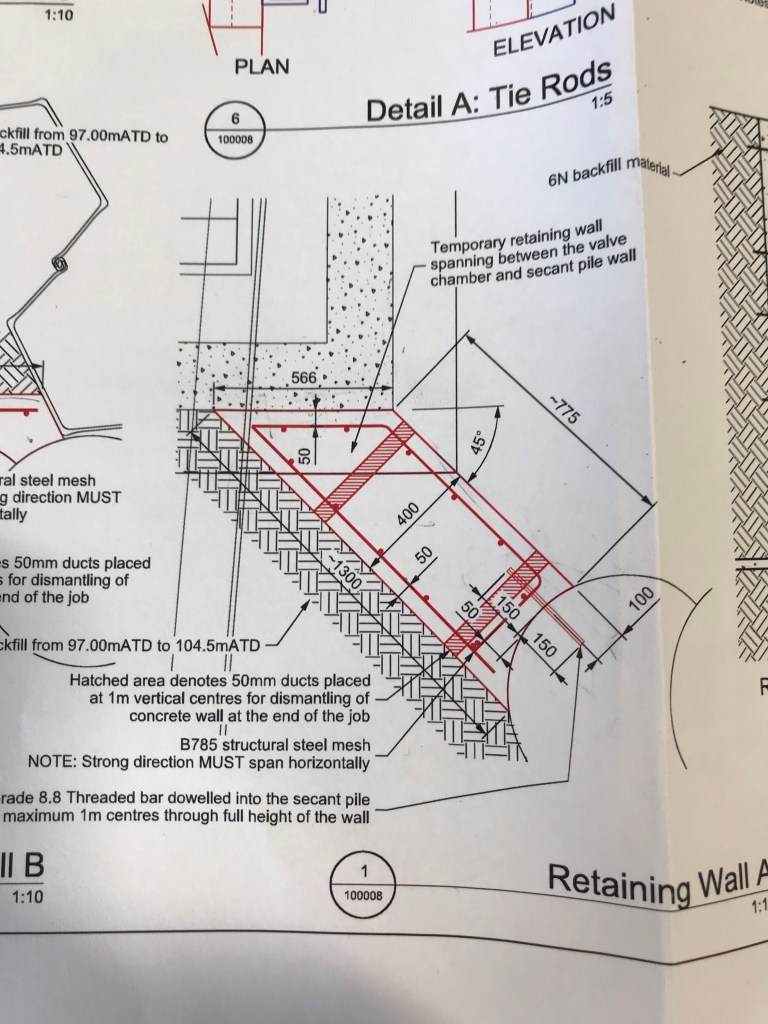
The wall is being held in place with a threaded bar on the right and “friction with the existing wall” on the left. So the designer has said that the angle between the retaining wall and existing wall is enough to restrain the wall. The engineer model I created for it looks like this
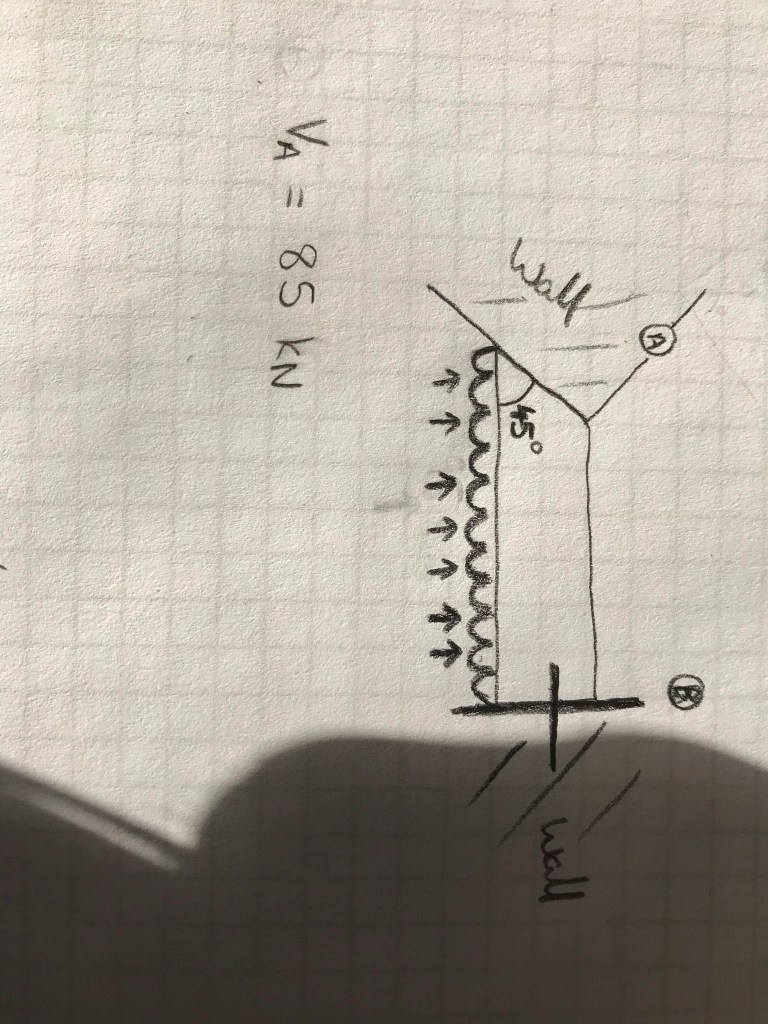
I think as the there is no bond between the two walls that friction alone cannot restrain the 86 kN. I think I should calculate the amount of load that can be taken by the friction (F= u N) away from that end reaction and then treat the B reaction as a reduced cantilever ie increase the shear load in the threaded bar.
Happy for anyone to tell me I’m wrong.
 Holdfast Training Services Trial Blog
For any of those following this. I came up with a solution after resolving forces, taking moments etc. Assumed there was no friction between the members. I can’t share the solution because this blog doesn’t allow pictures in the comments. But it turns out the shear force in the dowel actually went down which surprised me.
Yes I think you’ve answered your own question
As always it comes done to a free body diagram
With this the dowel must take a shear of .2/,975 Po
(here Po is the action form the soil form the soil ( probably best to take Ko in estimating this)
The 45 degrees surface has a normal force (N) and a shear force (T) in the ratio T=0.35*N
(the 0.35 is the friction factor for concrete surfaces)
So the outcome of the FBD is also an equilibration action of 0.38Po normal to the doweled surface
Thanks John. Deffo a little proud of myself that I chose the correct K factor!