The Great Escape
I’ve been supervising a fun little job on my project in the City and remembering Ash’s CI’s Paper presentation on tunnelling I thought I would share.
The challenge is to connect the new building into the existing sewer which lies 10m beneath the junction of Bishopsgate and Leadenhall Street – two of the busiest roads in the City. The process will be to break through the secant piled basement box and tunnel under the road to find the sewer under the street.
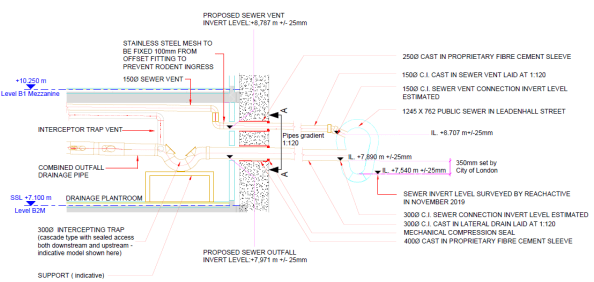
Cross section through proposed connection
There is however no fancy machine option for this job and the solution will be good old fashioned timber heading or mining. This is pretty much the exact process seen in The Great Escape and, judging by some of the characters who do this work, I don’t think H&S attitudes have advanced much since then (see video link at the bottom).

Example timber heading
Timber headings like this one are surprisingly common still, especially in London, so we had a few examples to follow as well as the British Tunnel Society guide “Traditional Timbering in Soft Ground Tunnelling”. What makes our tunnel a bit special is the need to dig through River Terrace deposits rather than the preferred London Clay. The BTS guide makes it very clear that this is seriously sketchy and lays out a load of extra considerations but, in short, it can be done.
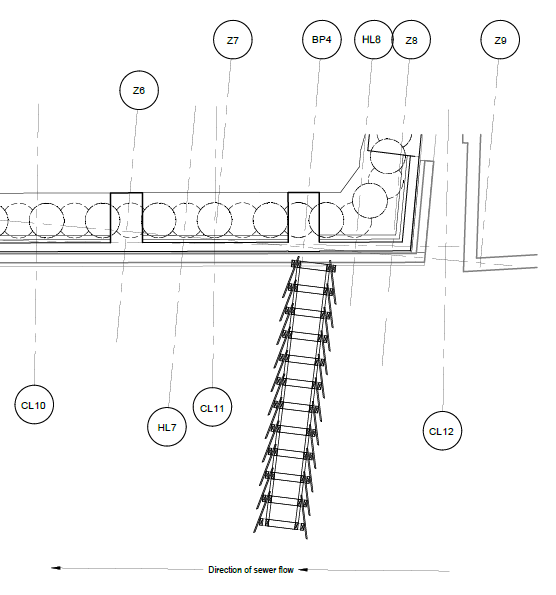
Dig line from the basement box to the sewer
The general method of timber tunnelling is portrayed quite well in this cartoon though our tunnel will need to adopt the Newcastle tucking frame method for use specifically in granular soils.

Newcastle tucking frame heading design
For the unmissable, immersive experience check out this time-lapse video of some nutters digging one of these tunnels. It needs sound but is well worth it.


Very timely. We are heading off on a Battlefield Tour to Ypres next week where tunnelling is on of the topics for discussion. I have nearly finished the book Beneath Hill 60, a book about WW1 mining, following the Australian Miners.
It looks like methodology has not changed much.
Very interesting post Tom.
What’s the long term durability plan for the heading? Presumably it will be retained for future maintenance access?
There were lots of coal mines like this in the West Midlands however over time the timber can creep and decay resulting in tunnel collapses. I know of a number of buildings that have collapsed or subsided as a result. Not something you want to happen underneath some of London’s busiest roads.
Im curious, does the literature cover this issue? Has a maintenance regime being specified or is it just being installed and left?
Hi Mark,
Normal form for a pipe connection is to backfill. From the surface we would use as dug material, in a heading it is either lean mix or foamed concrete.
Hope this goes well Tom. It is essentially a low tech artisan trade at this level. Planning it is the officer sport, hence the geotechnics knowledge you have is probably all you need to start thinking about it. Enjoy!